Portret Frank Bowling

8 najbolj znanih slik umetnika Frank Bowling, galerijska izbira

Posodobljeno november 2026 · uvrščeno glede na naš skoraj priljubljenosti (iskanja, obiske in naročila za vsako delo) · 9 del v našem katalogu avtorja Frank Bowling

Kratek opis

Med vsem originalom, ki ga je Frank Bowling pustil, je najbolj znan Night Journey (1969). Takoj za njima sta Who's Afraid of Barney Newman (1968) in Clem's No. I (1972). Naš katalog vsebuje 9 del umetnika Frank Bowling; galerija je ohranila 8 del, ki jih svet najbolj oboževa, odlikovanih z datumom nastanka, pripadajočim muzajem in zgodbojo.

rojen 1934, Bartica Največ del: Tate Modern

10 najboljših slik umetnika Frank Bowling: izbira galerije

1
Night Journey (1969) avtorja Frank Bowling

Night Journey

1969

Night Journey belongs to Bowling’s Map series, a group of mostly abstract paintings composed of broad fields of color into which the artist placed the continents of Australia, South America, and Africa. Here, the barely discernible shapes of South America, in red at center left, and Africa, in blue and pink at center right, hover in a luminous but moody composition, which he created primarily by pouring various layers of…

8
Wintergreens (1986) avtorja Frank Bowling

Wintergreens

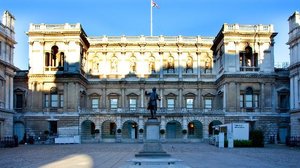
1986 · Royal Academy of Arts, London

One of the modern masterpieces in the RA Collection, Wintergreens was made in 1986, the year Frank Bowling moved to a studio with a view of the Thames in Limehouse, London. He’s referred to the city as “Turner’s town” and the scale of this painting has attracted comparisons with the ambitious landscapes of past artists such as Turner and Constable.The title refers to plants that keep their leaves throughout winter,…

Muzeji, ki hranijo originala umetnika Frank Bowling

3 muzejev, ki vsebujo največ slik na tej strani.

Muzej Mesto Sloga Frank Bowling Slike iz tega seznama
Tate Modern, LondonTate Modern London 2 Who's Afraid of Barney Newman, Sacha Jason Guyana Dreams
Muzej fine arts, BostonMuzej fine arts Boston 1 Suncrush
Royal Academy of Arts, LondonRoyal Academy of Arts London 1 Wintergreens

Frank Bowling desetletje za desetletjem: originali, ki definira vsako od njih

Delo po desetletjih

Izberite desetletje, da si ogledate original, ki ga opredeljuje.

Vprašanja zbirateljev o slikah umetnika Frank Bowling

Za katero delo je Frank Bowling najbolj znan/a?Razkriti odgovor

Night Journey (1969). Zatem sledeta Who's Afraid of Barney Newman (1968) in Clem's No. I (1972).

Koliko je bil Frank Bowling let, ko je nastalo delo Night Journey?Razkriti odgovor

35 let: delo Night Journey iz leta 1969, Frank Bowling pa je bil/a rojen/a leta 1934.

Koliko slik je pustil Frank Bowling?Razkriti odgovor

Naš katalog vsebuje 9 del avtorja Frank Bowling, datiranih od 1968 do 1989.

V katerih muzejih so razložena remek dela umetnika Frank Bowling?Razkriti odgovor

Večini v Tate Modern (London), Muzej fine arts (Boston) in Royal Academy of Arts (London). Zgoraj navedena tabela muzejev vsebuje njihov celoten seznam.

V katerih letih je Frank Bowling naslikal svoja najbolj znana dela?Razkriti odgovor

V obdobju 1970s: 3 od 8 del na tej strani je bilo izdelovanih takrat, med njimi pa Clem's No. I.

Kakšna sta prva in zadnja znana originala umetnika Frank Bowling?Razkriti odgovor

Na tej strani je najstarejše delo iz Who's Afraid of Barney Newman (1968) in najstarejše iz Sacha Jason Guyana Dreams (1989).

Katera dela umetnika Frank Bowling so razstavljena v muzeju Tate Modern?Razkriti odgovor

Who's Afraid of Barney Newman in Sacha Jason Guyana Dreams: v muzeju Tate Modern, London se nahaja 2 del z te strani.

Frank Bowling: življenje in delo

The Architect of Abstraction: The Life and Legacy of Frank Bowling

In the vast, textured landscapes of contemporary abstraction, few names resonate with as much profound authority as Frank Bowling. Born in 1934 in the riverside town of Bartica, British Guiana, Bowling’s journey is one of remarkable movement—not just across continents, but through the very layers of paint and medium itself. His arrival in Britain as a young man marked the beginning of a career that would fundamentally reshape the trajectory of post-war British art. As a pioneer of color field painting and lyrical abstraction, Bowling did not merely paint surfaces; he constructed worlds that evoke the geological, the cartographic, and the deeply psychological.

Bowling’s formative years in the United Kingdom saw him immersed in the rigorous creative environments of the Regent Street Polytechnic and the Chelsea School of Art. By 1959, his talent earned him a prestigious scholarship to the Royal College of Art, placing him at the heart of a revolutionary generation. Alongside luminaries such as David Hockney and R.B. Kitaj, Bowling was part of a cohort that challenged the boundaries of British experimentalism. It was during this period that the echoes of American Abstract Expressionism—the monumental legacies of Mark Rothko and Barnative Newman—began to resonate within his work, inspiring a fascination with vast, immersive canvases that prioritize emotional resonance over representational clarity.

The Cartography of Color and Materiality

The mid-1960s heralded the emergence of Bowling’s most iconic contribution to the art world: the 'Map' series. These groundbreaking works eschewed traditional imagery in favor of a complex, fluid language of color and texture. In these paintings, the artist utilized the technique of pouring diluted paint onto canvas, allowing pigments to bleed, stain, and coalesce into shapes that suggest continents, oceans, and shifting borders. This approach transformed the canvas into a living topography, where the boundaries between land and sea, or self and other, become beautifully blurred.

What truly distinguishes Bowling’s technique is his daring exploration of materiality. He famously incorporated industrial substances such as asphalt and resin into his compositions, creating heavy, tactile surfaces that possess a physical weight and geological presence. This use of non-traditional media was more than a stylistic choice; it was a deliberate gesture against the polished aesthetic conventions of his era. Through these rugged textures, Bowling explored themes of globalization, cultural displacement, and the anxieties of a post-colonial world, making his work as much about political identity as it is about formal beauty.

A Modern Master on the Global Stage

The historical significance of Frank Bowling extends far beyond the aesthetic realm. As one of the most distinguished Black artists to emerge from the post-war British art school system, his success represents a pivotal moment in the diversification of the British canon. His career has been defined by a series of monumental achievements that have cemented his status as a modern master:

Today, Frank Bowling remains a singular figure whose work continues to breathe and evolve. Whether through the vibrant energy of pieces like 'Who’s Afraid of Barney Newman' or the atmospheric depth of 'Wintergreens', he invites the viewer into a space where color is not just seen, but felt. His legacy is etched into the very fabric of modern art—a testament to the power of abstraction to navigate the complexities of the human experience.