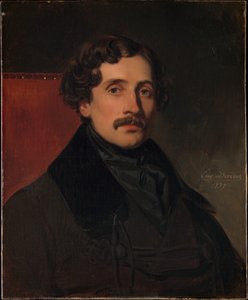
Portret Eugène Devéria

33 najbolj znanih slik umetnika Eugène Devéria, vsaka popolnoma edinstvena

Posodobljeno november 2026 · uvrščeno glede na naš skoraj priljubljenosti (iskanja, obiske in naročila za vsako delo) · 33 del v našem katalogu avtorja Eugène Devéria

Kratek opis

Portrait of Monsieur Couche (1824) je slika avtorja Eugène Devéria, ki pritegne največ pogledov; original se nahaja v muzeju Detroit Institute of Arts, Detroit. Nato se pogled smeri k Young Women Sitting (1827) in The Assassination (1828). Med 33 dela umetnika Eugène Devéria v našem katalogu so ta 33 najbolj znana; vsako je edinstven original, predstavljen z letnico nastanka, muzejem in razlogom za njegovo nečasenost.

1805 – 1865, Pariz Največ del: Musée des Beaux-Arts de Pau

10 najboljjših slik umetnika Eugène Devéria skozi oči galerije

2
Young Women Sitting (1827) avtorja Eugène Devéria

Young Women Sitting

1827 · Oil On Canvas

In the oil painting Young Women Sitting by Eugène Devéria, the composition is centered on a woman seated upon a large, gilded yellow chaise longue. To the left, a second woman reclines, her form partially obscured by heavy red drapery. The scene is set within an opulent interior where the color palette is dominated by deep reds, golds, and creams. This arrangement creates a shallow perspective that directs the viewer's…

3
The Assassination (1828) avtorja Eugène Devéria

The Assassination

1828 · Oil On Canvas · Reading Public Museum, Reading

We find ourselves before The Assassination, a significant work by the French painter Eugène Devéria. This piece was executed about 1828, a period when the artist was beginning to establish his presence within the Parisian art scene. Devéria, who was born in Paris, France, in 1805, brought a specific sense of historical gravity to his compositions, a quality that is palpable in this particular canvas.

4
Portrait of General Joseph-Léopold Sigisbert Hugo (1835) avtorja Eugène Devéria

Portrait of General Joseph-Léopold Sigisbert Hugo

1835 · Oil On Canvas · Musée Victor Hugo, Pariž

The subject is captured in a moment of quiet authority, positioned centrally against a somber, atmospheric landscape. He wears a dark blue military tunic, heavily detailed with gold braided aiguillettes, epaulettes, and medals that catch a sharp, directional light. This illumination, striking from the upper left, defines the contours of his face and the metallic textures of his uniform while casting the background into deep shadow. A sense of monumental…

5
Puget Presenting His Statue of Milon de Crotone to Louis XIV, in the Gardens of Versailles (1832) avtorja Eugène Devéria

Puget Presenting His Statue of Milon de Crotone to Louis XIV, in the Gardens of Versailles

1832 · Oil On Canvas

In this 1832 oil on canvas, we find ourselves within the formal, structured elegance of the Gardens of Versailles. The scene captures a specific historical intersection: the presentation of a sculpture by Puget to the French monarchy. At the heart of the composition, a large, muscular statue of Milon de Crotone commands the viewer's attention. The figure is rendered with a sense of physical weight, its pale, marble-like surface contrasting…

6
Puget Presenting His Statue of Milo of Croton to Louis XIV, in the Gardens of Versailles (1832) avtorja Eugène Devéria

Puget Presenting His Statue of Milo of Croton to Louis XIV, in the Gardens of Versailles

1832 · Oil On Canvas

The scene unfolds in the grand, manicured expanse of the Gardens of Versailles, where the air feels heavy with the weight of ceremony. Here, the artist Eugène Devéria captures a moment of profound historical significance. In this work, titled Puget Presenting His Statue of Milo of Croton to Louis XIV, in the Gardens of Versailles, the viewer finds themselves amidst a gathering of the French elite. The composition centers on…

7
Portrait of the Artist and His Brother Achille (1836) avtorja Eugène Devéria

Portrait of the Artist and His Brother Achille

1836 · Terracotta · Opera House, Versailles

The gaze settles upon Portrait of the Artist and His Brother Achille, a work that brings together two figures bound by blood and art. This piece is the creation of Eugène Devéria, a man whose life began in Paris, France, in 1805. He carries the weight of a long creative life until his passing in 1865. Within this frame, the artist captures a personal connection, presenting himself alongside his brother,…

8
Breton Family Praying Before a Country Oratory (1838) avtorja Eugène Devéria

Breton Family Praying Before a Country Oratory

1838 · Oil · Musée des Beaux-Arts de Quimper, Quimper

In Breton Family Praying Before a Country Oratory, Eugène Devéria arranges a quiet, intimate scene of religious devotion. The composition is centered on a group of five figures—two men, one woman, and two children—who are gathered in a moment of shared prayer. They are positioned in a triangular formation, a structural choice that provides a sense of stability and familial unity. This geometric arrangement naturally directs the viewer's eye toward…

9
Sketch for the church Notre-Dame-de-Lorette: Apotheosis of Saint Genevieve (1835) avtorja Eugène Devéria

Sketch for the church Notre-Dame-de-Lorette: Apotheosis of Saint Genevieve

1835 · Oil On Canvas · Petit Palais, Pariz

The artwork titled Sketch for the church Notre-Dame-de-Lorette: Apotheosis of Saint Genevieve is a religious study by the French painter Eugène Devéria. Created about 1835, this oil on canvas work functions as a preliminary sketch for a larger painting intended for the church Notre-Dame-de-Lorette. The composition focuses on the subject matter of the Apotheosis of Saint Genevieve, depicting the saint's transition toward a celestial state.

10
Apotheosis of Saint Genevieve, sketch for the painting of the church Notre-Dame-de-Lorette (1835) avtorja Eugène Devéria

Apotheosis of Saint Genevieve, sketch for the painting of the church Notre-Dame-de-Lorette

1835 · Drawing · Carnavalet Museum, Pariz

This vertical sketch, dated 1835, captures a moment of religious exaltation centered on the figure of Saint Genevieve. The composition is organized around a strong upward movement, drawing the eye from the lower grouping of figures toward a concentrated burst of white and yellow light at the top of the frame. Saint Genevieve is positioned in the midground, her arms reaching toward the celestial light, her white garments providing a…

Slavna platna umetnika Eugène Devéria, od številk 11 do 33

Slavna platna umetnika Eugène Devéria, razdeljena po obdobjih

Motivi, ki so očarali Eugène Devéria

Četiri teme, ki se v teh originalih najpogosteje ponavljajo, vsaka z svojim vrhunskim primerom.

Muzeji, ki hranijo originala umetnika Eugène Devéria

8 muzejev, ki vsebujo največ slik na tej strani.

Muzej Mesto Sloga Eugène Devéria Slike iz tega seznama
Musée des Beaux-Arts de Pau, PauMusée des Beaux-Arts de Pau Pau 3 Portrait of Octavie Courcier, née Devéria (1804-1887), Portrait of Philippe-Adolphe Courcier, husband of Octavie Devéria, Christopher Columbus at the Court of Ferdinand and Isabella
Detroit Institute of Arts, DetroitDetroit Institute of Arts Detroit 1 Portrait of Monsieur Couche
Reading Public Museum, ReadingReading Public Museum Reading 1 The Assassination
Musée Victor Hugo, ParižMusée Victor Hugo Pariž 1 Portrait of General Joseph-Léopold Sigisbert Hugo
Opera House, VersaillesOpera House Versailles 1 Portrait of the Artist and His Brother Achille
Musée des Beaux-Arts de Quimper, QuimperMusée des Beaux-Arts de Quimper Quimper 1 Breton Family Praying Before a Country Oratory
Petit Palais, ParizPetit Palais Pariz 1 Sketch for the church Notre-Dame-de-Lorette: Apotheosis of Saint Genevieve
Carnavalet Museum, ParizCarnavalet Museum Pariz 1 Apotheosis of Saint Genevieve, sketch for the painting of the church Notre-Dame-de-Lorette

Eugène Devéria skozi desetetja: vsak unikatni original za vsako obdobje

Delo po desetletjih

Izberite desetletje, da si ogledate original, ki ga opredeljuje.

Slike umetnika Eugène Devéria: vprašanja za galerijo

Katero je najbolj znano delo umetnika Eugène Devéria?Razkriti odgovor

Portrait of Monsieur Couche (1824), Detroit Institute of Arts, Detroit. Zatem sledeta Young Women Sitting (1827) in The Assassination (1828).

Pri kateri dobe je Eugène Devéria ustvaril Portrait of Monsieur Couche?Razkriti odgovor

19 let: delo Portrait of Monsieur Couche iz leta 1824, Eugène Devéria pa je bil/a rojen/a leta 1805.

Katera desetina slik avtorja Eugène Devéria je najbolj znana?Razkriti odgovor

Portrait of Monsieur Couche, Young Women Sitting, The Assassination, Portrait of General Joseph-Léopold Sigisbert Hugo, Puget Presenting His Statue of Milon de Crotone to Louis XIV, in the Gardens of Versailles, Puget Presenting His Statue of Milo of Croton to Louis XIV, in the Gardens of Versailles, Portrait of the Artist and His Brother Achille, Breton Family Praying Before a Country Oratory, Sketch for the church Notre-Dame-de-Lorette: Apotheosis of Saint Genevieve in Apotheosis of Saint Genevieve, sketch for the painting of the church Notre-Dame-de-Lorette. Zgornja lestica prikazuje leto nastanka in muzej za vsako delo.

Koliko je znanih del avtorja Eugène Devéria?Razkriti odgovor

Naš katalog vsebuje 33 del avtorja Eugène Devéria, datiranih od 1824 do 1864.

Kje si lahko ogledate najslavnejše originale umetnika Eugène Devéria?Razkriti odgovor

Večini v Musée des Beaux-Arts de Pau (Pau), Detroit Institute of Arts (Detroit) in Reading Public Museum (Reading). Zgoraj navedena tabela muzejev vsebuje njihov celoten seznam.

V katerem obdobju je Eugène Devéria ustvaril svoja najbolj znana dela?Razkriti odgovor

V obdobju 1830s: 10 od 33 del na tej strani je bilo izdelovanih takrat, med njimi pa Portrait of General Joseph-Léopold Sigisbert Hugo.

Katero znano sliko je naslikal Eugène Devéria najprej in katero najpozdneje?Razkriti odgovor

Na tej strani je najstarejše delo iz Portrait of Monsieur Couche (1824) in najstarejše iz Charles-Théodule Devéria (1831-1871) (1864).

Katere teme je Eugène Devéria najprej ravnate?Razkriti odgovor

Man (11), Woman (9) in People (6), na 33 delih na tej strani.

S katerimi materiali je Eugène Devéria najpogosteje slikal?Razkriti odgovor

Oil On Canvas, za 10 od 33 del na tej strani.

Katere originale Eugène Devéria lahko vidim v muzeju Musée des Beaux-Arts de Pau?Razkriti odgovor

Portrait of Octavie Courcier, née Devéria (1804-1887), Portrait of Philippe-Adolphe Courcier, husband of Octavie Devéria in Christopher Columbus at the Court of Ferdinand and Isabella: v muzeju Musée des Beaux-Arts de Pau, Pau se nahaja 3 del z te strani.

Eugène Devéria: portret umetnika

Eugène Devéria: Premoščanje zgodovine in opazovanja

Eugène François Marie Joseph Devéria (1805 – 1865) je bil francoski slikar, katerega značilen slog je združeval natančen realizem z ekspresivno obdelavo barv, kar mu je prineslo status enega izmed najboljstih kronikarjev njegove dobe. Rodjen v Parizu v družini, globoko vpleti v umetniško tradicijo — njegov oče je bil vorec — je Devéria's zgodnje življenje napovedalo njegovo prihodnjo poklicno pot, saj se je potopil v živahno kulturno pokrajino Prerestoracije v Franciji. Čeprav so biografski podatki precej sparse, strokovna raziskava nakazuje, da je svoje veščine izpil pod Jean-Baptiste Camille Corot in Alexandre Cabanel, kjer je vprl impresionističkega duha v akademsko rigoroznost École Supérieure des Beaux-Arts.
  • Zgodnji vplivi in izobraževanje: Devéria's oblikovalne leta so se kljubičila obdobju umetniške vzema po Napoleonovem vladanju. Romantična gibanje je globoko vplivalo na njegovo občutljivost in spodbudilo spoštovanje do dramatičnih pokrajin ter čustveno naloženih pričev. Vendar je te vplive večno uravnotežil z natančnim opazovanjem, ki ga je zagovaroval Corot in Cabanel — umetnika, ki sta prednost dajala zajemanju naravne svetlobe in teksture z neprimerovnim natančnim prikazom.
  • Slikar scen in portretov: Devéria's celoten opus je izjemno raznolik, ki obsega tako monumentalne zgodovinske slike kot tudi intimne portrete. Priljubljen je postal zaradi svojih prikazov škotskih klanov, ki so bili natančno naslikani v oljah, ki ne izpostavljajo le fizično podobo, temveč tudi psihološko globino — kar je dokaz njegove sposobnosti prelivanja kompleksnih čustev na platno.

Znomenita dela in umetniški slog

Devéria's umetniški slog je značilen po izjemnem zlitju realizma in tonske subtilnosti. Namesto modnih in hiterih poteg, ki so jih raje izvajali nekateri njegovi sodobniki, je izbral gladke, prepletene površine, ki so dosegle presenečujočo stopnjo luminoznosti. Ta tehnika — ki je še posebej očitna na njegovih slavnih platnah, ki prikazujejo prihod Christophera Columbusa v Ameriko in The Woodpigeon — mu je omogočila, da je z dihashnim natančnim prikazom izrazil atmosfere. Poleg tega je bila Devéria's paleta zdržana, a hkrati izrazita, saj je uporabljal utihnene barve za ustvarjanje vzdušja in mooda, ki je globoko odjekoval v gledalcih.
  • Zgodovinske pripovedi: Njegova monumentalna platna, kot je „The Reception Of Christopher Columbus“, ponazarjajo njegovo predanost prikazovanju zgodovinskih dogodkov z neomovnim podrobnostmi. Devéria's kompozicije so skrbno konstruirane, vodijo oko skozi prostore pokrajine in zajamejo belezke izrazi človeških čustev — kar odraža humanističko občutljivost, ki ga je ločila od mnogih umetnikov njegovega časa.
  • Portretna slikarstvo: Devéria's portreti so bili prav tako izpostavljeni zaradi svoje psihološke globine. S svojo veščino je zajel esenco osebnosti svojih subjektov, s čimer je prenašal ne le zunanji videz, temveč tudi notranji značaj skozi subtilne geste in izrazi obrazov.

Dediščino in zgodovinski pomen

Prispevek, ki ga je prinesel Eugène Devéria francoski umetnostni zgodovini, sega dlje od njegovih posameznih izmagistratov. Pomagal je utrditi ugled École Supérieure des Beaux-Arts kot institucije odličnosti, negoval pa je generacijo umetnikov, ki so sprejeli tako akademsko tradicijo kot impresionistično inovacijo. Njegove slike še vedno navdušujejo z svojo tehnično virtuoznostjo in čustvenim odločilnim močjo — služijo kot trajna opomnik ključnega trenutka v evropski umetniški kulturi. Devéria's natančno opazovanje in tonska mojstrovina sta mu utrdili mesto med najbolj vplownimi slikarji sredine 19. stoletja, kar zagotavlja, da bo njegovo del študirano in cenjeno še desetletja naprej.