1


Posodobljeno november 2026 · uvrščeno glede na naš skoraj priljubljenosti (iskanja, obiske in naročila za vsako delo) · 29 del v našem katalogu avtorja David Octavius Hill
Kratek opis
Med vsemi originali, ki jih je pustil David Octavius Hill, je najbolj znan Unidentified minister (Sketch for the The Signing of the Deed of Demission, The Disruption of the Church of Scotland 1843) (1843), ki se nahaja v kolekciji Scottish National Portrait Gallery, Edinburgh. Takoj za njima sta Unidentified minister (Sketch for the The Signing of the Deed of Demission, The Disruption of the Church of Scotland 1843) (1843) in Viaduct over the River Almond, West Lothian (1841). Naš katalog vsebuje 29 del umetnika David Octavius Hill; galerija je ohranila 28 del, ki jih svet najbolj oboževa, odlikovanih z datumom nastanka, pripadajočim muzajem in zgodbojo.
 1. Unidentified minister (Sketch for the The Signing of the Deed of Demission, The Disruption of the Church of Scotland 1843) 1843
 2. Unidentified minister (Sketch for the The Signing of the Deed of Demission, The Disruption of the Church of Scotland 1843) 1843
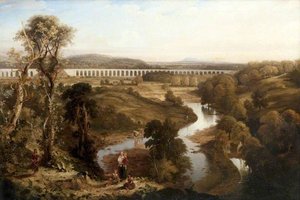 3. Viaduct over the River Almond, West Lothian 1841


 Portrait of a Minister – Sketch for 'The Signing of the Deed of Demission, The Disruption of the Church of Scotland 1843'1843 · Scottish National Portrait Gallery
12
 An Evening Landscape1855
13
 A View in a Wood1855
14
 Clouds at Sunset1855
15
 Ballochmyle Viaduct over the River Ayr1851
16
 Reverend Thomas Chalmers (1780–1847), Preacher and Social Reformer, with his Grandson Thomas Chalmers Hanna (after a calotype by Robert Adamson and David Octavius Hill)1853 · Scottish National Portrait Gallery
17
 Dumbarton from Kirktonhill1857
18
 Minister (unidentified)Scottish National Portrait Gallery
19
 The Firth of ForthThe Hunterian Museum and Art Gallery
20
 Edinburgh Old and NewScottish National Gallery
21
 Thomas Hill1830
22
 View of Falkirk High Station1851 · Callendar House
23
 Kilmarnock Cross1840 · The Dick Institute
24
 An Old MillHospitalfield Arts
25
 In Memoriam The Calton
26
 Old Edinburgh, Showing the Castle from Greyfriars Churchyard
27
 Portrait of a MinisterScottish National Portrait Gallery
28
 On the Quay at LeithScottish National Gallery
Četiri teme, ki se v teh originalih najpogosteje ponavljajo, vsaka z svojim vrhunskim primerom.
8 muzejev, ki vsebujo največ slik na tej strani.
| Muzeji | Mesto | Sloga David Octavius Hill | Slike iz tega seznama |
|---|---|---|---|
 Scottish National Portrait Gallery |
Edinburgh | 6 | Unidentified minister (Sketch for the The Signing of the Deed of Demission, The Disruption of the Church of Scotland 1843), Unidentified minister (Sketch for the The Signing of the Deed of Demission, The Disruption of the Church of Scotland 1843), Portrait of a Minister – Sketch for 'The Signing of the Deed of Demission, The Disruption of the Church of Scotland 1843' |
 Scottish National Gallery |
Edinburgh | 2 | Edinburgh Old and New, On the Quay at Leith |
 The Stirling Smith Art Gallery - Museum |
Stirling | 1 | Sweetheart Abbey |
 Kraljeva zbirka |
London | 1 | A View of Dunkeld |
 The Hunterian Museum and Art Gallery |
Glasgow | 1 | The Firth of Forth |
 Callendar House |
Falkirk | 1 | View of Falkirk High Station |
 The Dick Institute |
Kilmarnock | 1 | Kilmarnock Cross |
 Hospitalfield Arts |
Arbroath | 1 | An Old Mill |
Izberite desetletje, da si ogledate original, ki ga opredeljuje.

Unidentified minister (Sketch for the The Signing of the Deed of Demission, The Disruption of the Church of Scotland 1843) (1843), Scottish National Portrait Gallery, Edinburgh. Zatem sledeta Unidentified minister (Sketch for the The Signing of the Deed of Demission, The Disruption of the Church of Scotland 1843) (1843) in Viaduct over the River Almond, West Lothian (1841).
41 let: delo Unidentified minister (Sketch for the The Signing of the Deed of Demission, The Disruption of the Church of Scotland 1843) iz leta 1843, David Octavius Hill pa je bil/a rojen/a leta 1802.
Unidentified minister (Sketch for the The Signing of the Deed of Demission, The Disruption of the Church of Scotland 1843), Unidentified minister (Sketch for the The Signing of the Deed of Demission, The Disruption of the Church of Scotland 1843), Viaduct over the River Almond, West Lothian, A View of Leith, Perth from Boatland, Coasters Discharging in Perth Harbour, Sweetheart Abbey, Feu de joie, Taymouth Castle, Kirkoswald, Tam o' Shanter's Grave in A View of Dunkeld. Zgornja lestica prikazuje leto nastanka in muzej za vsako delo.
Naš katalog vsebuje 29 del avtorja David Octavius Hill, datiranih od 1826 do 1857.
Večini v Scottish National Portrait Gallery (Edinburgh), Scottish National Gallery (Edinburgh) in The Stirling Smith Art Gallery - Museum (Stirling). Zgoraj navedena tabela muzejev vsebuje njihov celoten seznam.
V obdobju 1850s: 7 od 28 del na tej strani je bilo izdelovanih takrat, med njimi pa An Evening Landscape.
Na tej strani je najstarejše delo iz Perth from Boatland (1826) in najstarejše iz Dumbarton from Kirktonhill (1857).
Romanticism, glede na originala na tej strani.
Unidentified minister (Sketch for the The Signing of the Deed of Demission, The Disruption of the Church of Scotland 1843), Unidentified minister (Sketch for the The Signing of the Deed of Demission, The Disruption of the Church of Scotland 1843) in Portrait of a Minister – Sketch for 'The Signing of the Deed of Demission, The Disruption of the Church of Scotland 1843': v muzeju Scottish National Portrait Gallery, Edinburgh se nahaja 6 del z te strani.
In the mid-nineteenth century, as the world stood on the precipice of a technological revolution, David Octavius Hill emerged not merely as a chronicler of reality, but as a poet of light. Born in 1802 in Perth, Scotland, Hill possessed an intellect shaped by the rigorous disciplines of mathematics and natural philosophy at Edinburgh University. This scientific foundation, paired with his early training in lithography and painting, allowed him to approach the nascent medium of photography with a rare duality: the precision of a scientist and the soul of an artist. While many saw the camera as a mere tool for mechanical reproduction, Hill envisioned it as a brush capable of capturing the profound psychological depths of the human condition.
His journey into the heart of photographic history was inextricably linked to his partnership with the engineer Robert Adamson. Together, they established the first photography studio in Scotland in 1843, creating a collaborative sanctuary where chemistry and art converged. Their work was defined by the use of the calotype process, a revolutionary method pioneered by William Henry Fox Talbot. Unlike the sharp, clinical clarity of the daguerreotype, the calotype offered a soft, textured grain that allowed for a more painterly expression. Through this medium, Hill and Adamson achieved a Rembrandtesque mastery of chiaroscuro, using dramatic shadows and luminous highlights to imbue their portraits with an almost spiritual weight.
The partnership of Hill and Adamson was brief but incandescent, lasting only from 1843 until Adamson's untimely death in 1847. Yet, in those few years, they produced a body of work that remains the cornerstone of Scottish photographic art. Their subjects ranged from the rugged, salt-laced faces of Newhaven fishermen to the dignified silhouettes of Edinburgh’s intellectual elite. Hill’s innate ability to put sitters at ease—a skill honed during his years as a prominent painter—allowed him to capture more than just a likeness; he captured an essence. In images such as those featuring Reverend Thomas Chalmers, one can sense the heavy atmosphere of Victorian morality and the quiet dignity of a life dedicated to social reform.
<Beyond the studio walls, Hill’s influence extended into the very fabric of the Scottish art scene. As an arts activist and painter, his contributions to the development of local institutions were as significant as his photographic prints. Even as he moved away from the camera following Adamson's death, the aesthetic principles he helped pioneer—the emphasis on tonal depth, texture, and emotional resonance—continued to ripple through the generations of photographers who followed. Today, the name David Octavius Hill stands as a testament to the moment when the mechanical eye first learned to see with the heart of an artist.