Portret Augustus Vincent Tack

17 najbolj znanih slik umetnika Augustus Vincent Tack, galerijska izbira

Posodobljeno november 2026 · uvrščeno glede na naš skoraj priljubljenosti (iskanja, obiske in naročila za vsako delo) · 76 del v našem katalogu avtorja Augustus Vincent Tack

Kratek opis

Med vsemi originali, ki jih je pustil Augustus Vincent Tack, je najbolj znan Elihu Root (1922), ki se nahaja v kolekciji National Portrait Gallery, Washington, D.C.. Takoj za njima sta Rosa Mystica (1923) in Benjamin Nathan Cardozo (1931). Naš katalog vsebuje 76 del umetnika Augustus Vincent Tack; galerija je ohranila 17 del, ki jih svet najbolj oboževa, odlikovanih z datumom nastanka, pripadajočim muzajem in zgodbojo.

1870 – 1949, Pittsburgh Največ del: National Portrait Gallery

10 najboljših slik umetnika Augustus Vincent Tack: izbira galerije

1
Elihu Root (1922) avtorja Augustus Vincent Tack

Elihu Root

1922 · Oil On Canvas · National Portrait Gallery, Washington, D.C.

The portrait depicts an older man seated in a dark suit against a muted brown background. He is positioned centrally, his posture creating a strong vertical line within the frame. The subject wears a formal dark jacket and a white shirt, with the fabric of his clothing rendered through visible brushstrokes that suggest a textured surface. His face is oval-shaped, illuminated by a directional light source originating from above and…

2
Rosa Mystica (1923) avtorja Augustus Vincent Tack

Rosa Mystica

1923 · Oil · Cleveland Museum of Art, Cleveland

In Rosa Mystica, Augustus Vincent Tack organizes the pictorial space through a hierarchical perspective that separates the celestial from the mortal. The composition centers on a divine female figure, likely the Virgin Mary, who floats within a luminous blue mandorla. She is positioned in a higher plane above the earthly realm, surrounded by a sky of fragmented, pale clouds. Her arms are outstretched in a gesture of grace, draped in…

3
Benjamin Nathan Cardozo (1931) avtorja Augustus Vincent Tack

Benjamin Nathan Cardozo

1931 · Oil On Canvas

In this formal portrait, Augustus Vincent Tack presents Benjamin Nathan Cardozo in a moment of quiet, judicial dignity. Painted about 1931, the work captures the subject in his capacity as a judge, a role that informs the entire gravity of the piece. There is a certain stillness here, a sense of the weight of responsibility that accompanies such a position. Tack avoids the superficiality of a mere likeness, focusing instead…

4
John Munro Woolsey (1934) avtorja Augustus Vincent Tack

John Munro Woolsey

1934 · Oil · New York Historical Society, New York City

This oil portrait by Augustus Vincent Tack depicts John Munro Woolsey, a United States district judge. Painted about 1934, the work presents the subject in a formal setting that emphasizes his professional status. The composition focuses on the man seated behind a wooden desk, positioned in a medium close-up view that establishes a direct presence before the viewer.

5
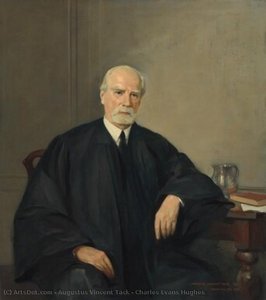
Charles Evans Hughes (1941) avtorja Augustus Vincent Tack

Charles Evans Hughes

1941 · Oil On Canvas

This formal portrait of Charles Evans Hughes, executed by Augustus Vincent Tack, offers a quiet moment of reflection. Painted about 1941, the work captures the subject in a setting that suggests a private study or a professional office. There is a sense of stillness here, as if we have interrupted a moment of deep thought. The composition places Hughes at the center of the viewer's attention, establishing a presence that…

6
Harry S. Truman (1948) avtorja Augustus Vincent Tack

Harry S. Truman

1948 · Oil On Canvas

In this formal portrait of Harry S. Truman, Augustus Vincent Tack captures the subject in a half-length composition that centers the viewer's attention on the man's face and upper body. The figure sits slightly off-center to the right, creating a subtle tension within the frame. A strong light source emerges from the upper left, casting deep shadows that define the contours of the face and the heavy folds of the…

7
Harlan F. Stone (1944) avtorja Augustus Vincent Tack

Harlan F. Stone

1944 · Oil On Canvas

In this formal portrait, Augustus Vincent Tack presents Harlan F. Stone in a moment of quiet, seated dignity. Painted in 1944, the work captures the subject in a three-quarter view, a composition that emphasizes his presence and the weight of his position. There is a certain stillness to the figure, which is likely intended to reflect Stone's role as Chief Justice of the United States Supreme Court. The subject's expression…

8
The High Command Right Panel (1949) avtorja Augustus Vincent Tack

The High Command Right Panel

1949 · Oil On Canvas · National Portrait Gallery, Washington, D.C.

The High Command Right Panel is a work by Augustus Vincent Tack, executed in 1949. The painting captures two men seated within the quiet confines of an office setting. Their presence is anchored by the weight of their surroundings, suggesting a moment of professional stillness. The subject matter centers on naval officers or individuals tied to maritime affairs, a theme reflected in the nautical elements that populate the scene.

Izbor umetnika Augustus Vincent Tack se nadaljuje, od 11 do 17

Slavna platna umetnika Augustus Vincent Tack, razdeljena po obdobjih

Motivi, ki so očarali Augustus Vincent Tack

Četiri teme, ki se v teh originalih najpogosteje ponavljajo, vsaka z svojim vrhunskim primerom.

Muzeji, ki hranijo originala umetnika Augustus Vincent Tack

6 muzejev, ki vsebujo največ slik na tej strani.

Muzej Mesto Sloga Augustus Vincent Tack Slike iz tega seznama
National Portrait Gallery, Washington, D.C.National Portrait Gallery Washington, D.C. 4 Elihu Root, The High Command Right Panel, The High Command Left Panel
Metropolitanski muzej umetnosti, New YorkMetropolitanski muzej umetnosti New York 2 John La Farge, Night Clouds and Star Dust
Cleveland Museum of Art, ClevelandCleveland Museum of Art Cleveland 1 Rosa Mystica
New York Historical Society, New York CityNew York Historical Society New York City 1 John Munro Woolsey
Reading Public Museum, ReadingReading Public Museum Reading 1 Rising Wind and Tide
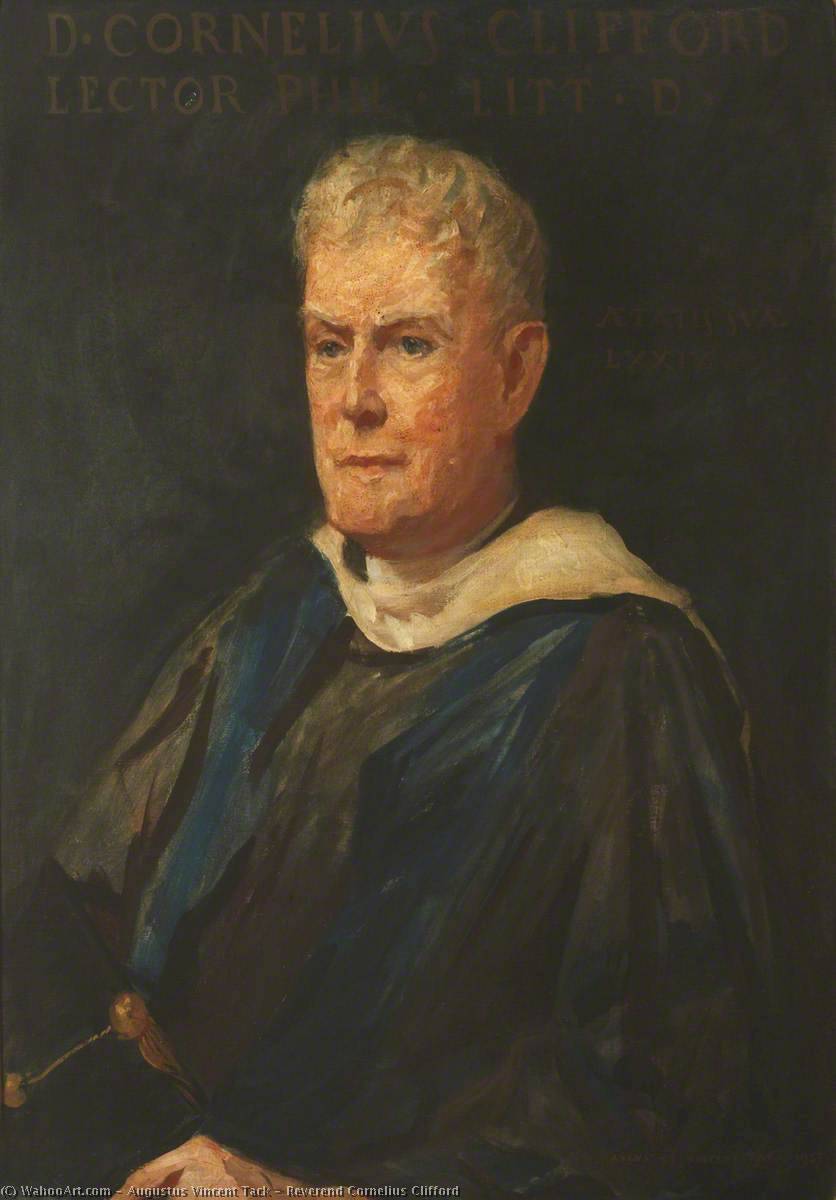
Campion Hall, OxfordCampion Hall Oxford 1 Reverend Cornelius Clifford

Augustus Vincent Tack desetletje za desetletjem: originali, ki definira vsako od njih

Delo po desetletjih

Izberite desetletje, da si ogledate original, ki ga opredeljuje.

Vprašanja zbirateljev o slikah umetnika Augustus Vincent Tack

Za katero delo je Augustus Vincent Tack najbolj znan/a?Razkriti odgovor

Elihu Root (1922), National Portrait Gallery, Washington, D.C.. Zatem sledeta Rosa Mystica (1923) in Benjamin Nathan Cardozo (1931).

Koliko je bil Augustus Vincent Tack let, ko je nastalo delo Elihu Root?Razkriti odgovor

52 let: delo Elihu Root iz leta 1922, Augustus Vincent Tack pa je bil/a rojen/a leta 1870.

Katera je deset najbolj znanih slik umetnika Augustus Vincent Tack?Razkriti odgovor

Elihu Root, Rosa Mystica, Benjamin Nathan Cardozo, John Munro Woolsey, Charles Evans Hughes, Harry S. Truman, Harlan F. Stone, The High Command Right Panel, Rising Wind and Tide in Reverend Cornelius Clifford. Zgornja lestica prikazuje leto nastanka in muzej za vsako delo.

Koliko slik je pustil Augustus Vincent Tack?Razkriti odgovor

Naš katalog vsebuje 76 del avtorja Augustus Vincent Tack, datiranih od 1897 do 1949.

V katerih muzejih so razložena remek dela umetnika Augustus Vincent Tack?Razkriti odgovor

Večini v National Portrait Gallery (Washington, D.C.), Metropolitanski muzej umetnosti (New York) in Cleveland Museum of Art (Cleveland). Zgoraj navedena tabela muzejev vsebuje njihov celoten seznam.

V katerih letih je Augustus Vincent Tack naslikal svoja najbolj znana dela?Razkriti odgovor

V obdobju 1940s: 7 od 17 del na tej strani je bilo izdelovanih takrat, med njimi pa Charles Evans Hughes.

Kakšna sta prva in zadnja znana originala umetnika Augustus Vincent Tack?Razkriti odgovor

Na tej strani je najstarejše delo iz John La Farge (1897) in najstarejše iz The High Command Right Panel (1949).

Katere teme je Augustus Vincent Tack najpogosteje izbiral?Razkriti odgovor

Portraiture (4), Man (4) in Chair (3), na 17 delih na tej strani.

Katero tehniko je Augustus Vincent Tack najpogosteje uporabljal?Razkriti odgovor

Oil On Canvas, za 8 od 17 del na tej strani.

Katera dela umetnika Augustus Vincent Tack so razstavljena v muzeju National Portrait Gallery?Razkriti odgovor

Elihu Root, The High Command Right Panel in The High Command Left Panel: v muzeju National Portrait Gallery, Washington, D.C. se nahaja 4 del z te strani.

Augustus Vincent Tack: življenje in delo

Augustus Vincent Tack: Pioneer of Spiritual Landscape

Augustus Vincent Tack (1870 – 1949) stands as a singular figure in American art history, recognized primarily for his distinctive blend of realism and abstraction—a stylistic approach that foreshadowed the burgeoning movement of Abstract Expressionism. Born in Pittsburgh, Pennsylvania, Tack’s artistic journey began with formal training at St. Francis Xavier College before he honed his skills at the Art Students League of New York, absorbing influences from luminaries like John La Farge whose studio he frequented. This formative period established a foundation for his subsequent explorations into landscape painting and, crucially, into deeply symbolic representations of nature—a preoccupation that would define much of his oeuvre.
  • Early Career & Influences:
  • Tack’s debut exhibition at Kraushaar Galleries in 1896 marked the commencement of a prolific artistic career characterized by consistent engagement with prominent institutions such as Worcester Art Museum, Carnegie International Exhibitions, and Pennsylvania Academy of Fine Arts. His collaborations with Duncan Phillips—particularly their involvement in the Allied War Salon of 1918—demonstrated not only his social connections but also his commitment to addressing pressing societal concerns through artistic expression.
  • Deerfield Colony & Marriage:
  • Seeking inspiration and camaraderie, Tack relocated to Deerfield, Massachusetts, where he established an artist’s colony and married Agnes Gordon Fuller, daughter of renowned painter George Fuller. This union fostered a supportive environment conducive to creative pursuits and solidified his position within the artistic community.
  • Teaching & Yale University:
  • Tack’s pedagogical role extended beyond Deerfield; he lectured at the Art Students League of New York between 1906 and 1910 and subsequently taught at Yale University from 1910 to 1913, imparting his artistic vision to a new generation of artists.

A Distinctive Style: Realism Infused with Mysticism

Tack’s artistic style distinguished itself through a careful balance between traditional realism and evocative abstraction. While his portraits adhered to academic conventions—capturing likenesses with meticulous detail and dramatic lighting—his landscapes transcended mere depiction, delving into realms of spiritual contemplation. Paintings like “Time and Timelessness” exemplify this approach, juxtaposing geometric forms with figurative elements to convey a sense of enduring beauty and profound symbolism. Critics noted that Tack’s work "was a contemporary reworking of nineteenth-century heroic idealism," highlighting its ambition to elevate the viewer beyond the mundane.
  • Notable Works:
  • Among his most celebrated pieces are “The High Command Right Panel” (1949), portraying naval officers with masterful realism and compositional complexity; portraits of Harry S. Truman and Elihu Root—executed in 1948 and 1922 respectively—demonstrating Tack’s ability to convey character and emotion through nuanced brushwork; and “Time and Timelessness,” a landscape masterpiece reflecting his fascination with spiritual themes.

Legacy & Recognition

Despite commercial setbacks, Tack's artistic legacy persists as a precursor to Abstract Expressionism—a movement that would reshape the landscape of American art in the decades following his death. His paintings remain housed in major collections and continue to inspire artists and scholars alike. Augustus Vincent Tack’s contribution to American art lies not merely in his stylistic innovations but also in his unwavering pursuit of artistic truth—a testament to the enduring power of imagination and vision.