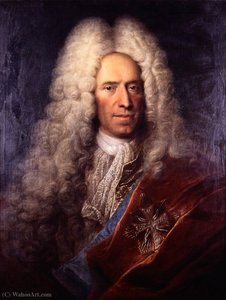
Portret Ádám Mányoki

Slike avtorja Ádám Mányoki: 30 najbolj znanih del skozi oči galerije

Posodobljeno november 2026 · uvrščeno glede na naš skoraj priljubljenosti (iskanja, obiske in naročila za vsako delo) · 31 del v našem katalogu avtorja Ádám Mányoki

Kratek opis

Za oči galerije je najbolj znano sliko umetnika Ádám Mányoki delo Baroness Katarzyna de Besenval, née Countess Bielinska (1713), katere original visi v muzeju Staatliche Kunstsammlungen Dresden, Dresden. Portrait of Prince Ferenc Rákóczi II (1724) in Portrait of a Hungarian nobleman. (1701) dopolnjujeta trijo, ki jo prepozna vsak pogled. Od 31 del avtorja Ádám Mányoki v našem katalogu galerija spodaj predstavlja 30 najbolj znanih; vsako je original z letom nastanka, pripadajočim mu muzejem in opisom tistega, kar ga dela edinstavnim.

1673 – 1757, Szokolya Baroque Največ del: Madžarska nacionalna galerija

Top 10 slik umetnika Ádám Mányoki v galeriji

2
Portrait of Prince Ferenc Rákóczi II (1724) avtorja Ádám Mányoki

Portrait of Prince Ferenc Rákóczi II

1724 · Oil · Madžarska nacionalna galerija, Budimpešta

The portrait depicts a man positioned centrally, facing the viewer with a steady gaze. He wears a dark hat and a garment accented by a red cape. A mustache and a beard frame his face, and his hair is gathered into a ponytail. The subject is dressed in formal attire suitable for a ceremony. In the background, the faint outlines of two other figures are visible, though they remain secondary…

3
Portrait of a Hungarian nobleman. (1701) avtorja Ádám Mányoki

Portrait of a Hungarian nobleman.

1701 · Oil · Narodni muzej v Varšavi, Varšava

The room feels heavy with the weight of centuries as an elderly man emerges from a deep, undifferentiated darkness. He sits in a quiet, somber stillness, his gaze fixed directly upon the viewer with a sense of quiet authority. The light, striking from the upper left, carves his features out of the gloom, catching the silver of his thinning hair and the sharp, crisp edges of a white lace cravat.…

4
Lady with a large decolletage (1710) avtorja Ádám Mányoki

Lady with a large decolletage

1710 · Oil On Canvas · District Museum in Toruń, Toruń

In Lady with a large decolletage, Ádám Mányoki employs a formal portraiture style characteristic of the late Baroque or early Rococo periods. The subject is presented from the chest up, positioned centrally against a dark, indistinct background. This arrangement creates a shallow depth, making the figure appear to emerge from an atmospheric void. The composition relies on a direct, frontal view that establishes an immediate sense of presence between the…

5
Countess Maria Magdalena von Dönhoff, née Countess Bielinska (1718) avtorja Ádám Mányoki

Countess Maria Magdalena von Dönhoff, née Countess Bielinska

1718 · Oil On Canvas · Staatliche Kunsthalle Karlsruhe, Karlsruhe

Ádám Mányoki’s portrait of Countess Maria Magdalena von Dönhoff, née Countess Bielinska, captures a prominent figure of the 18th-century European aristocracy. A German-Polish noblewoman, she was the daughter of Kazimierz Ludwik Bieliński and Ludwika Maria Morsztyn. Her social standing was further defined by her position as the official royal mistress, or Maîtresse-en-titre, to King Augustus II the Strong.

6
Princess Sobieski, née Maria Josepha Wessolowska (1713) avtorja Ádám Mányoki

Princess Sobieski, née Maria Josepha Wessolowska

1713 · Oil On Canvas · Madžarska nacionalna galerija, Budimpešta

In this 1713 portrait, we encounter Princess Sobieski, née Maria Josepha Wessolowska, captured in a moment of quiet, aristocratic poise. She is positioned slightly to the right of the center, a choice that lends a sense of movement to her stillness. A large, dark tree anchors the left side of the composition, while a classical stone urn rests to her right, framing her within a carefully balanced landscape. Her gown,…

7
Portrait of Count Georg Wilhelm Werthern (1719) avtorja Ádám Mányoki

Portrait of Count Georg Wilhelm Werthern

1719 · Oil On Canvas · Madžarska nacionalna galerija, Budimpešta

The Count gazes out from a realm of shadow and light, his presence commanding the space with a quiet, heavy authority. He sits in a three-quarter view, his body angled slightly away while his eyes maintain a direct, steady connection with the viewer. A voluminous, powdered wig frames a face marked by the gravity of his station, its soft, cloud-like curls contrasting sharply against the dark, atmospheric void behind him.…

8
Portrait of a Nobleman in Armour (1718) avtorja Ádám Mányoki

Portrait of a Nobleman in Armour

1718 · Oil On Canvas · Narodni muzej v Krakovu, Krakov

In this 1718 portrait, we encounter a man defined by the quiet gravity of his station. He is presented in a three-quarter length view, his body turned slightly away while his gaze meets ours with a direct, steady composure. There is a profound stillness here, the kind found in those who are accustomed to being observed. The lighting is deliberate, sweeping in from the upper left to carve his features…

9
Maria Anna of Austria as child (1723) avtorja Ádám Mányoki

Maria Anna of Austria as child

1723 · Oil On Canvas · Bavarske državne slikopisne zbirke, München

This portrait by Ádám Mányoki depicts Maria Anna of Austria as a child. Created about 1723, the work captures the young subject in a formal setting. Maria Anna was the daughter of Emperor Charles VI. The painting presents the child in a three-quarter length view, positioned against a dark, atmospheric background that emphasizes the figure.

10
Portrait of Archduchess Maria Theresa of Austria, later Empress (1717-1780) (1723) avtorja Ádám Mányoki

Portrait of Archduchess Maria Theresa of Austria, later Empress (1717-1780)

1723 · Oil · Bavarske državne slikopisne zbirke, München

A young girl sits in a quiet, shadowed space, her presence commanding the air around her. This is the Archduchess Maria Theresa, captured in a moment of serene dignity that belies her tender years. The light, descending softly from the upper left, brushes against the delicate contours of her face and the soft texture of her hair, creating a sense of three-dimensional volume through a gentle chiaroscuro effect. She is…

Slikarska dela umetnika Ádám Mányoki, uvrščena od 11 do 30

Slavna platna umetnika Ádám Mányoki, razdeljena po obdobjih

Motivi, ki so očarali Ádám Mányoki

Četiri teme, ki se v teh originalih najpogosteje ponavljajo, vsaka z svojim vrhunskim primerom.

Muzeji, ki hranijo originala umetnika Ádám Mányoki

8 muzejev, ki vsebujo največ slik na tej strani.

Muzeji Mesto Sloga Ádám Mányoki Slike iz tega seznama
Madžarska nacionalna galerija, BudimpeštaMadžarska nacionalna galerija Budimpešta 7 Portrait of Prince Ferenc Rákóczi II, Princess Sobieski, née Maria Josepha Wessolowska, Portrait of Count Georg Wilhelm Werthern
Narodni muzej v Varšavi, VaršavaNarodni muzej v Varšavi Varšava 3 Portrait of a Hungarian nobleman., Portrait of Józef Potocki, Portrait of Queen Catherine Opalińska.
Bavarske državne slikopisne zbirke, MünchenBavarske državne slikopisne zbirke München 2 Maria Anna of Austria as child, Portrait of Archduchess Maria Theresa of Austria, later Empress (1717-1780)
Staatliche Kunstsammlungen Dresden, DresdenStaatliche Kunstsammlungen Dresden Dresden 1 Baroness Katarzyna de Besenval, née Countess Bielinska
District Museum in Toruń, ToruńDistrict Museum in Toruń Toruń 1 Lady with a large decolletage
Staatliche Kunsthalle Karlsruhe, KarlsruheStaatliche Kunsthalle Karlsruhe Karlsruhe 1 Countess Maria Magdalena von Dönhoff, née Countess Bielinska
Narodni muzej v Krakovu, KrakovNarodni muzej v Krakovu Krakov 1 Portrait of a Nobleman in Armour
Východoslovenské Galéria, KošiceVýchodoslovenské Galéria Košice 1 Likeness of a Man

Ádám Mányoki, ena značilna slika na desetletje

Slikorstva po desetletjih

Izberite desetletje, da si ogledate original, ki ga opredeljuje.

Slike umetnika Ádám Mányoki: odgovori galerije

Katero sliko avtorja Ádám Mányoki je najbolj znana med vsemi?Razkriti odgovor

Baroness Katarzyna de Besenval, née Countess Bielinska (1713), Staatliche Kunstsammlungen Dresden, Dresden. Zatem sledeta Portrait of Prince Ferenc Rákóczi II (1724) in Portrait of a Hungarian nobleman. (1701).

Koliko je bil Ádám Mányoki let, ko je dokončal Baroness Katarzyna de Besenval, née Countess Bielinska?Razkriti odgovor

40 let: delo Baroness Katarzyna de Besenval, née Countess Bielinska iz leta 1713, Ádám Mányoki pa je bil/a rojen/a leta 1673.

Katera je 10 najboljjših slik umetnika Ádám Mányoki?Razkriti odgovor

Baroness Katarzyna de Besenval, née Countess Bielinska, Portrait of Prince Ferenc Rákóczi II, Portrait of a Hungarian nobleman., Lady with a large decolletage, Countess Maria Magdalena von Dönhoff, née Countess Bielinska, Princess Sobieski, née Maria Josepha Wessolowska, Portrait of Count Georg Wilhelm Werthern, Portrait of a Nobleman in Armour, Maria Anna of Austria as child in Portrait of Archduchess Maria Theresa of Austria, later Empress (1717-1780). Zgornja lestica prikazuje leto nastanka in muzej za vsako delo.

Koliko dzieł stworzył Ádám Mányoki?Razkriti odgovor

Naš katalog vsebuje 31 del avtorja Ádám Mányoki, datiranih od 1701 do 1747.

Kje so razpostavljena najbolj znana originala umetnika Ádám Mányoki?Razkriti odgovor

Večini v Madžarska nacionalna galerija (Budimpešta), Narodni muzej v Varšavi (Varšava) in Bavarske državne slikopisne zbirke (München). Zgoraj navedena tabela muzejev vsebuje njihov celoten seznam.

Kdaj je Ádám Mányoki ustvaril svoja najbolj znana slika?Razkriti odgovor

V obdobju 1710s: 7 od 30 del na tej strani je bilo izdelovanih takrat, med njimi pa Baroness Katarzyna de Besenval, née Countess Bielinska.

Kateri so najstarejši in najmlajši znanii dela umetnika Ádám Mányoki?Razkriti odgovor

Na tej strani je najstarejše delo iz Portrait of a Hungarian nobleman. (1701) in najstarejše iz Likeness of a Man (1747).

Kateri motivi so bili za Ádám Mányoki najbolj značilni?Razkriti odgovor

Woman (7), Man (6) in Dark background (5), na 30 delih na tej strani.

Pri katerem medijem je Ádám Mányoki delal največ?Razkriti odgovor

Oil On Canvas, za 12 od 30 del na tej strani.

S katerim umetnostnim slogom je povezan Ádám Mányoki?Razkriti odgovor

Baroque, glede na originala na tej strani.

Katera originalna dela umetnika Ádám Mányoki ima v svoji zbirki Madžarska nacionalna galerija?Razkriti odgovor

Portrait of Prince Ferenc Rákóczi II, Princess Sobieski, née Maria Josepha Wessolowska in Portrait of Count Georg Wilhelm Werthern: v muzeju Madžarska nacionalna galerija, Budimpešta se nahaja 7 del z te strani.

Ádám Mányoki: umetnik

The Luminous Legacy of Ádám Mányoki

In the grand tapestry of the European Baroque, few threads are as intricately woven or as emotionally resonant as those spun by Ádám Mányoki. Born in 1673 in the modest village of Szokolya, Hungary, Mányoki’s journey from the son of a struggling Protestant pastor to a celebrated court painter is a testament to the transformative power of raw talent. His early years were defined by the quiet hardships of a rural parish, yet his destiny was redirected by the intervention of Dölfer, a German officer who recognized the boy's burgeoning genius. This pivotal mentorship provided Mányoki with an education that would eventually carry him across the most vibrant artistic hubs of Europe, from the scholarly halls of Lüneburg and Hamburg to the sophisticated ateliers of Hanover and Paris.

The evolution of Mányoki’s style was a continuous dialogue with the masters of his era. In Paris, under the guidance of Nicolas de Largillière, he absorbed the elegance and fluid grace characteristic of the French Baroque, learning to infuse his subjects with a sense of aristocratic poise. This was further enriched by his immersion in the Dutch Republic, where the mastery of light and shadow—the very essence of the Dutch tradition—deepened his ability to capture the psychological nuances of the human face. His work became a sophisticated synthesis of these diverse influences: the structural grandeur of German training, the refined elegance of French portraiture, and the atmospheric depth of the Netherlands.

A Wanderer Through Royal Courts

Mányoki’s career was as much a geographical odyssey as an artistic one, marked by his service to some of the most powerful figures in 18th-century Europe. His arrival in Berlin in 1703 secured him a prestigious position as a court painter for King Frederick William I of Prussia, a role that demanded both technical precision and the ability to convey royal dignity. However, his spirit remained restless and nomadic. In 1707, he entered the service of Francis II Rákóczi, following the Prince into Poland. This period of wandering brought him into contact with the Polish elite, leading to significant commissions, including a notable portrait of King Augustus II.

As his reputation grew, so did the breadth of his patronage. His travels took him through Prague and Vienna, where he captured the likenesses of Emperor Charles VI and the young archduchesses Maria Theresa and Maria Anna. Each new court offered a fresh canvas for his developing mastery of the portrait genre. Whether painting the high nobility of Hungary or the monarchs of Poland and Prussia, Mányoki possessed a singular ability to render not just the physical likeness, but the very gravitas and inner character of his sitters. His later years in Dresden and Leipzig saw him serving Augustus III of Poland, further cementing his status as one of the most significant portraitists of his age.

The Twilight of a Master

Despite the heights of his professional success, the final chapters of Mányoki’s life were marked by a poignant irony. The man who had captured the splendor of kings ended his days in the shadows of poverty and personal struggle. After resigning from his court position in 1753 due to unpaid salaries—a common grievance among artists of the era—he succumbed to the distractions of alchemy, a pursuit that famously drained his remaining wealth. He passed away in Dresden in 1757, an impoverished figure whose death required the charity of friends.

Yet, the historical significance of Ádám Mányoki remains undiminished by his personal decline. His contribution to the Baroque tradition lies in his ability to bridge regional styles into a cohesive, international language of portraiture. He remains a vital figure in Hungarian art history, representing a period when Central European artists moved seamlessly between the cultural epicenters of Europe. Today, his works serve as windows into the 18th century, offering us more than mere likenesses; they offer an enduring glimpse into the light, shadow, and soul of a bygone era.