Portrét William James Blacklock

12 najznámejších obrazov od umelca William James Blacklock, každý jedinečný

Aktualizované november 2026 · zoradené podľa našej miery popularity (vyhľadávanie, návštevy a objednávky pre každou prácu) · 14 dielov umelca William James Blacklock v našom katalógu

Stručne povedané

Landscape with Bridge and Figures (1858) je obrazom od William James Blacklock, ktorý priťahuje najviac pohľadov. Potom sa pohľad presunie na The Terrace, Haddon Hall (1845) a On the Banks of Derwentwater Silver Birch (1843). Z 14 diel umelca William James Blacklock v našom katalógu je týchto 12 najznámejších; každá z nich je jedinečným originálom prezentovaným s jeho rokom vzniku, múzeom a dôvodom, prečo pretrváva.

1816 – 1858, Shoreditch Najviac diel: National Gallery of Ireland

Top 10 obrazov umelca William James Blacklock podľa výberu galérie

1
Landscape with Bridge and Figures (1858) od William James Blacklock

Landscape with Bridge and Figures

1858 · Oil On Canvas

Landscape with Bridge and Figures is an oil on canvas by the British artist William James Blacklock. Created in 1858, this work measures 30 x 42 cm. It offers a quiet glimpse into the mid-nineteenth-century landscape tradition, capturing a specific moment of stillness through the artist's practiced hand.

6
The Ruins of Kirkoswald Castle, Cumberland (1854) od William James Blacklock

The Ruins of Kirkoswald Castle, Cumberland

1854 · Laing Art Gallery, Newcastle upon Tyne

In the quiet corners of Cumberland, where history breathes through the cracks of weathered stone, William James Blacklock captured a moment of profound stillness in his 1854 masterpiece, The Ruins of Kirkoswald Castle. This evocative landscape does more than merely document a crumbling structure; it invites the viewer into a romantic dialogue between man-made grandeur and the inexorable persistence of nature. The painting presents the skeletal remains of the castle,…

8
Catbells and Causey Pike, Derwentwater (1854) od William James Blacklock

Catbells and Causey Pike, Derwentwater

1854

The majestic landscape of Catbells and Causey Pike, Derwentwater is a testament to the artistic genius of William James Blacklock, a renowned British artist. This stunning oil on canvas painting, created in 1854, measures 32 x 55 cm and is currently housed at the Tullie House Museum and Art Gallery in the United Kingdom. A Glimpse into the Painting's Details The painting depicts a serene valley surrounded by snow-capped mountains,…

9
Gilnockie Tower (1843) od William James Blacklock

Gilnockie Tower

1843

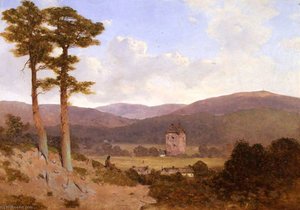
The Gilnockie Tower painting by William James Blacklock is a beautiful representation of a peaceful landscape. Created in 1843, this oil on canvas piece measures 49 x 69 cm and is currently housed at the Tullie House Museum and Art Gallery in the United Kingdom. The scene features a man standing between two trees, with mountains in the background and a castle-like structure, possibly a church or tower, surrounded by…

10
Buit's Castle, Bewcastle (1844) od William James Blacklock

Buit's Castle, Bewcastle

1844

The painting Buit's Castle, Bewcastle by William James Blacklock is a stunning representation of the English landscape. Created in 1844, this oil on canvas piece measures 32 x 55 cm and is currently housed at the Tullie House Museum and Art Gallery in the United Kingdom. A Glimpse into the Artist's Style William James Blacklock was an English landscape painter known for his scenery depictions in Cumbria, the Lake District,…

Slávne obrazy umelca William James Blacklock, čísla 11 až 12

Motívy, ktoré zaujali William James Blacklock

Štyri témy, ktoré sa v týchto origináloch najčastejšie vracajú, každá s jej najvychybenejším príkladom.

Múzeá, ktoré uchovávajú originály umelca William James Blacklock

3 múzeá, v ktorých sa nachádza najviac obrazov z tejto stránky.

Múzeá Mesto Diela umelca William James Blacklock Obrazy z tohto zoznamu
National Gallery of Ireland, DublinNational Gallery of Ireland Dublin 1 Naworth Castle, Cumbria
Abbot Hall Art Gallery, KendalAbbot Hall Art Gallery Kendal 1 Devock Water
Laing Art Gallery, Newcastle upon TyneLaing Art Gallery Newcastle upon Tyne 1 The Ruins of Kirkoswald Castle, Cumberland

William James Blacklock v priebehu rokov: jedinečné originály každého diela

Dlhá kariéra trvajúca 16 rokov, od 1843 do 1858: najznámejšie originály umelca William James Blacklock, zobrazené rok po roku.

Diela podľa roku

Vyberte si rok a pozrite si originály.

Obrazy umelca William James Blacklock: otázky pre galériu

Akým najznámejším dielom sa pýta William James Blacklock?Odhaľte odpoveď

Landscape with Bridge and Figures (1858). Nasledujú The Terrace, Haddon Hall (1845) a On the Banks of Derwentwater Silver Birch (1843).

V akom veku vytvoril/a William James Blacklock dielo Landscape with Bridge and Figures?Odhaľte odpoveď

42 rokov: Landscape with Bridge and Figures vzniklo v roku 1858 a William James Blacklock sa narodil/a v roku 1816.

Ktorých desať obrazov William James Blacklock je najznámejších?Odhaľte odpoveď

Landscape with Bridge and Figures, The Terrace, Haddon Hall, On the Banks of Derwentwater Silver Birch, Naworth Castle, Cumbria, Devock Water, The Ruins of Kirkoswald Castle, Cumberland, Scene on the Wear, Catbells and Causey Pike, Derwentwater, Gilnockie Tower a Buit's Castle, Bewcastle. Vyššie uvedené hodnotenie uvádza rok a múzeu pre každé z nich.

Koľko je známych diel umelca William James Blacklock?Odhaľte odpoveď

Náš katalóg obsahuje 14 diel od umelca William James Blacklock z perioda od 1843 do 1858.

Kde možno vidieť najznámejšie originály od William James Blacklock?Odhaľte odpoveď

Väčšinou v National Gallery of Ireland (Dublin), Abbot Hall Art Gallery (Kendal) a Laing Art Gallery (Newcastle upon Tyne). Tabuľka múzeí vyššie ich všetky uvádza.

V akom období vytvoril/a William James Blacklock svoje najznámejšie obrazy?Odhaľte odpoveď

V období 1854: 3 z 12 diel na tejto stránke bolo vytvorených vtedy, pričom The Ruins of Kirkoswald Castle, Cumberland z nich.

Ktorý z najslávnejších obrazov autora William James Blacklock je najstarší a ktorý najnovší?Odhaľte odpoveď

Na tejto stránke je najstaršie dielo z On the Banks of Derwentwater Silver Birch (1843) a najnovšie z Landscape with Bridge and Figures (1858).

Aké témy obľúbené William James Blacklock?Odhaľte odpoveď

Landscape (4), Trees (2) a River (2), v rámci 12 diel na tejto stránke.

William James Blacklock: portrét umelca

A Life Immersed in Landscape: The Evocative World of William James Blacklock

William James Blacklock, born in the bustling heart of Shoreditch, London, in 1816, was an artist whose life became inextricably linked with the serene beauty of the British countryside. Though initially rooted in the urban landscape of his birth, a pivotal relocation as a young boy would forever shape his artistic vision. In 1818, his family returned to their ancestral Cumberland roots, settling in Cumwhitton near Carlisle, where they embraced farming and a quieter existence. This immersion into the natural world proved transformative for Blacklock, igniting within him a passion for landscape painting that would define his career. His early training began with an apprenticeship to a local bookseller, but his innate artistic talent soon led him to formal studies at the Carlisle Academy of Art under Matthew Ellis Nutter. Even in these formative years, Blacklock demonstrated a remarkable sensitivity to nature, earning recognition as a “rising artist” upon exhibiting his work locally in 1833 and subsequently at the prestigious Royal Academy from 1836 onwards.

Bridging Romanticism and Pre-Raphaelite Sensibilities

Blacklock’s artistic development unfolded against a backdrop of shifting aesthetic currents. His time in London, beginning in 1836, exposed him to the influences of prominent artists such as William Mulready, J.M.W. Turner, David Roberts, and Thomas Creswick. While his style initially echoed the traditions of Romantic landscape painting—characterized by dramatic compositions and emotional intensity—Blacklock soon began to forge a unique path. He possessed an exceptional eye for detail and atmospheric light, qualities that set him apart. A crucial moment in this evolution came with the cleaning of old master paintings at the National Gallery in 1844-45. This experience provided Blacklock with invaluable insights into artistic techniques and the subtle nuances of color and form. It was during this period that he began experimenting with a groundbreaking “white ground” technique, applying luminous glazes over a white base layer to achieve an extraordinary sense of luminosity and depth in his paintings.

The White Ground Technique and Artistic Innovation

This innovative approach did not go unnoticed. Blacklock’s "white ground" technique became the subject of intense study among artists associated with the burgeoning Pre-Raphaelite movement, including William Bell Scott and Dante Gabriel Rossetti. The Steps at Haddon Hall (1848), is considered a prime example of this technique, showcasing its ability to capture light and texture with remarkable fidelity. While Blacklock’s meticulous attention to detail often drew comparisons to the Pre-Raphaelites, he consciously rejected Ruskin's emphasis on strict naturalism. He believed that art should not merely replicate nature but rather express the artist’s inner thoughts and imagination. This distinction is crucial to understanding Blacklock’s unique position within 19th-century British art—he stood at a fascinating intersection between Romantic ideals, Pre-Raphaelite precision, and his own deeply personal vision. His notable paintings include Buit’s Castle, Bewcastle, Gilnockie Tower, Landscape with Bridge and Figures, and The Rookery (1854).

Recognition, Decline, and Lasting Legacy

Blacklock’s talent garnered recognition from influential figures of his time. William Ewart Gladstone acquired his painting *Lanercost Abbey*, a testament to the artist's growing reputation. Further patronage came from Tyneside industrialists James Leathart and Lord Armstrong, facilitated by the support of William Bell Scott. However, Blacklock’s success was tragically cut short by declining health and eyesight. By 1850, he returned to Cumwhitton, continuing to work in his studio as long as possible. Sadly, he succumbed to mental health challenges, attributed to syphilis, and was admitted to the Crichton Royal Hospital in Dumfries in 1855. Despite his condition, he continued to draw until mid-1857, a poignant testament to his unwavering dedication to art. He passed away in 1858 at the age of 42. Though his life was relatively short, William James Blacklock left an indelible mark on British landscape painting. His work represents a pivotal moment between the early 19th-century landscape school and the innovative spirit of the Pre-Raphaelite movement. As Geoffrey Grigson observed, he belonged to a generation bridging Romanticism and Impressionism, deeply influenced by Italian Renaissance masters like Giorgione and Giovanni Bellini. Today, his paintings are treasured for their evocative beauty, technical mastery, and unique contribution to the rich tapestry of British art history.

A Pioneer Remembered

  • Early Influences: Turner, Creswick, Roberts, Mulready.
  • Key Technique: The “white ground” technique – luminous glazes over a white base.
  • Notable Works: *Lanercost Abbey*, *Gilnockie Tower*, *The Steps at Haddon Hall*.
  • Patrons: William Ewart Gladstone, James Leathart, Lord Armstrong.
  • Historical Significance: Bridged Romanticism and Pre-Raphaelitism; influenced by Italian Renaissance masters.