Portrét William Baziotes

24 najznámejších obrazov od William Baziotes, výber z galérie

Aktualizované november 2026 · zoradené podľa našej miery popularity (vyhľadávanie, návštevy a objednávky pre každou prácu) · 24 dielov umelca William Baziotes v našom katalógu

Stručne povedané

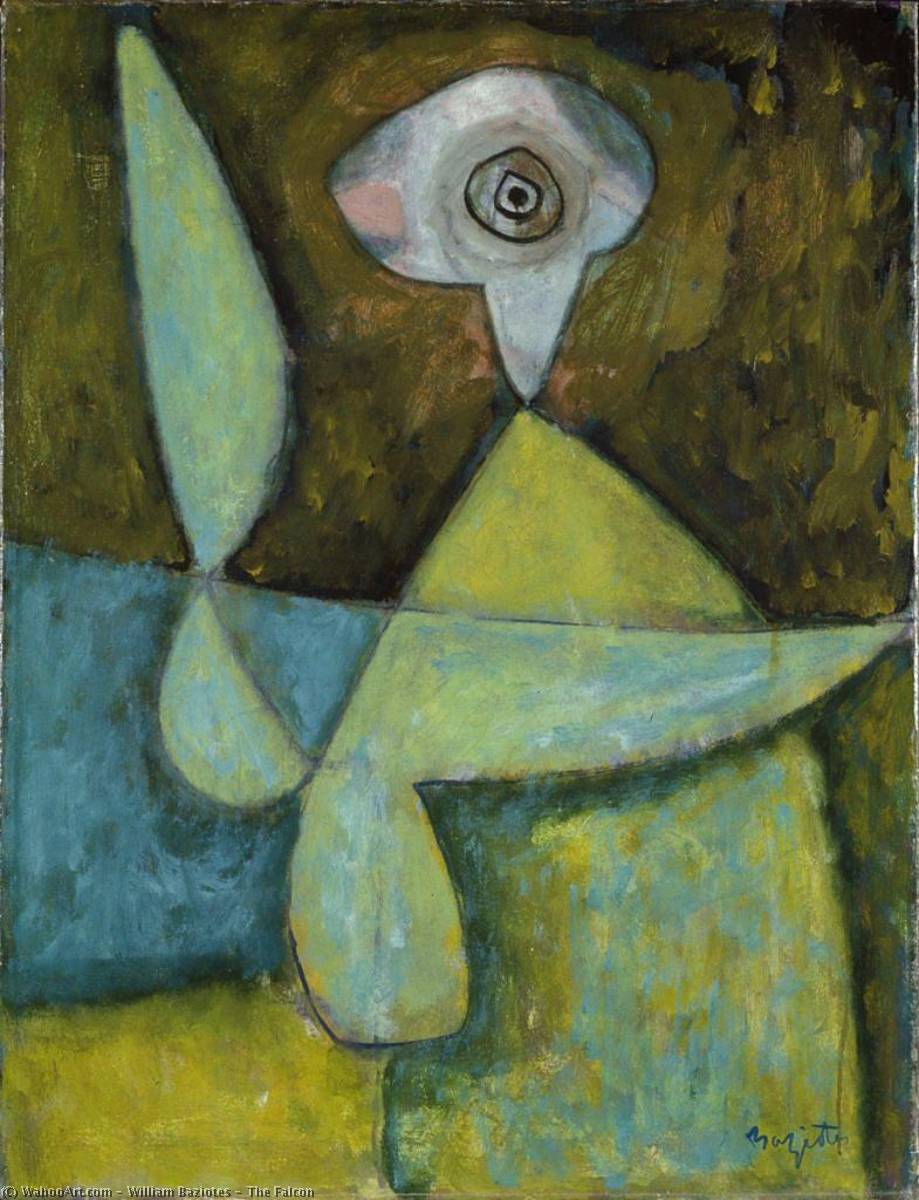
Z všetkých originálov, ktoré William Baziotes zanechal, je najznámejší Pierrot (1947). Hneď za ním nasledujú Desert Landscape (1951) a The Falcon (1947). Náš katalóg obsahuje 24 diel od William Baziotes; galéria si zachovala tých 24, ktoré obdivuje celý svet, pričom každý z nich je prezentovaný spolu s jeho dátumom, múzeou a príbehom.

1912 – 1963, Pittsburgh Abstract expressionism Najviac diel: Izraelské múzeum

Top 10 obrazov umelca William Baziotes: výber galérie

1
Pierrot (1947) od William Baziotes

Pierrot

1947 · Oil On Canvas

The canvas titled Pierrot is a work by the American painter William Baziotes. Created in 1947, the piece moves away from the literal to embrace a highly abstracted subject matter. It exists in the quiet space between a recognizable figure and a dreamlike shape.

2
Desert Landscape (1951) od William Baziotes

Desert Landscape

1951 · Oil On Canvas

In Desert Landscape, William Baziotes moves away from the literal to find the essence of a terrain. Created about 1951, the work suggests a desert through a language of soft, organic shapes rather than precise geography. It is a vision of heat and stillness captured in oil. The subject matter remains abstractly suggestive, offering the feeling of a wasteland without the burden of detail.

4
Jungle Form (1952) od William Baziotes

Jungle Form

1952 · Oil On Canvas · MAM Rio, Rio de Janeiro

In the evocative depths of William Baziotes’ Jungle Form, viewers are invited into a dreamscape where the boundaries between the human silhouette and the primordial wild begin to dissolve. Created in 1952, this masterpiece serves as a profound testament to the artist's ability to bridge the psychological intensity of Surrealism with the raw, gestural energy of Abstract Expressionism. The painting presents a striking green figure, a woman seen from behind,…

Výber umelcov William Baziotes pokračuje, od 11 do 24

Múzeá, ktoré uchovávajú originály umelca William Baziotes

5 múzeá, v ktorých sa nachádza najviac obrazov z tejto stránky.

Múzeá Mesto Diela umelca William Baziotes Obrazy z tohto zoznamu
Izraelské múzeum, JeruzalemIzraelské múzeum Jeruzalem 2 Untitled, Morning
MAM Rio, Rio de JaneiroMAM Rio Rio de Janeiro 1 Jungle Form
Buffalo AKG Art Museum, BuffaloBuffalo AKG Art Museum Buffalo 1 Puppets
Tucson Museum of Art, TucsonTucson Museum of Art Tucson 1 Tropical Bird
Art Institute of Chicago, ChicagoArt Institute of Chicago Chicago 1 Cyclops

William Baziotes rok po roku: originály, ktoré definujú každú éru

Od 1940 do 1958, William Baziotes tvoril po dobu 19 rokov: výber sleduje túto dlhú kariéru rok po roku prostredníctvom jeho najlepších originálnych diel.

Diela podľa roku

Vyberte si rok a pozrite si originály.

Otázky zberateľov o obrazoch od William Baziotes

Ktorým dielom je William Baziotes najznámejší/najznámejšia?Odhaľte odpoveď

Pierrot (1947). Nasledujú Desert Landscape (1951) a The Falcon (1947).

V akom veku bol/a William Baziotes, keď vzniklo dielo Pierrot?Odhaľte odpoveď

35 rokov: Pierrot vzniklo v roku 1947 a William Baziotes sa narodil/a v roku 1912.

Ktorých desať najznámejších obrazov má William Baziotes?Odhaľte odpoveď

Pierrot, Desert Landscape, The Falcon, Jungle Form, Untitled, Ethel Baziotes (recto) Untitled (Clown and Female Nude) (verso), The Prisoner, Untitled, Puppets a Tropical Bird. Vyššie uvedené hodnotenie uvádza rok a múzeu pre každé z nich.

Koľko obrazov zanechal umenec William Baziotes?Odhaľte odpoveď

Náš katalóg obsahuje 24 diel od umelca William Baziotes z perioda od 1940 do 1958.

V ktorých múzeách visia majstrovské diela umelca William Baziotes?Odhaľte odpoveď

Väčšinou v Izraelské múzeum (Jeruzalem), MAM Rio (Rio de Janeiro) a Buffalo AKG Art Museum (Buffalo). Tabuľka múzeí vyššie ich všetky uvádza.

V ktorých rokoch vytvoril William Baziotes svoje najznámejšie diela?Odhaľte odpoveď

V období 1947: 5 z 24 diel na tejto stránke bolo vytvorených vtedy, pričom Pierrot z nich.

Aké sú prvé a posledné známe originály od William Baziotes?Odhaľte odpoveď

Na tejto stránke je najstaršie dielo z Ethel Baziotes (recto) Untitled (Clown and Female Nude) (verso) (1940) a najnovšie z Watercolor 4 (1958).

Ktorú techniku používal(a) William Baziotes najčastejšie?Odhaľte odpoveď

Oil On Canvas, pre 3 z 24 diel na tejto stránke.

Do ktorého umeleckého smeru patrí William Baziotes?Odhaľte odpoveď

Abstract expressionism, podľa originálov na tejto stránke.

Aké diela umelca William Baziotes sa nachádzajú v múzeu Izraelské múzeum?Odhaľte odpoveď

Untitled a Morning: múzeá Izraelské múzeum, Jeruzalem uchovávajú 2 z diel na tejto stránke.

William Baziotes: život a dielo

The Dreamscape Architect: The Life and Vision of William Baziotes

Within the vibrant, often turbulent constellation of the New York School, few artists captured the ethereal boundary between the conscious mind and the primordial subconscious as poignantly as William Baziotes. Born in 1912 to Greek immigrants in Pittsburgh, Pennsylvania, Baziotes carried within him a profound connection to ancient heritage—a fascination with classical sculpture and mythic resonance that would later breathe life into his abstract forms. His formal journey began at the National Academy of Design, where he emerged in 1936 as a painter deeply attuned to the technical rigors of his craft, yet possessed by an irrepressible urge to explore the unseen realms of the psyche.

The trajectory of Baziotes’ career was irrevocably shaped by the socio-economic landscape of the Great Depression. Through his involvement with the Works Progress Administration (WPA), particularly the easel project between 1938 and 1940, he found the freedom to experiment with large-scale canvases that demanded a more visceral, gestural approach. It was during this era that he began to weave together the disparate threads of European Surrealism and the burgeoning American Abstract Expressionism. While his contemporaries often leaned toward pure abstraction or intellectualized concepts, Baziotes remained a poet of the image, utilizing automatism not merely as a technique, but as a gateway to a more evocative, biomorphic language.

Biomorphic Echoes and Surrealist Shadows

Baziotes’ visual vocabulary is perhaps most famously defined by its use of biomorphic forms—organic, rounded shapes that suggest biological life, cellular structures, or the fluid movement of deep-sea organisms. His work often feels like a window into a prehistoric or extraterrestrial landscape, where the distinction between flesh and flora becomes beautifully blurred. In masterpieces such as Jungle Form (1952), one encounters a mesmerizing metamorphosis; a verdant figure emerges from a tangled thicket, her very essence seemingly woven from emerald and mossy textures. This ability to marry the psychological intensity of Surrealism with the raw, energetic brushwork of Abstract Expressionism allowed him to create works that are simultaneously haunting and deeply rhythmic.

His inspirations were as diverse as they were profound. Beyond the visual influence of primitive art, Baziotes drew immense spiritual and linguistic nourishment from the poetry of Charles Baudelaire and the timeless elegance of ancient Greek art. This literary and historical depth infused his paintings with a sense of tragic beauty and ritualistic movement. Whether through the melancholic color palettes found in works like The Falcon or the stark, haunting compositions of The Flesh Eaters, Baziotes sought to capture a moment of transcendence—a reaching toward the heavens or an exploration of the shadows lurking within the human spirit.

Legacy and the New York School

The mid-1940s marked the zenith of Baziotes’ professional recognition. His 1944 debut solo exhibition at Peggy Guggenheim’s legendary Art of This Century gallery served as a definitive arrival, placing him at the epicenter of the modern art world. He was not merely a participant in this movement but a foundational architect of its community. Alongside luminaries such as Mark Rothko, Robert Motherwell, and David Hare, Baziotes co-founded the Subjects of the Artist School in 1948. This institution became a vital crucible for artistic dialogue, hosting lectures by icons like John Cage and Jean Arp, and fostering a collaborative environment that would define the postwar American aesthetic.

In his later years, Baziotes transitioned into a period of significant pedagogical influence, teaching at prestigious institutions including the Museum of Modern Art and New York University. Though his life was tragically cut short by lung cancer in 1963, just days before his fifty-first birthday, his contribution to the evolution of modern art remains indelible. He leaves behind a legacy characterized by:

  • The Synthesis of Styles: Successfully bridging the gap between the dream-logic of Surrealism and the gestural freedom of Abstract Expressionism.
  • Biomorphic Innovation: Developing a unique visual language of organic, fluid forms that evoke both biological life and mythic archetypes.
  • Cultural Integration: Infusing American abstraction with the weight of classical antiquity and European poetic traditions.
  • Educational Leadership: Strengthening the New York art community through the establishment of collaborative schools and academic instruction.

Today, the works of William Baziotes continue to captivate collectors and historians alike, offering a profound meditation on the interconnectedness of the human soul and the untamed natural world.