Portrét Felix Nussbaum

Obrazy umelca Felix Nussbaum: 49 najznámejších výtvarných diel prostretých pohľadom galérie

Aktualizované november 2026 · zoradené podľa našej miery popularity (vyhľadávanie, návštevy a objednávky pre každou prácu) · 49 dielov umelca Felix Nussbaum v našom katalógu

Stručne povedané

Z hľadiska galérie je najznámejším obrazom umelca Felix Nussbaum dielo Fish Market (1936), ktorého originál visí v Kulturgeschichtliche Museum Osnabrück v meste Osnabrück. Fishing Boats with Island (1933) a Loneliness (1942) dopĺňajú trojicu, ktorú pozná každé oko. Z 49 diel umelca Felix Nussbaum v našom katalógu prezentuje galéria nižšie 49 najznámejších, z ktorých je každá originál s uvedeným rokom vzniku, múzeom a unikátnosťou.

1904 – 1944, Osnabrück Surrealist expressionism Najviac diel: Kulturgeschichtliche Museum Osnabrück

Top 10 obrazov umelca Felix Nussbaum v galérii

2
Fishing Boats with Island (1933) od Felix Nussbaum

Fishing Boats with Island

1933 · Gouache

The water holds the light in a pale, steady grip. In this 1933 gouache on paper, the sea is a surface of calm, interrupted only by the presence of two boats. One vessel rests near the left edge, while another sits further back, drifting toward the right. Between them, two figures stand close together on the shore. They are small against the expanse, mere silhouettes of companionship amidst the blue…

5
Memory of Norderney (1929) od Felix Nussbaum

Memory of Norderney

1929 · Oil On Canvas · Kulturgeschichtliche Museum Osnabrück, Osnabrück

In the hauntingly beautiful oil on canvas, Memory of Norderney, Felix Nussbaum invites us into a world that feels simultaneously vibrant and ghostly. Painted in 1929, this large-scale masterpiece captures a moment of serene leisure, yet it is imbued with a profound sense of nostalgia that transcends its literal subject matter. The scene unfolds before a stately building, perhaps a grand hotel or a coastal mansion, characterized by its classical…

6
Entombment (also known as Organ Grinders at the Roman Forum) (1933) od Felix Nussbaum

Entombment (also known as Organ Grinders at the Roman Forum)

1933 · Oil On Canvas · Kulturgeschichtliche Museum Osnabrück, Osnabrück

This oil on canvas painting depicts the entombment of Jesus Christ. The central figure of Jesus lies at the heart of the scene, surrounded by a group of individuals. Some figures stand in close proximity to the body, while others are positioned at a distance. In the background, two men are engaged in playing musical instruments. To the left of the main group, a horse is visible, its form contributing…

7
Lovers (1928) od Felix Nussbaum

Lovers

1928 · Oil

In this 1928 work titled Lovers, Felix Nussbaum turns his attention toward the quietude of human connection. The scene captures a couple in a moment of deep intimacy, caught in an embrace while seated within a small boat. They are positioned upon a body of water, a setting that isolates them from the surrounding world and focuses the viewer entirely on their physical closeness. This sense of seclusion is heightened…

8
The mad square (1931) od Felix Nussbaum

The mad square

1931 · Oil On Canvas · Berlinische Galerie, Berlín

Created in 1931, The mad square is a work by the German-Jewish surrealist painter Felix Nussbaum. The canvas captures a fragmented urban landscape, a crowded Berlin where the architecture seems to fracture under the weight of a pale, desaturated blue sky. Amidst the rigid lines of the city, a surreal procession of figures moves through the streets, some carrying large, framed artworks that disrupt the geometric stability of the scene.…

9
Self-Portrait With Painters Cloth (1935) od Felix Nussbaum

Self-Portrait With Painters Cloth

1935 · Oil · Židovské múzeum v Berlíne, Berlín

To look at this portrait is to encounter the artist's internal landscape during a period of immense transition. Painted in 1935, the work reflects a style characterized by a blend of realism and surrealism, often associated with the New Objectivity movement. The composition avoids the grandiosity of traditional portraiture, opting instead for a directness that feels almost intrusive. It is a study of a man caught in a moment of…

Obrazy umelca Felix Nussbaum, usporiadané od 11 do 49

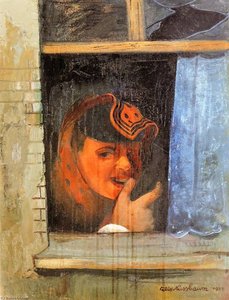
11Self-Portrait in a Shroud (Group picture) (1942) od Felix NussbaumSelf-Portrait in a Shroud (Group picture)1942 · Berlinische Galerie 12Self-Portrait with Jewish Identity Card (1943) od Felix NussbaumSelf-Portrait with Jewish Identity Card1943 13Man with Flower (1939) od Felix NussbaumMan with Flower1939 14Evening (unfinished) (also known as Self Portrait with Felka Platek) (1942) od Felix NussbaumEvening (unfinished) (also known as Self Portrait with Felka Platek)1942 · Kulturgeschichtliche Museum Osnabrück 15Jaqui in the Street (1944) od Felix NussbaumJaqui in the Street1944 · Kulturgeschichtliche Museum Osnabrück 16Drawbridge across a Moorland Ditch (1927) od Felix NussbaumDrawbridge across a Moorland Ditch1927 · Kulturgeschichtliche Museum Osnabrück 17Gypsy Woman (1927) od Felix NussbaumGypsy Woman1927 · Kulturgeschichtliche Museum Osnabrück 18The Hakenhof in Kommenderiestrasse in Onasbrück (1927) od Felix NussbaumThe Hakenhof in Kommenderiestrasse in Onasbrück1927 19Men Mending Nets in a Street in Ostend (1928) od Felix NussbaumMen Mending Nets in a Street in Ostend1928 20Fairground (1925) od Felix NussbaumFairground1925 21Group Portrait (1930) od Felix NussbaumGroup Portrait1930 22Gallows (also known as Funeral) (1930) od Felix NussbaumGallows (also known as Funeral)1930 · Berlinische Galerie 23Fisherman's House (1933) od Felix NussbaumFisherman's House1933 · Kulturgeschichtliche Museum Osnabrück 24The Hurdy Gurdy Man (1931) od Felix NussbaumThe Hurdy Gurdy Man1931 · Berlinische Galerie 25Narcussus (1932) od Felix NussbaumNarcussus1932 · Kulturgeschichtliche Museum Osnabrück 26Harbor Scene (1935) od Felix NussbaumHarbor Scene1935 · Kulturgeschichtliche Museum Osnabrück 27Interior with Still Life (1935) od Felix NussbaumInterior with Still Life1935 28Landscape (also known as Tree Behind a Wall) (1935) od Felix NussbaumLandscape (also known as Tree Behind a Wall)1935 29Locomotive (1936) od Felix NussbaumLocomotive1936 · Kulturgeschichtliche Museum Osnabrück 30Man behind the Window (also known as Self Portrait after Adriaen van Ostade) (1937) od Felix NussbaumMan behind the Window (also known as Self Portrait after Adriaen van Ostade)1937 · Kulturgeschichtliche Museum Osnabrück 31Don Quixote and the Windmills (1938) od Felix NussbaumDon Quixote and the Windmills1938 · Kulturgeschichtliche Museum Osnabrück 32Dover Ferry (1935) od Felix NussbaumDover Ferry1935 · Kulturgeschichtliche Museum Osnabrück 33Nightly view from the workshop with dishcloth. (1940) od Felix NussbaumNightly view from the workshop with dishcloth.1940 34The Refugee (1939) od Felix NussbaumThe Refugee1939 35The Kitchen in Hiding (1943) od Felix NussbaumThe Kitchen in Hiding1943 · Kulturgeschichtliche Museum Osnabrück 36Man with Withered Leaf (1941) od Felix NussbaumMan with Withered Leaf1941 37Stillleben mit Schachteln (Still life with boxes) (1941) od Felix NussbaumStillleben mit Schachteln (Still life with boxes)1941 38Hurdy Gurdy Man in a Surreal Landscape (1939) od Felix NussbaumHurdy Gurdy Man in a Surreal Landscape1939 · Kulturgeschichtliche Museum Osnabrück 39Jew by the Window (1943) od Felix NussbaumJew by the Window1943 · Niedersächsisches Landesmuseum Für Kunst Und Kulturgeschichte Oldenburg 40Manikins (1943) od Felix NussbaumManikins1943 · Kulturgeschichtliche Museum Osnabrück 41Group of Three (1944) od Felix NussbaumGroup of Three1944 42Felka Platek Painting (1935) od Felix NussbaumFelka Platek Painting1935 · Jüdisches Museum Rendsburg 43In the camp (1940) od Felix NussbaumIn the camp1940 · Deutsches Historisches Museum 44Gypsy (1928) od Felix NussbaumGypsy1928 · Kulturgeschichtliche Museum Osnabrück 45Moja matka (1926) od Felix NussbaumMoja matka1926 · Kulturgeschichtliche Museum Osnabrück 46Untitled (AQQJ26) od Felix NussbaumUntitled (AQQJ26) 47Masquerade (1927) od Felix NussbaumMasquerade1927 48Death Triumphant (1944) od Felix NussbaumDeath Triumphant1944 49Self-Portrait in the Camp (1940) od Felix NussbaumSelf-Portrait in the Camp1940 · Neue Galerie New York

Slávne obrazy umelca Felix Nussbaum podľa jednotlivých období

Motívy, ktoré zaujali Felix Nussbaum

Štyri témy, ktoré sa v týchto origináloch najčastejšie vracajú, každá s jej najvychybenejším príkladom.

Múzeá, ktoré uchovávajú originály umelca Felix Nussbaum

7 múzeá, v ktorých sa nachádza najviac obrazov z tejto stránky.

Múzeá Mesto Diela umelca Felix Nussbaum Obrazy z tohto zoznamu
Kulturgeschichtliche Museum Osnabrück, OsnabrückKulturgeschichtliche Museum Osnabrück Osnabrück 21 Fish Market, Fear (also known as Self Portrait with His Niece Marianna), Memory of Norderney
Berlinische Galerie, BerlínBerlinische Galerie Berlín 4 The mad square, Self-Portrait in a Shroud (Group picture), Gallows (also known as Funeral)
Židovské múzeum v Berlíne, BerlínŽidovské múzeum v Berlíne Berlín 2 Loneliness, Self-Portrait With Painters Cloth
Niedersächsisches Landesmuseum Für Kunst Und Kulturgeschichte Oldenburg, OldenburgNiedersächsisches Landesmuseum Für Kunst Und Kulturgeschichte Oldenburg Oldenburg 1 Jew by the Window
Jüdisches Museum Rendsburg, RendsburgJüdisches Museum Rendsburg Rendsburg 1 Felka Platek Painting
Deutsches Historisches Museum, BerlínDeutsches Historisches Museum Berlín 1 In the camp
Neue Galerie New York, New YorkNeue Galerie New York New York 1 Self-Portrait in the Camp

Felix Nussbaum, jeden ikonický obraz na každé desaťročie

Diela podľa dekád

Vyberte si dekádu a pozrite si originál, ktorý ju definuje.

Obrazy umelca Felix Nussbaum: odpovede galérie

Ktorý obraz od Felix Nussbaum je najznámejší zo všetkých?Odhaľte odpoveď

Fish Market (1936), Kulturgeschichtliche Museum Osnabrück, Osnabrück. Nasledujú Fishing Boats with Island (1933) a Loneliness (1942).

Koľko rokov mal/a Felix Nussbaum pri dokončeni diela Fish Market?Odhaľte odpoveď

32 rokov: Fish Market vzniklo v roku 1936 a Felix Nussbaum sa narodil/a v roku 1904.

Ktorých 10 najlepších obrazov má Felix Nussbaum?Odhaľte odpoveď

Fish Market, Fishing Boats with Island, Loneliness, Fear (also known as Self Portrait with His Niece Marianna), Memory of Norderney, Entombment (also known as Organ Grinders at the Roman Forum), Lovers, The mad square, Self-Portrait With Painters Cloth a Masks and Cat. Vyššie uvedené hodnotenie uvádza rok a múzeu pre každé z nich.

Koľko diel vytvoril/a Felix Nussbaum?Odhaľte odpoveď

Náš katalóg obsahuje 49 diel od umelca Felix Nussbaum z perioda od 1925 do 1944.

Kde visia najznámejšie originály umelca Felix Nussbaum?Odhaľte odpoveď

Väčšinou v Kulturgeschichtliche Museum Osnabrück (Osnabrück), Berlinische Galerie (Berlín) a Židovské múzeum v Berlíne (Berlín). Tabuľka múzeí vyššie ich všetky uvádza.

Kedy vytvoril/a Felix Nussbaum svoje najznámejšie obrazy?Odhaľte odpoveď

V období 1930s: 22 z 49 diel na tejto stránke bolo vytvorených vtedy, pričom Fish Market z nich.

Aké sú najskoršie a najneskoršie známe diela umelca Felix Nussbaum?Odhaľte odpoveď

Na tejto stránke je najstaršie dielo z Fairground (1925) a najnovšie z Jaqui in the Street (1944).

K akým témamam sa Felix Nussbaum najčastejšie vracia?Odhaľte odpoveď

People (7), Man (6) a Men (5), v rámci 49 diel na tejto stránke.

V akom médiu tvoril/a Felix Nussbaum najčastejšie?Odhaľte odpoveď

Oil On Canvas, pre 9 z 49 diel na tejto stránke.

S ktorým smerom je spojený/á umenec Felix Nussbaum?Odhaľte odpoveď

Surrealist expressionism a New objectivity, podľa originálov na tejto stránke.

Aké originály umelca Felix Nussbaum má v zbierkach Kulturgeschichtliche Museum Osnabrück?Odhaľte odpoveď

Fish Market, Fear (also known as Self Portrait with His Niece Marianna) a Memory of Norderney: múzeá Kulturgeschichtliche Museum Osnabrück, Osnabrück uchovávajú 21 z diel na tejto stránke.

Felix Nussbaum: umelec

Felix Nussbaum (1904-1944): A Life Etched in Exile

Felix Nussbaum’s story is a stark and profoundly moving testament to the power of art born from unimaginable suffering. Born in Osnabrück, Germany, in 1904, his life unfolded against the backdrop of rising nationalism and escalating persecution, culminating in the horrors of the Holocaust. He wasn't simply a victim *of* history; he was an artist who meticulously documented its impact on his soul, creating a body of work that stands as both a personal lament and a universal warning. Nussbaum’s paintings offer a rare, unflinching glimpse into the psychological landscape of displacement, fear, and ultimately, annihilation – a perspective often absent from broader historical narratives. His father, Philipp Nussbaum, a World War I veteran with an early passion for painting himself, recognized and nurtured his son's talent, providing encouragement that would prove vital in the darkening years to come. This initial support fostered a lifelong dedication to art, even as political realities increasingly constricted his path.

Early Life and Artistic Influences

Nussbaum’s artistic journey began with formal studies in Hamburg and Berlin in 1920, continuing for as long as circumstances allowed. His early work reveals a clear debt to the Post-Impressionist masters, particularly Vincent van Gogh and Henri Rousseau. The vibrant colors and expressive brushwork of these artists provided a foundation upon which Nussbaum would later build his unique style. However, he wasn’t content with mere imitation. He actively sought out new influences, drawn to the unsettling dreamscapes of Giorgio de Chirico and Carlo Carrà, pioneers of the *pittura metafisica* movement. The careful attention to color demonstrated by Carl Hofer's expressionist paintings also left a lasting impression on Nussbaum’s approach. These diverse inspirations coalesced into what would become known as his “New Objectivity” style – a blend of realism and surrealism, characterized by precise detail, unsettling compositions, and a pervasive sense of alienation. This period was marked by experimentation and growth, but the looming shadow of Nazi ideology soon threatened to extinguish his artistic promise. He took refuge in Rome after 1933 where he studied under a scholarship awarded by the German government.

The Rise of Fascism and Artistic Resistance

The ascent of Adolf Hitler and the National Socialist party in 1933 irrevocably altered Nussbaum’s life trajectory. Studying on a scholarship at Villa Massimo, Rome, he witnessed firsthand the chilling pronouncements of Hitler's propaganda minister regarding Nazi artistic values – glorification of heroism and the Aryan race. Recognizing that as a Jew, he could not remain within this ideological framework, Nussbaum made the courageous decision to leave Rome in 1933. Shortly thereafter, his studio was destroyed by arson—a deliberate act orchestrated by Nazi sympathizers—effectively erasing much of his early oeuvre. Despite facing immense hardship and persecution, Nussbaum continued to paint prolifically during this period, driven by an unwavering commitment to artistic expression as a form of resistance against oppression. His work became increasingly imbued with themes of exile, loss, and psychological torment – reflections of his own personal experience and the broader anxieties of European Jewry under Nazi rule.

Exile and Artistic Transformation

In 1937, Nussbaum and Felka Platek emigrated to Belgium, seeking refuge from the escalating dangers posed by Nazi Germany. They established a home in Ostende, where Nussbaum continued his artistic endeavors amidst the uncertainty of wartime conditions. His paintings from this era—particularly *The Beach at Rapallo*, 1934—capture the fleeting beauty of a moment before the storm of war descended upon Europe. The poignant depiction of Felka Platek painting—a portrait of his beloved wife—underscores Nussbaum’s enduring fascination with capturing human emotion and vulnerability. As the Nazi occupation deepened, Nussbaum faced increasing restrictions on his freedom and artistic activity. Nevertheless, he persevered, producing some of his most powerful works during this period—including *The Great Disaster*, 1939—a haunting meditation on the impending catastrophe that would engulf Europe.

A Legacy of Suffering and Artistic Integrity

The Nazi invasion of Belgium in 1940 marked a devastating turning point for Nussbaum’s life. Arrested as a “hostile alien,” he endured imprisonment at Saint-Cyprien camp, where he documented the dehumanizing conditions of internment with unflinching honesty. He escaped captivity and sought refuge with Felka Platek, relying on the generosity of Belgian friends for sustenance and protection. Nussbaum continued to paint relentlessly during this perilous period—producing *Self Portrait with Jewish Identity Card*, 1943—a visceral depiction of existential anguish—and *Triumph of Death*, 1944—a monumental canvas imbued with symbolic references to mortality and the horrors of the Holocaust. Tragically, Nussbaum’s parents perished at Auschwitz in August 1944—a devastating loss that underscored the immensity of his personal tragedy. Shortly thereafter, he and Felka were deported to Mechelen transit camp, where Felix was murdered upon arrival in August of that year. His brother and sister-in-law followed soon after, completing the annihilation of Nussbaum’s family within a single year. Despite this unimaginable loss, Nussbaum's art—particularly *Self Portrait with Jewish Identity Card* and *Triumph of Death*—remains a profoundly moving testament to human resilience and artistic integrity—a haunting reminder of the horrors endured during the Holocaust and an enduring symbol of courage in the face of oppression.