Portrét Thomas Walker Bretland

8 najznámejších obrazov od umelca Thomas Walker Bretland, každý jedinečný

Aktualizované november 2026 · zoradené podľa našej miery popularity (vyhľadávanie, návštevy a objednávky pre každú prácu) · 11 dielov umelca Thomas Walker Bretland v našom katalógu

Stručne povedané

The Greyhound (1830) je obrazom umelca Thomas Walker Bretland, ktorý priťahuje najviac pohľadov; originál sa nachádza v múzeu Bristol Museum And Art Gallery, Bristol. Potom sa pohľad presunie na Gone Away (1838) a Horse Owned by Mr Robert White (1838). Z 11 diel umelca Thomas Walker Bretland v našom katalógu je týchto 8 najznámejších; každá z nich je jedinečným originálom prezentovaným s jeho rokom vzniku, múzeom a dôvodom, prečo pretrváva.

1802 – 1874, Nottingham Romanticism Najviac diel: National Trust

Top 10 obrazov umelca Thomas Walker Bretland podľa výberu galérie

1
The Greyhound (1830) od Thomas Walker Bretland

The Greyhound

1830 · Oil · Bristol Museum And Art Gallery, Bristol

A single dog occupies the center of the frame, its slender neck extended toward an unseen point beyond the canvas. The greyhound stands amidst the tall, unmanicured grass, its posture alert and poised. In the distance, the landscape stretches toward a heavy, clouded sky that presses down with atmospheric weight. Two horses move through the background, small silhouettes against the vastness of the field, while a lone figure stands near…

2
Gone Away (1838) od Thomas Walker Bretland

Gone Away

1838 · Oil

A group of men on horseback occupies a sprawling landscape, their presence marking a moment of social assembly within the natural world. Some riders are clad in red coats, while others wear black, creating a rhythmic contrast against the muted tones of the terrain. Below the horses, a dog rests upon the ground, a quiet observer to the movement above. The scene is animated by birds in flight, adding a…

3
Horse Owned by Mr Robert White (1838) od Thomas Walker Bretland

Horse Owned by Mr Robert White

1838 · Oil

The air in the stable feels heavy with the scent of hay and the quiet industry of farm life. At the center of this bustling scene, a white horse bows its head, its neck curving in a moment of stillness amidst the surrounding movement. This animal, belonging to Mr. Robert White, commands the space not through action, but through its sheer physical presence. To the right, two dogs linger, their…

4
Horse and Groom (1843) od Thomas Walker Bretland

Horse and Groom

1843 · Oil On Canvas · York Museums Trust, York

The scene unfolds in a quiet, indoor setting, perhaps a stable or a barn, where the air feels heavy with the presence of living creatures. Here, we find Horse and Groom, a work painted by Thomas Walker Bretland. The artist captures a specific moment in time, dating this particular creation to 1843. There is a stillness in the atmosphere, yet the subjects remain palpably present before us.

5
A Bay Hunter in a Landscape (1842) od Thomas Walker Bretland

A Bay Hunter in a Landscape

1842 · Oil On Canvas · National Trust, Derby

A brown horse occupies the center of this oil on canvas, positioned within a grassy field. The animal's coat is a deep bay color, and its head is turned toward an unseen point off-camera. In the background, trees rise against the landscape, providing a vertical element to the horizontal expanse of the field. Two human figures are present in the scene: one is located on the left side, while the…

6
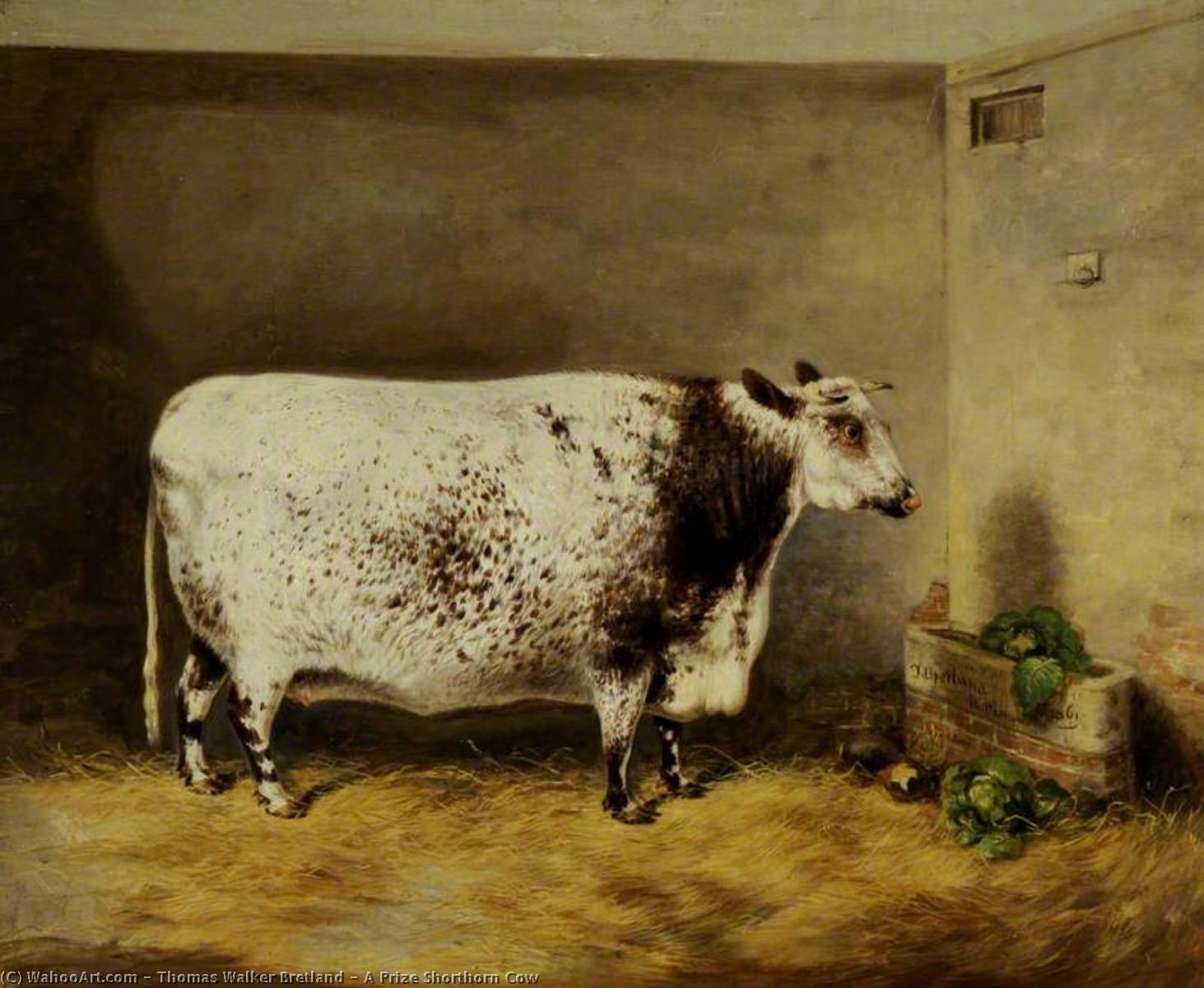
A Prize Shorthorn Cow (1861) od Thomas Walker Bretland

A Prize Shorthorn Cow

1861 · Oil · National Trust, Derby

The painting presents a black and white representation of a cow standing in front of a brick wall. The cow's body occupies most of the image, with its head positioned towards the right side of the frame, appearing to look at the camera. In the background, a building can be seen through the brick wall. The scene includes two birds: one located near the top left corner and another closer…

7
Longhorn Cow (1864) od Thomas Walker Bretland

Longhorn Cow

1864 · Oil On Canvas · Shugborough Hall, Stoke-on-Trent

The longhorn cow stands anchored in the grass, a heavy presence of brown and white. Its face, pale as bleached linen, breaks the darker tones of its hide. It looks toward something unseen beyond the frame, its gaze steady and quiet. Behind the animal, the silhouette of a building rises against the sky, a silent witness to the stillness of the field. Two birds drift through the upper air, mere…

Motívy, ktoré zaujali Thomas Walker Bretland

Štyri témy, ktoré sa v týchto origináloch najčastejšie vracajú, každá s jej najvychybenejším príkladom.

Múzeá, ktoré uchovávajú originály umelca Thomas Walker Bretland

5 múzeá, v ktorých sa nachádza najviac obrazov z tejto stránky.

Múzeum Mesto Diela umelca Thomas Walker Bretland Obrazy z tohto zoznamu
National Trust, DerbyNational Trust Derby 2 A Bay Hunter in a Landscape, A Prize Shorthorn Cow
Bristol Museum And Art Gallery, BristolBristol Museum And Art Gallery Bristol 1 The Greyhound
York Museums Trust, YorkYork Museums Trust York 1 Horse and Groom
Shugborough Hall, Stoke-on-TrentShugborough Hall Stoke-on-Trent 1 Longhorn Cow
Nottingham Castle Museum And Art Gallery, NottinghamNottingham Castle Museum And Art Gallery Nottingham 1 Portrait of the Horse, Which Belonged to Major Burton at the Balaklava Charge

Thomas Walker Bretland naprieč dekádami: jeden jedinečný originál pre každý

Diela podľa dekád

Vyberte si dekádu a pozrite si originál, ktorý ju definuje.

Obrazy umelca Thomas Walker Bretland: otázky pre galériu

Akým najznámejším dielom sa pýta Thomas Walker Bretland?Odhaľte odpoveď

The Greyhound (1830), Bristol Museum And Art Gallery, Bristol. Nasledujú Gone Away (1838) a Horse Owned by Mr Robert White (1838).

V akom veku vytvoril/a Thomas Walker Bretland dielo The Greyhound?Odhaľte odpoveď

28 rokov: The Greyhound vzniklo v roku 1830 a Thomas Walker Bretland sa narodil/a v roku 1802.

Koľko je známych diel umelca Thomas Walker Bretland?Odhaľte odpoveď

Náš katalóg obsahuje 11 diel od umelca Thomas Walker Bretland z perioda od 1830 do 1864.

Kde možno vidieť najznámejšie originály od Thomas Walker Bretland?Odhaľte odpoveď

Väčšinou v National Trust (Derby), Bristol Museum And Art Gallery (Bristol) a York Museums Trust (York). Tabuľka múzeí vyššie ich všetky uvádza.

V akom období vytvoril/a Thomas Walker Bretland svoje najznámejšie obrazy?Odhaľte odpoveď

V období 1830s: 3 z 8 diel na tejto stránke bolo vytvorených vtedy, pričom The Greyhound z nich.

Ktorý z najslávnejších obrazov autora Thomas Walker Bretland je najstarší a ktorý najnovší?Odhaľte odpoveď

Na tejto stránke je najstaršie dielo z The Greyhound (1830) a najnovšie z Longhorn Cow (1864).

Aké témy obľúbené Thomas Walker Bretland?Odhaľte odpoveď

Horse (4), Grass (3) a Dog (2), v rámci 8 diel na tejto stránke.

S akými materiálmi mal(a) Thomas Walker Bretland najčastejšie pracuje?Odhaľte odpoveď

Oil, pre 4 z 8 diel na tejto stránke.

Do ktorého smeru patrí tvorba umelca Thomas Walker Bretland?Odhaľte odpoveď

Romanticism, podľa originálov na tejto stránke.

Aké originály od Thomas Walker Bretland môžem vidieť v National Trust?Odhaľte odpoveď

A Bay Hunter in a Landscape a A Prize Shorthorn Cow: múzeá National Trust, Derby uchovávajú 2 z diel na tejto stránke.

Thomas Walker Bretland: portrét umelca

Thomas Walker Bretland: A Chronicle of Rural Life and Equestrian Grace

Born in Nottingham in 1802, Thomas Walker Bretland’s artistic journey began not within a formal studio, but amidst the bustling world of his father's coach and carriage painting business. From an early age, young Thomas possessed a keen eye for detail and a deep fascination with animals – a passion that would ultimately define his career. Initially apprenticed to his father in this traditional craft, he nonetheless found himself drawn to capturing the essence of the creatures he observed, sketching horses, dogs, and cows with an intensity that hinted at a future far removed from heraldic designs.

Bretland’s early life was shaped by a confluence of influences. The legacy of George Stubbs, the celebrated English animal painter of the 18th century, proved particularly formative. Stubbs' meticulous anatomical studies and dramatic depictions of horses ignited a desire within Bretland to elevate his own work beyond mere illustration, striving instead for a profound understanding of equine anatomy and movement. His father’s initial discouragement of artistic pursuits was ultimately overridden by the advice of Lord Middleton, a discerning patron who recognized the burgeoning talent within the young artist. This pivotal encounter provided Bretland with the encouragement and opportunity to pursue his passion fully.

The Rise of a Sporting Painter

The mid-19th century witnessed a flourishing of sporting art in Britain, fueled by the growing popularity of hunting, racing, and equestrian pursuits among the landed gentry. Bretland skillfully positioned himself within this vibrant milieu, becoming a sought-after painter of horses and scenes related to rural life. His commissions came primarily from wealthy landowners – Dukes of Buccleuch and Montrose, Lord Chesterfield, Baron Rothschild – individuals who valued both artistic skill and social standing. These patrons commissioned portraits of their prized steeds, hunting scenes depicting thrilling chases through the countryside, and evocative landscapes that captured the beauty of the English estate.

Bretland’s style evolved over time, reflecting the prevailing trends of the Victorian era while retaining a distinctly individual character. His paintings are characterized by meticulous detail, rich colors, and a remarkable ability to convey both the physical presence and the spirit of the animals he depicted. He wasn't merely rendering horses; he was capturing their power, grace, and intelligence – imbuing each canvas with a sense of life and movement.

Key Works and Artistic Techniques

Among Bretland’s most celebrated works is “A Prize Shorthorn Cow,” a remarkably detailed depiction of a magnificent bovine specimen. This painting exemplifies his mastery of animal anatomy, capturing the cow's muscular form and expressive features with astonishing accuracy. Similarly, "A Bay Hunter in a Landscape" showcases his ability to integrate animals seamlessly into evocative rural settings, creating scenes that are both visually stunning and emotionally resonant.

Bretland’s technique involved careful observation, preliminary sketches, and a methodical approach to layering paint. He employed a rich palette of colors – deep browns, greens, and blues – to create atmospheric effects and enhance the sense of depth in his compositions. His use of light and shadow was particularly effective in conveying the texture of fur and the sheen of horse coats.

Legacy and Historical Significance

Thomas Walker Bretland died in Nottingham in 1874, leaving behind a significant body of work that reflects both the artistic trends and social customs of his time. His paintings are now held in public collections across Britain, including those at Bristol Museum & Art Gallery, Nottingham City Museums & Galleries, and Shugborough Hall. Bretland’s contribution to sporting art lies not only in his technical skill but also in his ability to capture the essence of rural life – a world of tradition, leisure, and close connection with nature.

His work serves as a valuable window into Victorian England, offering insights into the lives of the landed gentry, their passions for hunting and equestrian pursuits, and their appreciation for fine art. Bretland’s legacy endures as a testament to the enduring appeal of animal portraiture and the power of art to capture the beauty and spirit of the natural world.