


1

Alexander Stewart
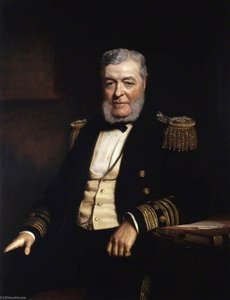
Stephen Pearce painted Alexander Stewart in 1854. This oil on canvas portrait measures 38 x 32 cm and is currently held in the collection of the National Portrait Gallery (United States).

Aktualizované november 2026 · zoradené podľa našej miery popularity (vyhľadávanie, návštevy a objednávky pre každou prácu) · 57 dielov umelca Štefan Pearce v našom katalógu
Stručne povedané
Alexander Stewart (1854) je obrazom od Štefan Pearce, ktorý priťahuje najviac pohľadov. Potom sa pohľad presunie na Robert Brown (1773–1858), DCL, LLD, FRS, PLS (1856) a "Antler" with Grey Petty (1840). Z 57 diel umelca Štefan Pearce v našom katalógu je týchto 56 najznámejších; každá z nich je jedinečným originálom prezentovaným s jeho rokom vzniku, múzeom a dôvodom, prečo pretrváva.
Stephen Pearce painted Alexander Stewart in 1854. This oil on canvas portrait measures 38 x 32 cm and is currently held in the collection of the National Portrait Gallery (United States).

The man stares directly through the veil of years, his gaze meeting the viewer with a heavy, unyielding seriousness. He sits in a space where the background has dissolved into a deep, indistinct darkness, leaving nothing to distract from the weight of his presence. This is Robert Brown, captured in a moment of quiet, intellectual intensity. The light falls from above and slightly to the left, carving out the contours…

In "Antler" with Grey Petty" by Stephen Pearce, a side profile view captures a large, muscular horse in a moment of stillness. A man stands beside the animal, his hands steady upon the lead. This formal presentation of a prized animal is rendered in a grayscale palette. Deep blacks define the horse's coat, while soft grays settle into the background. The scene is set against a minimalist, textured backdrop that…

Stephen Pearce executed this oil on millboard portrait of John Rae. The work was exhibited in 1853, appearing alongside other Arctic-related portraits during that year's Royal Academy exhibitions. It captures the likeness of Rae, a figure central to the mid-nineteenth-century maritime and exploratory interests of the era.

The oil on canvas depicts a man from the waist up, positioned in a three-quarter view against a dark, atmospheric background. He wears a heavy, dark coat with thick folds that suggest a coarse, insulating fabric. A rifle is held within the composition, its barrel and stock rendered with straight, defined lines. The lighting is directed toward the subject's face and the upper portion of his attire, creating a sharp…

This portrait, titled William Kennedy, was executed by the British artist Stephen Pearce in 1853. It presents a study of a man captured in profile, a choice that emphasizes the specific contours of his features and the quiet dignity of his posture. The work belongs to a period when Pearce was establishing his reputation for capturing the nuanced character of his sitters through a disciplined, academic approach.

This oil portrait of Sir Edward Augustus Inglefield, painted by Stephen Pearce, captures a man defined by the rigid geometry of his station. Executed in 1853, the work presents a naval or military official through the lens of academic realism. The subject is rendered in formal military attire, a costume of heavy fabric and structured lines that anchors him within the frame. Every medal and button serves as a quiet…

This oil painting, titled Sir William Edward Parry, was executed by the artist Stephen Pearce in 1850. The subject of the portrait is Sir William Edward Parry, a Royal Navy officer and explorer. The work presents the man in formal attire, capturing his likeness during a period of significant maritime activity. The portrait focuses on the upper body and face of the subject, presenting him in a frontal perspective.

The man sits in a quiet, commanding stillness, his gaze meeting the viewer with the weight of lived experience. He is rendered in a realistic style that feels immediate, as if the air in the room has just settled after his arrival. A single, soft light source emanates from the upper left, washing over his features and casting deep, sculptural shadows that define the contours of his face and the…

A single red rose rests against the dark, heavy folds of a gown. The subject, Emily Louise Shepherd, Countess Belmore, sits in a stillness that feels permanent. Her presence is defined by the deep black of her dress and the pale, delicate lace at her wrists. Light falls from above, catching the curve of a cheek and the subtle texture of her skin, while the rest of the room recedes…
 Robert McCormick1856 · National Portrait Gallery
12
 Stephen Pearce1860 · National Portrait Gallery
13
 Sir Horatio Thomas Austin1860 · National Portrait Gallery
14
 Rochfort Maguire1860 · National Portrait Gallery
15
 Sir (Francis) Leopold McClintock1859 · National Portrait Gallery
16
 HRH Henry Frederick (1745–1790), 1st Duke of Cumberland and Strathearn1884 · The Library And Museum of Freemasonry
17
 John Barrow (1764–1848)1846 · The Royal Society
18
 William Philip (1835–1897), 4th Earl of Sefton at Ashdown Park1864 · Walker Art Gallery
19
 Francúzsky (1754–1826), 2. earl z Moira, neskôr marquess Hastings, KG (kopia po Martine Archerovi Shee)1884 · The Library And Museum of Freemasonry
20
 Sherard Osborn1847 · National Portrait Gallery
21
 George Payne Rainsford James1846 · National Portrait Gallery
22
 Sir Francis Beaufort1850 · National Portrait Gallery
23
 Sir James Clark Ross1850 · National Portrait Gallery
24
 John Rae (1813–1893), Arctic Explorer1853 · Škótska národná galéria portrétov
25
 Frederick William Beechey1850 · National Portrait Gallery
26
 William Penny1853 · National Portrait Gallery
27
 Joseph René Bellot1851 · National Portrait Gallery
28
 William Alexander Baillie Hamilton1850 · National Portrait Gallery
29
 Sir John Richardson1850 · National Portrait Gallery
30
 Sir Richard Collinson1855 · National Portrait Gallery
31
 Sir Edward Sabine1850 · National Portrait Gallery
32
 Somerset Richard Lowry Corry (1835–1913), 4th Earl Belmore1857
33
 David Walker1860 · National Portrait Gallery
34
 Sir Henry Kellett1856 · National Portrait Gallery
35
 Thomas Edward Laws Moore1860 · National Portrait Gallery
36
 Sir (Francis) Leopold McClintock1859 · National Portrait Gallery
37
 Sir Roderick Impey Murchison, 1st Bt1856 · National Portrait Gallery
38
 Rear Admiral Sir Francis Beaufort (1774–1857)1856 · National Maritime Museum
39
 William Robert Hobson1860 · National Portrait Gallery
40
 Sir Edward Belcher1859 · National Portrait Gallery
41
 Sir Erasmus Ommanney1861 · National Portrait Gallery
42
 Daniel Robert Scratton of Prittlewell Priory, Essex1867
43
 William Seppings, Mayor (1848)1869
44
 Lord Kesteven on a Horse, with Hounds1871 · Usher Gallery
45
 Captain Sir James Clark Ross1871 · National Maritime Museum
46
 Sir George Henry Richards1865 · National Portrait Gallery
47
 Sir George Strong Nares1877 · National Portrait Gallery
48
 Edward Sabine (1788–1883)1855 · The Royal Society
49
 Sir Allen William Young1876 · National Portrait Gallery
50
 Philip Wykeham Martin, MP1880 · Guildhall Museum
51
 Sir Erasmus Wilson (1809–1884)1882
52
 Admiral John Lort Stokes (1812–1885)1879 · National Maritime Museum
53
 Benjamin Leigh Smith1886 · National Portrait Gallery
54
 John Franklin (1786–1847) (after Joseph Mathias Negelen)Scott Polar Research Institute
55
 Sir Edward Augustus Inglefield (copy after an original of c.1853 by the artist)
56
 The Arctic Council planning a search for Sir John Franklin1851 · National Portrait Gallery
Štyri témy, ktoré sa v týchto origináloch najčastejšie vracajú, každá s jej najvychybenejším príkladom.
8 múzeá, v ktorých sa nachádza najviac obrazov z tejto stránky.
| Múzeá | Mesto | Diela umelca Štefan Pearce | Obrazy z tohto zoznamu |
|---|---|---|---|
 National Portrait Gallery |
Londýn | 35 | John Rae, Sir Robert McClure, William Kennedy |
 National Maritime Museum |
Londýn | 3 | Rear Admiral Sir Francis Beaufort (1774–1857), Captain Sir James Clark Ross, Admiral John Lort Stokes (1812–1885) |
 The Library And Museum of Freemasonry |
London | 2 | HRH Henry Frederick (1745–1790), 1st Duke of Cumberland and Strathearn, Francúzsky (1754–1826), 2. earl z Moira, neskôr marquess Hastings, KG (kopia po Martine Archerovi Shee) |
 The Royal Society |
Londýn | 2 | John Barrow (1764–1848), Edward Sabine (1788–1883) |
 Collection of The Herbarium |
Richmond | 1 | Robert Brown (1773–1858), DCL, LLD, FRS, PLS |
 Royal Collection |
Londýn | 1 | "Antler" with Grey Petty |
 Walker Art Gallery |
Liverpool | 1 | William Philip (1835–1897), 4th Earl of Sefton at Ashdown Park |
 Škótska národná galéria portrétov |
Edinburgh | 1 | John Rae (1813–1893), Arctic Explorer |
Vyberte si dekádu a pozrite si originál, ktorý ju definuje.
In "Antler" with Grey Petty" by Stephen Pearce, a side profile view captures a large, muscular horse in a moment of stillness. A man stands beside the animal, his hands steady upon the lead. This formal presentation of a prized animal is rendered in a grayscale palette. Deep blacks define the horse's coat, while soft grays settle into the background. The scene is set against a minimalist, textured backdrop that…
Stephen Pearce painted Alexander Stewart in 1854. This oil on canvas portrait measures 38 x 32 cm and is currently held in the collection of the National Portrait Gallery (United States).

This formal portrait, titled Stephen Pearce, was executed by the artist Stephen Pearce in 1860. It presents a study of the subject in a three-quarter view, capturing the man with a sense of quiet dignity. The work belongs to the mid-Victorian period, a time when the artist was refining his ability to translate character through the medium of oil on canvas.


Alexander Stewart (1854). Nasledujú Robert Brown (1773–1858), DCL, LLD, FRS, PLS (1856) a "Antler" with Grey Petty (1840).
35 rokov: Alexander Stewart vzniklo v roku 1854 a Štefan Pearce sa narodil/a v roku 1819.
Alexander Stewart, Robert Brown (1773–1858), DCL, LLD, FRS, PLS, "Antler" with Grey Petty, John Rae, Sir Robert McClure, William Kennedy, Sir Edward Augustus Inglefield, Sir William Edward Parry, John Barrow a Emily Louise Shepherd (1814–1904), Countess Belmore. Vyššie uvedené hodnotenie uvádza rok a múzeu pre každé z nich.
Náš katalóg obsahuje 57 diel od umelca Štefan Pearce z perioda od 1840 do 1886.
Väčšinou v National Portrait Gallery (Londýn), National Maritime Museum (Londýn) a The Library And Museum of Freemasonry (London). Tabuľka múzeí vyššie ich všetky uvádza.
V období 1850s: 29 z 56 diel na tejto stránke bolo vytvorených vtedy, pričom Alexander Stewart z nich.
Na tejto stránke je najstaršie dielo z "Antler" with Grey Petty (1840) a najnovšie z Benjamin Leigh Smith (1886).
Portrait (9), Victorian era (9) a Formal attire (8), v rámci 56 diel na tejto stránke.
Oil On Canvas, pre 14 z 56 diel na tejto stránke.
Academic realism, podľa originálov na tejto stránke.
John Rae, Sir Robert McClure a William Kennedy: múzeá National Portrait Gallery, Londýn uchovávajú 35 z diel na tejto stránke.


