Portrét Robert Polhill Bevan

Obrazy umelca Robert Polhill Bevan: 100 najznámejších výtvarných diel prostretých pohľadom galérie

Aktualizované október 2026 · zoradené podľa našej miery popularity (vyhľadávanie, návštevy a objednávky pre každou prácu) · 106 dielov umelca Robert Polhill Bevan v našom katalógu

Stručne povedané

Z hľadiska galérie je najznámejším obrazom umelca Robert Polhill Bevan dielo From the Artist's Window (1915). Horse Dealers (Sale at Ward's Repository No.1) (1918) a Devonshire Valley, No. 2 (1913) dopĺňajú trojicu, ktorú pozná každé oko. Z 106 diel umelca Robert Polhill Bevan v našom katalógu prezentuje galéria nižšie 100 najznámejších, z ktorých je každá originál s uvedeným rokom vzniku, múzeom a unikátnosťou.

1865 – 1925, Hove Fauvism Najviac diel: Yale Center for British Art

Top 10 obrazov umelca Robert Polhill Bevan v galérii

1
From the Artist's Window (1915) od Robert Polhill Bevan

From the Artist's Window

1915 · Oil On Canvas

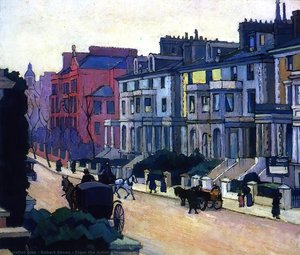
The city breathes through the narrow canyon of a street, captured from an elevated vantage point that feels intimate yet detached. High above the cobblestones, the world unfolds in a flurry of motion and shadow. Tall buildings line the thoroughfare, their verticality framing a scene of constant transit. Horses pull heavy carriages through the center of the frame, their strength palpable as they navigate the urban flow. A single horse…

2
Horse Dealers (Sale at Ward's Repository No.1) (1918) od Robert Polhill Bevan

Horse Dealers (Sale at Ward's Repository No.1)

1918 · Oil On Canvas

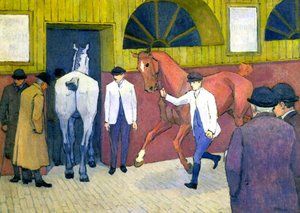
Horse Dealers (Sale at Ward's Repository No.1) is a work by the British artist Robert Bevan. Created about 1918, the piece emerged during a period of significant stylistic transition for the artist, who was a key figure in the development of modern British art. Bevan was a founding member of several influential collectives, including the Camden Town Group and the Fitzroy Street group, contributing to the evolution of early twentieth-century…

3
Devonshire Valley, No. 2 (1913) od Robert Polhill Bevan

Devonshire Valley, No. 2

1913 · Oil On Canvas

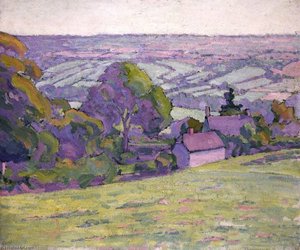
In the quietude of 1913, just before the world was irrevocably altered by the shadows of the Great War, Robert Polhill Bevan captured a moment of profound serenity in Devonshire Valley, No. 2. This exquisite oil on canvas serves as more than a mere landscape; it is an evocative portal into a lost era of English tranquility. The painting presents a sweeping, panoramic vista of a verdant valley, where rolling…

5
Queen's Grove, St John's Wood (1918) od Robert Polhill Bevan

Queen's Grove, St John's Wood

1918 · Oil On Canvas · The Ashmolean Museum of Art And Archaeology, Oxford

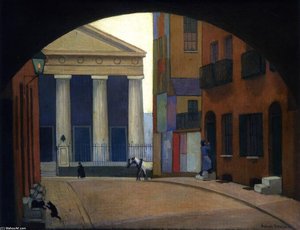
In the quiet, rhythmic pulse of 1918, Robert Bevan captured a moment of suspended animation in Queen's Grove, St John's Wood. This oil on canvas depicts a street scene where the horse-drawn carriage still shared the cobblestone streets with the whispers of a new century. The composition employs a deliberate flattening of perspective, inviting the viewer to step into a world that feels both intimately familiar and dreamily distant. There…

6
The Smithy, Szeliwy, No. 2 (1906) od Robert Polhill Bevan

The Smithy, Szeliwy, No. 2

1906 · Oil On Canvas

In the quiet corners of the early twentieth century, there existed a profound beauty in the rhythmic simplicity of village life, a sentiment captured with breathtaking tenderness in Robert Polhill Bevan’s 1906 masterpiece, The Smithy, Szeliwy, No. 2. This evocative oil on canvas serves as more than just a depiction of a landscape; it is a portal into a bygone era of communal harmony and pastoral grace. As the viewer…

Obrazy umelca Robert Polhill Bevan, usporiadané od 11 do 100

11A London Church (1922) od Robert Polhill BevanA London Church1922 12Stanislawa Bevan, née de Karlowska (1920) od Robert Polhill BevanStanislawa Bevan, née de Karlowska1920 · National Portrait Gallery 13Two Bridges (1912) od Robert Polhill BevanTwo Bridges1912 14The Hay Harvest (1916) od Robert Polhill BevanThe Hay Harvest1916 15Mare and Foal (1917) od Robert Polhill BevanMare and Foal1917 16The Caller at the Mill (1918) od Robert Polhill BevanThe Caller at the Mill1918 · Yale Center for British Art 17The Horse Mart (Barbican No. 1) (1917) od Robert Polhill BevanThe Horse Mart (Barbican No. 1)1917 · Yale Center for British Art 18Town Field, Horsgate (1914) od Robert Polhill BevanTown Field, Horsgate1914 19Self-Portrait (1913) od Robert Polhill BevanSelf-Portrait1913 · National Portrait Gallery 20Under the Hammer (1914) od Robert Polhill BevanUnder the Hammer1914 · Walker Art Gallery 21Hound at Attention (1895) od Robert Polhill BevanHound at Attention1895 22Threshing (1893) od Robert Polhill BevanThreshing1893 23The Forge, Pont Aven (1894) od Robert Polhill BevanThe Forge, Pont Aven1894 24The Carrosse, Poland (1903) od Robert Polhill BevanThe Carrosse, Poland1903 25The LIttle Villa (1901) od Robert Polhill BevanThe LIttle Villa1901 26Polish Tavern (1903) od Robert Polhill BevanPolish Tavern1903 27Morning over the Ploughed Fields (1904) od Robert Polhill BevanMorning over the Ploughed Fields1904 28The Gate at Szeliwy (1901) od Robert Polhill BevanThe Gate at Szeliwy1901 29The Well at Mydlow, Poland (1909) od Robert Polhill BevanThe Well at Mydlow, Poland1909 · Auckland Art Gallery Toi o Tāmaki 30The Turn Rice-Plough, Sussex (1909) od Robert Polhill BevanThe Turn Rice-Plough, Sussex1909 · Yale Center for British Art 31The Farmyard Gate, Evening (1907) od Robert Polhill BevanThe Farmyard Gate, Evening1907 32Grooming Horse (1909) od Robert Polhill BevanGrooming Horse1909 33Thirsty Cab Horse (1910) od Robert Polhill BevanThirsty Cab Horse1910 34The Yard Gate, Mydlow (1907) od Robert Polhill BevanThe Yard Gate, Mydlow1907 35The Cab Yard, Night (1910) od Robert Polhill BevanThe Cab Yard, Night1910 36Ploughing on the Downs (1907) od Robert Polhill BevanPloughing on the Downs1907 37Three Poplars and a Well (1908) od Robert Polhill BevanThree Poplars and a Well1908 38A Small Southdown Farm (1906) od Robert Polhill BevanA Small Southdown Farm1906 39Pod kladivom (1914) od Robert Polhill BevanPod kladivom1914 · Walker Art Gallery 40The Cab Horse (1910) od Robert Polhill BevanThe Cab Horse1910 41Mydlow Village, Poland (1907) od Robert Polhill BevanMydlow Village, Poland1907 42Woman from Moëlan cutting bread (1891) od Robert Polhill BevanWoman from Moëlan cutting bread1891 · Musée de Pont-Aven 43Whisky and Soda (1914) od Robert Polhill BevanWhisky and Soda1914 44Hay Carts, Cumberland Market (1915) od Robert Polhill BevanHay Carts, Cumberland Market1915 · Yale Center for British Art 45The Weigh House, Cumberland Market (1914) od Robert Polhill BevanThe Weigh House, Cumberland Market1914 · Yale Center for British Art 46Parade at Aldridge's (1914) od Robert Polhill BevanParade at Aldridge's1914 · Museum of Fine Arts 47Under the Hammer (1913) od Robert Polhill BevanUnder the Hammer1913 48The Farmhouse (1917) od Robert Polhill BevanThe Farmhouse1917 49Horse Sale at the Barbican (1912) od Robert Polhill BevanHorse Sale at the Barbican1912 50Robert Polhill Bevan (1914) od Robert Polhill BevanRobert Polhill Bevan1914 · National Portrait Gallery 51Maples at Cuckfield, Sussex (1914) od Robert Polhill BevanMaples at Cuckfield, Sussex1914 52Haze over the Valley (1913) od Robert Polhill BevanHaze over the Valley1913 53A Street Scene in Belsize Park, a House at Hampstead, London (1917) od Robert Polhill BevanA Street Scene in Belsize Park, a House at Hampstead, London1917 54Cumberland Market, North Side (1912) od Robert Polhill BevanCumberland Market, North Side1912 55Rosemary la vallée (1916) od Robert Polhill BevanRosemary la vallée1916 56The Ford (1918) od Robert Polhill BevanThe Ford1918 · Yale Center for British Art 57Adelaide Road, N.W. (1922) od Robert Polhill BevanAdelaide Road, N.W.1922 · Museum of Fine Arts 58Watering Cattle, Poland (1921) od Robert Polhill BevanWatering Cattle, Poland1921 59The Plantation (1919) od Robert Polhill BevanThe Plantation1919 60Near Hemyock (1918) od Robert Polhill BevanNear Hemyock1918 61Watering Horses, Poland (1921) od Robert Polhill BevanWatering Horses, Poland1921 62Green Devon (1919) od Robert Polhill BevanGreen Devon1919 63The Well at Mydlow, Poland (No.2) (1922) od Robert Polhill BevanThe Well at Mydlow, Poland (No.2)1922 · Scottish National Gallery of Modern Art 64Aldwych (1924) od Robert Polhill BevanAldwych1924 · Yale Center for British Art 65Village Houses at Szeliwy (1903) od Robert Polhill BevanVillage Houses at Szeliwy1903 66Hay Carts (1915) od Robert Polhill BevanHay Carts1915 67Evening in the Culme Valley (1912) od Robert Polhill BevanEvening in the Culme Valley1912 68Horse Sale at the Barbican (1912) od Robert Polhill BevanHorse Sale at the Barbican1912 · Tate Gallery 69Showing at Tattersalls (1919) od Robert Polhill BevanShowing at Tattersalls1919 · The Ashmolean Museum of Art And Archaeology 70Gravelye Farm, Cuckfield (1910) od Robert Polhill BevanGravelye Farm, Cuckfield1910 71Pod kladivom (1913) od Robert Polhill BevanPod kladivom1913 · Walker Art Gallery 72Sale at Tattersall's (1911) od Robert Polhill BevanSale at Tattersall's1911 73The Green House, St. John/'s Wood (1919) od Robert Polhill BevanThe Green House, St. John/'s Wood1919 · Art Gallery of South Australia 74Mount Stephen, Devon (1924) od Robert Polhill BevanMount Stephen, Devon1924 75Queen's Road, St. John's Wood (1918) od Robert Polhill BevanQueen's Road, St. John's Wood1918 · Ashmolean Museum 76The Chestnut Tree (1919) od Robert Polhill BevanThe Chestnut Tree1919 · The Ashmolean Museum of Art And Archaeology 77Ploughing on the Downs (1906) od Robert Polhill BevanPloughing on the Downs1906 78A Polish Church, Mydlow (1921) od Robert Polhill BevanA Polish Church, Mydlow1921 79Crocks (1922) od Robert Polhill BevanCrocks1922 80Brimley Hill (1916) od Robert Polhill BevanBrimley Hill1916 · Herbert Art Gallery - Museum 81Devonská dolina č. 1 (1913) od Robert Polhill BevanDevonská dolina č. 11913 · Royal Albert Memorial Museum 82The Well at Mydlow, Poland No. 2 (1922) od Robert Polhill BevanThe Well at Mydlow, Poland No. 21922 83Polífadlo Horsgate (1914) od Robert Polhill BevanPolífadlo Horsgate1914 · Reading Museum - Town Hall 84The Chestnut Tree (1916) od Robert Polhill BevanThe Chestnut Tree1916 · Ashmolean Museum 85Showing at Tattersall's (1919) od Robert Polhill BevanShowing at Tattersall's1919 · Ashmolean Museum 86Devon Cottage (1920) od Robert Polhill BevanDevon Cottage1920 87The Smithy at Szeliwy, Poland od Robert Polhill BevanThe Smithy at Szeliwy, PolandNárodná spoločnosť 88The Feathered Hat (1915) od Robert Polhill BevanThe Feathered Hat1915 89The Horse Mart (Barbican No. 2) (1918) od Robert Polhill BevanThe Horse Mart (Barbican No. 2)1918 90Cumberland Marker, North Side (1915) od Robert Polhill BevanCumberland Marker, North Side1915 91Timber Hauling (1918) od Robert Polhill BevanTimber Hauling1918 92Polish Landscape (1901) od Robert Polhill BevanPolish Landscape1901 · New Walk Museum - Art Gallery 93Polish Tavern (1903) od Robert Polhill BevanPolish Tavern1903 · Fitzwilliam Museum 94Meadows, Poland od Robert Polhill BevanMeadows, PolandNárodná spoločnosť 95Showing the Paces, Aldridges od Robert Polhill BevanShowing the Paces, Aldridges 96Farm Landscape od Robert Polhill BevanFarm Landscape 97Portrait of a Man Wearing Green Shirt and Tie against Striped Wall (Dickie) od Robert Polhill BevanPortrait of a Man Wearing Green Shirt and Tie against Striped Wall (Dickie) 98The Ash Tree od Robert Polhill BevanThe Ash Tree 99Near Applehayes (1913) od Robert Polhill BevanNear Applehayes1913 100Pozadie stodóły, Polska (1904) od Robert Polhill BevanPozadie stodóły, Polska1904 · Swindon Art Gallery

Slávne obrazy umelca Robert Polhill Bevan podľa jednotlivých období

Motívy, ktoré zaujali Robert Polhill Bevan

Štyri témy, ktoré sa v týchto origináloch najčastejšie vracajú, každá s jej najvychybenejším príkladom.

Múzeá, ktoré uchovávajú originály umelca Robert Polhill Bevan

8 múzeá, v ktorých sa nachádza najviac obrazov z tejto stránky.

Múzeá Mesto Diela umelca Robert Polhill Bevan Obrazy z tohto zoznamu
Yale Center for British Art, New HavenYale Center for British Art New Haven 9 "Quiet with all Road Nuisances", A Morning at Tattersall', The Caller at the Mill
The Ashmolean Museum of Art And Archaeology, OxfordThe Ashmolean Museum of Art And Archaeology Oxford 4 Queen's Grove, St John's Wood, Showing at Tattersalls, The Chestnut Tree
National Portrait Gallery, LondýnNational Portrait Gallery Londýn 3 Stanislawa Bevan, née de Karlowska, Self-Portrait, Robert Polhill Bevan
Walker Art Gallery, LiverpoolWalker Art Gallery Liverpool 3 Under the Hammer, Pod kladivom, Pod kladivom
Ashmolean Museum, OxfordAshmolean Museum Oxford 3 Queen's Road, St. John's Wood, The Chestnut Tree, Showing at Tattersall's
Museum of Fine Arts, BostonMuseum of Fine Arts Boston 2 Parade at Aldridge's, Adelaide Road, N.W.
Národná spoločnosť, LondýnNárodná spoločnosť Londýn 2 The Smithy at Szeliwy, Poland, Meadows, Poland
Alfred East Art Gallery, KetteringAlfred East Art Gallery Kettering 1 Landscape in the Blackdown Hills, Devon

Robert Polhill Bevan, jeden ikonický obraz na každé desaťročie

Diela podľa dekád

Vyberte si dekádu a pozrite si originál, ktorý ju definuje.

Obrazy umelca Robert Polhill Bevan: odpovede galérie

Ktorý obraz od Robert Polhill Bevan je najznámejší zo všetkých?Odhaľte odpoveď

From the Artist's Window (1915). Nasledujú Horse Dealers (Sale at Ward's Repository No.1) (1918) a Devonshire Valley, No. 2 (1913).

Koľko rokov mal/a Robert Polhill Bevan pri dokončeni diela From the Artist's Window?Odhaľte odpoveď

50 rokov: From the Artist's Window vzniklo v roku 1915 a Robert Polhill Bevan sa narodil/a v roku 1865.

Ktorých 10 najlepších obrazov má Robert Polhill Bevan?Odhaľte odpoveď

From the Artist's Window, Horse Dealers (Sale at Ward's Repository No.1), Devonshire Valley, No. 2, Landscape in the Blackdown Hills, Devon, Queen's Grove, St John's Wood, The Smithy, Szeliwy, No. 2, Ploughing, The Ploughing Team, Dawn, "Quiet with all Road Nuisances" a A Morning at Tattersall'. Vyššie uvedené hodnotenie uvádza rok a múzeu pre každé z nich.

Koľko diel vytvoril/a Robert Polhill Bevan?Odhaľte odpoveď

Náš katalóg obsahuje 106 diel od umelca Robert Polhill Bevan z perioda od 1891 do 1924.

Kde visia najznámejšie originály umelca Robert Polhill Bevan?Odhaľte odpoveď

Väčšinou v Yale Center for British Art (New Haven), The Ashmolean Museum of Art And Archaeology (Oxford) a National Portrait Gallery (Londýn). Tabuľka múzeí vyššie ich všetky uvádza.

Kedy vytvoril/a Robert Polhill Bevan svoje najznámejšie obrazy?Odhaľte odpoveď

V období 1910s: 55 z 100 diel na tejto stránke bolo vytvorených vtedy, pričom From the Artist's Window z nich.

Aké sú najskoršie a najneskoršie známe diela umelca Robert Polhill Bevan?Odhaľte odpoveď

Na tejto stránke je najstaršie dielo z Woman from Moëlan cutting bread (1891) a najnovšie z Aldwych (1924).

K akým témamam sa Robert Polhill Bevan najčastejšie vracia?Odhaľte odpoveď

Landscape (14), British art (13) a Early 20th century (9), v rámci 100 diel na tejto stránke.

V akom médiu tvoril/a Robert Polhill Bevan najčastejšie?Odhaľte odpoveď

Oil On Canvas, pre 23 z 100 diel na tejto stránke.

S ktorým smerom je spojený/á umenec Robert Polhill Bevan?Odhaľte odpoveď

Fauvism, podľa originálov na tejto stránke.

Aké originály umelca Robert Polhill Bevan má v zbierkach Yale Center for British Art?Odhaľte odpoveď

"Quiet with all Road Nuisances", A Morning at Tattersall' a The Caller at the Mill: múzeá Yale Center for British Art, New Haven uchovávajú 9 z diel na tejto stránke.

Robert Polhill Bevan: umelec

Robert Polhill Bevan (1865–1925): British painter & Camden Town Group founder

Robert Polhill Bevan, born in Hove in 1865, occupies a pivotal yet often understated position within the narrative of early 20th-century British art. Emerging from a Quaker background steeped in banking connections – his parents were Richard Alexander Bevan and Laura Maria Polhill – he defied conventional expectations to become a daring innovator, a key figure in the transition from Impressionism towards more radical explorations of color and form. His journey was one of constant experimentation, absorbing influences from across Europe while forging a distinctly personal artistic vision that would profoundly impact the development of modern art in Britain. Bevan’s early education at Westminster School of Art under Fred Brown provided a solid foundation, but it was his subsequent studies at the Académie Julian in Paris that truly ignited his creative spark. There, he encountered a constellation of rising stars – Paul Sérusier, Pierre Bonnard, Édouard Vuillard, and Maurice Denis – artists who were challenging academic conventions and embracing new approaches to painting. These encounters proved formative, exposing Bevan to the principles of synthetism and laying the groundwork for his future explorations.

Early Influences & Parisian Awakening

Bevan’s artistic sensibilities were profoundly shaped by his formative years in Paris. The Académie Julian served as a crucible for innovation, immersing him in the vibrant intellectual atmosphere of the Belle Époque and fostering connections with artists who championed groundbreaking ideas. He was particularly captivated by the work of Gauguin and Cézanne, whose expressive use of color and simplified forms resonated deeply within his artistic sensibilities. These encounters instilled in Bevan a conviction that art should transcend mere representation, prioritizing emotional impact and conveying subjective experience—a stance that would become central to his subsequent artistic endeavors. The influence of Brittany is undeniable; two significant journeys undertaken between 1890 and 1891 cemented his fascination with the region’s dramatic landscapes and bold chromatic palette. Observing Gauguin's pioneering approach to depicting indigenous cultures and simplifying forms captivated Bevan, prompting him to translate these principles into his own artistic practice. His sketchbook pages from this period—now housed in the Ashmolean Museum—offer invaluable insight into the genesis of his distinctive visual language.

The Fauvist Breakthrough & Divisionist Technique

Around 1904 Bevan embarked on a transformative path of experimentation with pure color, anticipating the emergence of Fauvism on the continent and marking a decisive break from Impressionistic conventions. His painting “Courtyard” exemplifies this audacious stylistic choice—a deliberate rejection of naturalistic hues in favor of vibrant, emotionally charged pigments—demonstrating a willingness to prioritize expressive intensity over accurate depiction. This bold move wasn’t merely aesthetic; it reflected Bevan's belief that color possessed inherent power to communicate emotion and convey psychological states—a conviction that would inform his artistic vision throughout his career. Furthermore, Bevan honed his technique by adopting divisionist or pointillist principles, evident in masterpieces such as “Ploughing on the Downs” and “The Chestnut Tree.” This meticulous method involved applying tiny dots of color onto a canvas surface, allowing for subtle blending effects and creating luminous textures—a stylistic innovation that distinguished Bevan from many of his contemporaries. He drew inspiration from masters like Velázquez and Goya, recognizing their masterful use of chiaroscuro and capturing the essence of human emotion through nuanced tonal variations.

Collective Artistic Endeavors & Recognition

Bevan’s artistic pursuits weren't confined to solitary contemplation; he actively engaged in collaborative projects that propelled him into the forefront of British modern art. He was a founding member of the Camden Town Group, alongside artists like Walter Sickert and Frank Auerbach, who sought to depict urban life with uncompromising honesty and expressive fervor—challenging academic traditions and forging a new visual language rooted in direct observation. This collective spirit extended to his involvement with the London Group and the Cumberland Market Group, fostering an exchange of ideas that enriched his artistic repertoire. Notably, Bevan joined Walter Sickert’s Fitzroy Street group in 1908, where he encountered encouragement from Sickert to explore themes of everyday life—a pivotal moment that steered Bevan towards a more socially conscious aesthetic. His membership in the New English Art Club and participation in exhibitions underscored his commitment to disseminating innovative artistic concepts and engaging with broader cultural dialogues.

Legacy & Enduring Influence

Robert Polhill Bevan’s contribution to British art history is undeniable, securing his place as a pioneer of Fauvist principles and shaping the trajectory of modern British painting. His landscapes—particularly those depicting Sussex and Brittany—remain celebrated for their luminous color palettes and expressive brushwork—capturing the spirit of rural life with remarkable sensitivity. Works like “In the Downs near Lewes” and “The Chestnut Tree” exemplify Bevan’s ability to convey both visual beauty and emotional resonance—a testament to his artistic mastery and enduring influence on subsequent generations of painters. A retrospective exhibition at Colnaghi’s in 1961 served as a crucial moment of recognition, solidifying Bevan's legacy and ensuring that his innovative spirit continues to inspire artists today. His unwavering dedication to experimentation and his profound engagement with the visual arts cemented his position as one of Britain’s foremost artistic figures—a visionary who dared to challenge conventions and forge a path toward a radically new aesthetic horizon.