Early Life and Career
Maurice de Vlaminck, born April 4th, 1876, in Paris, France, was shaped by a familial musical heritage – his father, a violinist hailing from Flanders, instilled in him an appreciation for melody and harmony, while his mother, originating from Lorraine, nurtured his passion for piano performance. This formative environment profoundly impacted his artistic sensibilities, fostering a sensitivity to color and rhythm that would characterize his entire oeuvre. He embarked on his artistic journey relatively late in life, around the age of twenty, eschewing formal training in favor of an instinctive and deeply personal approach to painting. Initially self-taught, Vlaminck honed his skills through tireless experimentation and observation, developing a distinctive style rooted in raw emotion and unfiltered perception.The Fauvist Movement and Artistic Style
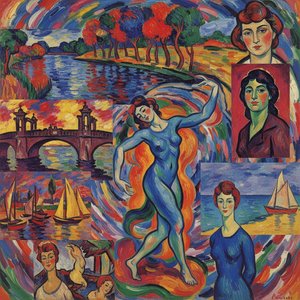
Maurice de Vlaminck stands as a cornerstone of the Fauvist movement (1904–1908), a revolutionary artistic endeavor that irrevocably altered the landscape of early 20th-century art. Alongside luminaries like André Derain and Henri Matisse, he formed an influential collective dedicated to dismantling established conventions and prioritizing expressive power above meticulous realism. The Fauves’ audacious embrace of color—bold, non-naturalistic hues deliberately deployed to convey emotion—became Vlaminck's signature aesthetic. His paintings pulsate with vibrant reds, yellows, and blues, reflecting the artist’s inner turmoil and capturing the immediacy of sensory experience. Characteristic of his style are:- Bold Color Choices: Vlaminck eschewed traditional color palettes, opting for intense shades that mirrored his emotional state rather than faithfully representing visual reality.
- Energetic Brushwork: Thick, visible brushstrokes dominate his canvases, conveying a palpable sense of dynamism and spontaneity—a deliberate rejection of Impressionistic diffusion in favor of forceful articulation.
- Simplified Forms: Vlaminck frequently reduced complex landscapes and objects to their essential shapes, prioritizing expressive impact over detailed depiction.
Influences and Artistic Development
Vlaminck's artistic vision was undeniably shaped by the legacy of Impressionism, particularly in its emphasis on capturing fleeting moments illuminated by sunlight—a technique he skillfully adapted to his own expressive aims. However, Vincent van Gogh exerted an unparalleled influence on Vlaminck’s artistic trajectory. After witnessing Van Gogh’s exhibition in Paris, Vlaminck famously declared his admiration for the artist's uncompromising honesty and emotional intensity, sentiments that resonated deeply within his own creative process. This kinship manifested itself in Vlaminck’s stylistic choices—the forceful brushstrokes and emotionally charged palette mirroring Van Gogh’s distinctive aesthetic. Furthermore, Cézanne’s geometric simplification of form served as a catalyst for Vlaminck's artistic evolution following 1908, prompting him to adopt a more monochromatic palette inspired by Cézanne’s exploration of tonal relationships.Major Achievements and Historical Significance
Vlaminck’s participation in the Salon des Refusés (1905) marked a pivotal moment in his career—a defiant rejection of artistic orthodoxy that solidified Fauvism's position as a vanguard movement challenging academic standards. His canvases, imbued with raw emotion and visceral energy, continue to captivate audiences today. Recognized for his pioneering use of color and brushwork, Vlaminck transcended stylistic boundaries, bridging the gap between Impressionism and Expressionism—a distinction that underscores his enduring contribution to modern art history. He remains celebrated as a visionary artist who dared to prioritize feeling over form, leaving an indelible mark on subsequent generations of painters.Legacy and Available Works
Today’s appreciation for Maurice de Vlaminck's artistic legacy stems from the profound impact of his groundbreaking style—a bold assertion of color and emotion that continues to inspire artists worldwide. His paintings—such as “Bougival” and “The Bridge at Chatou”—are housed in prestigious museums across Europe and America, offering visitors a glimpse into the artist’s singular vision. OriginalUniqueArt proudly presents reproductions of Vlaminck's iconic works, allowing enthusiasts to experience firsthand the vibrancy and expressive power of his Fauvist aesthetic.Otázky a odpovede
Kde a kedy sa narodil/a Maurice de Vlaminck?
Maurice de Vlaminck sa narodil v meste Paríž v roku 1876.
Môžem navštíviť virtuálne múzeum diel umelca Maurice de Vlaminck?
Diela umelca Maurice de Vlaminck si môžete pozrieť v 3D galérii na jeho stránke 3D múzeum.
Koľko umelých diel od Maurice de Vlaminck je možné si v katalógu prehliadnuť?
Na stránke Všetky diela si môžete prelistovať 208 umelých diel diel od umelca Maurice de Vlaminck.