Portrét Majster Mateo

44 najznámejších obrazov od umelca Majster Mateo, každý jedinečný

Aktualizované október 2026 · zoradené podľa našej miery popularity (vyhľadávanie, návštevy a objednávky pre každou prácu) · 44 dielov umelca Majster Mateo v našom katalógu

Stručne povedané

The disappeared façade at the end of the Camino (1211) je obrazom umelca Majster Mateo, ktorý priťahuje najviac pohľadov; originál sa nachádza v múzeu Katedrála sväteho Jakuba v Santiagu de Compostela – Muzeum, Santiago de Compostela. Potom sa pohľad presunie na Base of the mullion of the Portico of Glory (1188) a Trinity of the Portico of Glory (1188). Z 44 diel umelca Majster Mateo v našom katalógu je týchto 44 najznámejších; každá z nich je jedinečným originálom prezentovaným s jeho rokom vzniku, múzeom a dôvodom, prečo pretrváva.

1161 – 1217 Romanesque Najviac diel: Katedrála sväteho Jakuba v Santiagu de Compostela – Muzeum

Top 10 obrazov umelca Majster Mateo podľa výberu galérie

2
Base of the mullion of the Portico of Glory (1188) od Majster Mateo

Base of the mullion of the Portico of Glory

To stand before the Portico of Glory is to witness a profound shift in the language of stone. This specific base of the mullion, carved around 1188, offers a glimpse into the transition from the rigid forms of the Romanesque to a more fluid, naturalistic sensibility. Here, the stone does not merely exist; it breathes. The sculptor, Master Mateo, utilized a technique known as trabajo vivo, layering limestone to create…

3
Trinity of the Portico of Glory (1188) od Majster Mateo

Trinity of the Portico of Glory

Divine Presence in Stone The capital features God the Father holding the Christ child upon his lap. Above them, the Holy Spirit takes form as a dove at the peak of the composition. Angels surround these central figures, carrying incense burners to complete the celestial scene. This sculptural arrangement uses the trabajo vivo technique, layering stone slabs to create textures that mimic flesh and fabric. The result is a sense…

4
Statue-column of king David (1188) od Majster Mateo

Statue-column of king David

In the hallowed atmosphere of the Santiago Cathedral, where history and spirituality converge, stands a figure of profound majesty: the Statue-column of King David. Carved by the legendary Master Mateo around 1188, this Romanesque masterpiece is far more than a mere architectural ornament; it is a window into the soul of the twelfth century. The sculpture captures the biblical monarch in a moment of eternal resonance, seated upon a cross-frame…

5
The Glory, Central Arch, Portico of Glory (1211) od Majster Mateo

The Glory, Central Arch, Portico of Glory

The Glory, Central Arch, Portico of Glory is a sculptural work by Master Mateo. It forms a primary component of the Portico of Glory, located at the Cathedral of Santiago de Compostela in Spain. This specific section of the portal was part of a complete three-piece set that reached its conclusion in 1211. The work is currently held at The Catedral de Santiago Foundation in Santiago de Compostela.

6
The Elders holding instruments, Central Arch, Portico of Glory (1211) od Majster Mateo

The Elders holding instruments, Central Arch, Portico of Glory

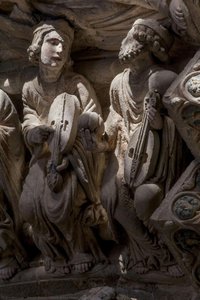
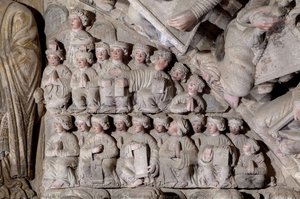
Within the sacred shadows of the Portico of Glory, a profound scene unfolds in stone. The Elders holding instruments, Central Arch, Portico of Glory emerges from the limestone, appearing as if caught in a moment of eternal preparation. This work, created by the hands of Master Mateo, brings the figures of the Apocalypse into a tangible, breathing presence. They sit amidst the radial archivolts, their bodies leaning toward one another…

8
Saint Matthew, Central Arch, Portico of Glory (1211) od Majster Mateo

Saint Matthew, Central Arch, Portico of Glory

The stone breathes under the soft, diffuse light of the cathedral, revealing a figure caught in a moment of eternal devotion. Here, within the central arch of the Portico of Glory, Saint Matthew sits with a quiet, heavy presence. He is a winged presence, his form emerging from the granite with a startling sense of life. He leans over a desk, his knees supporting the weight of his task, as…

9
Saint Luke, Central Arch, Portico of Glory (1211) od Majster Mateo

Saint Luke, Central Arch, Portico of Glory

The limestone relief of Saint Luke, carved around 1211, occupies a central position within the Portico of Glory at the Cathedral of Santiago de Compostela in Spain. The figure is depicted reclining on his right side, a posture that suggests both physical repose and deep introspection. In his left hand, he holds a book, while his head rests upon a lamb, a direct reference to his role as an Evangelist…

10
Arma Christi, Central Arch, Portico of Glory (1211) od Majster Mateo

Arma Christi, Central Arch, Portico of Glory

The relief known as Arma Christi, Central Arch, Portico of Glory is a sculptural work by the artist Master Mateo. This specific piece is situated within the Central Arch of the Portico of Glory. It was created in 1211. The work is part of a larger architectural and sculptural program located at the Santiago de Compostela Cathedral in Galicia, Spain.

Slávne obrazy umelca Majster Mateo, čísla 11 až 44

11Santo dos Croques of the Portico of Glory (1200) od Majster MateoSanto dos Croques of the Portico of Glory1200 · Katedrála sväteho Jakuba v Santiagu de Compostela – Muzeum 12Saint Matthew (1200) od Majster MateoSaint Matthew1200 · Katedrála sväteho Jakuba v Santiagu de Compostela – Muzeum 13Statues of David and Solomon (1188) od Majster MateoStatues of David and Solomon1188 · Katedrála sväteho Jakuba v Santiagu de Compostela – Muzeum 14Portico de la Gloria (1168) od Majster MateoPortico de la Gloria1168 · Cathedral 15Portico de la Gloria (detail) (1168) od Majster MateoPortico de la Gloria (detail)1168 · Cathedral 16Portico de la Gloria (1168) od Majster MateoPortico de la Gloria1168 · Cathedral 17Portico de la Gloria (detail) (1168) od Majster MateoPortico de la Gloria (detail)1168 · Cathedral 18Right arch of the Portico of Glory. Iconography of the condemned (1188) od Majster MateoRight arch of the Portico of Glory. Iconography of the condemned1188 · Katedrála sväteho Jakuba v Santiagu de Compostela – Muzeum 19Right arch of the Portico of Glory (1188) od Majster MateoRight arch of the Portico of Glory1188 · Katedrála sväteho Jakuba v Santiagu de Compostela – Muzeum 20Left arch of the Portico of Glory (1188) od Majster MateoLeft arch of the Portico of Glory1188 · Katedrála sväteho Jakuba v Santiagu de Compostela – Muzeum 21Right columns of the central arch of the Portico of Gloryh (1188) od Majster MateoRight columns of the central arch of the Portico of Gloryh1188 · Katedrála sväteho Jakuba v Santiagu de Compostela – Muzeum 22Saint Marcus, Central Arch, Portico of Glory (1211) od Majster MateoSaint Marcus, Central Arch, Portico of Glory1211 · Katedrála sväteho Jakuba v Santiagu de Compostela – Muzeum 23Saint John, Central Arch, Portico of Glory (1211) od Majster MateoSaint John, Central Arch, Portico of Glory1211 · Katedrála sväteho Jakuba v Santiagu de Compostela – Muzeum 24Ordo Prophetarum, The counter facade, Portico of Glory (1211) od Majster MateoOrdo Prophetarum, The counter facade, Portico of Glory1211 · Katedrála sväteho Jakuba v Santiagu de Compostela – Muzeum 25The Sybil, The counter facade, Portico of Glory (1211) od Majster MateoThe Sybil, The counter facade, Portico of Glory1211 · Katedrála sväteho Jakuba v Santiagu de Compostela – Muzeum 26Right arch of the Portico of Glory. Iconography of the blessed (1211) od Majster MateoRight arch of the Portico of Glory. Iconography of the blessed1211 · Katedrála sväteho Jakuba v Santiagu de Compostela – Muzeum 27Detail of the Elders, Central Arch, Portico of Glory (1211) od Majster MateoDetail of the Elders, Central Arch, Portico of Glory1211 · Katedrála sväteho Jakuba v Santiagu de Compostela – Muzeum 28Tribune of Portico of Glory (1211) od Majster MateoTribune of Portico of Glory1211 · Katedrála sväteho Jakuba v Santiagu de Compostela – Muzeum 29Angels, The Tribune, Portico of Glory (1211) od Majster MateoAngels, The Tribune, Portico of Glory1211 · Katedrála sväteho Jakuba v Santiagu de Compostela – Muzeum 30Portico of Glory (1211) od Majster MateoPortico of Glory1211 · Katedrála sväteho Jakuba v Santiagu de Compostela – Muzeum 31Keystones from Portico of the Glory (1211) od Majster MateoKeystones from Portico of the Glory1211 · Katedrála sväteho Jakuba v Santiagu de Compostela – Muzeum 32Detail Maiestas Domini of The Portico of Glory (1211) od Majster MateoDetail Maiestas Domini of The Portico of Glory1211 · Katedrála sväteho Jakuba v Santiagu de Compostela – Muzeum 33Arma Christi, Central Arch, Portico of Glory (1211) od Majster MateoArma Christi, Central Arch, Portico of Glory1211 · Katedrála sväteho Jakuba v Santiagu de Compostela – Muzeum 34The Just, Central Arch, Portico of Glory (1211) od Majster MateoThe Just, Central Arch, Portico of Glory1211 · Katedrála sväteho Jakuba v Santiagu de Compostela – Muzeum 35Detail of the Elders, Central Arch, Portico of Glory (1211) od Majster MateoDetail of the Elders, Central Arch, Portico of Glory1211 · Katedrála sväteho Jakuba v Santiagu de Compostela – Muzeum 36Detail of the Blessed, Central Arch, Portico of Glory (1211) od Majster MateoDetail of the Blessed, Central Arch, Portico of Glory1211 · Katedrála sväteho Jakuba v Santiagu de Compostela – Muzeum 37Central Arch of The Portico of Glory (1211) od Majster MateoCentral Arch of The Portico of Glory1211 · Katedrála sväteho Jakuba v Santiagu de Compostela – Muzeum 38Organistrum, Central Arch, Portico of Glory (1211) od Majster MateoOrganistrum, Central Arch, Portico of Glory1211 · Katedrála sväteho Jakuba v Santiagu de Compostela – Muzeum 39Drawing José Vega y Verdugo (1656-1657) Archivo de la Catedral (1657) od Majster MateoDrawing José Vega y Verdugo (1656-1657) Archivo de la Catedral1657 · Katedrála sväteho Jakuba v Santiagu de Compostela – Muzeum 40Left arch of the Portico of Glory. Iconography (1188) od Majster MateoLeft arch of the Portico of Glory. Iconography1188 · Katedrála sväteho Jakuba v Santiagu de Compostela – Muzeum 41Estatuas-columna de dos profetas procedentes de la desaparecida fachada exterior del Pórtico de la Gloria\n\n- Isaac (1188) od Majster MateoEstatuas-columna de dos profetas procedentes de la desaparecida fachada exterior del Pórtico de la Gloria\n\n- Isaac1188 · Katedrála sväteho Jakuba v Santiagu de Compostela – Muzeum 42Rose window (1200) od Majster MateoRose window1200 · Katedrála sväteho Jakuba v Santiagu de Compostela – Muzeum 43Stony choir reconstruction (1211) od Majster MateoStony choir reconstruction1211 · Katedrála sväteho Jakuba v Santiagu de Compostela – Muzeum 44Lintels Central Arch of The Portico of Glory (1188) od Majster MateoLintels Central Arch of The Portico of Glory1188 · Katedrála sväteho Jakuba v Santiagu de Compostela – Muzeum

Motívy, ktoré zaujali Majster Mateo

Štyri témy, ktoré sa v týchto origináloch najčastejšie vracajú, každá s jej najvychybenejším príkladom.

Múzeá, ktoré uchovávajú originály umelca Majster Mateo

2 múzeá, v ktorých sa nachádza najviac obrazov z tejto stránky.

Múzeá Mesto Diela umelca Majster Mateo Obrazy z tohto zoznamu
Katedrála sväteho Jakuba v Santiagu de Compostela – Muzeum, Santiago de CompostelaKatedrála sväteho Jakuba v Santiagu de Compostela – Muzeum Santiago de Compostela 40 The disappeared façade at the end of the Camino, Base of the mullion of the Portico of Glory, Trinity of the Portico of Glory
Cathedral, Santiago de CompostelaCathedral Santiago de Compostela 4 Portico de la Gloria, Portico de la Gloria (detail), Portico de la Gloria

Majster Mateo naprieč dekádami: jeden jedinečný originál pre každý

Diela podľa dekád

Vyberte si dekádu a pozrite si originál, ktorý ju definuje.

Obrazy umelca Majster Mateo: otázky pre galériu

Akým najznámejším dielom sa pýta Majster Mateo?Odhaľte odpoveď

The disappeared façade at the end of the Camino (1211), Katedrála sväteho Jakuba v Santiagu de Compostela – Muzeum, Santiago de Compostela. Nasledujú Base of the mullion of the Portico of Glory (1188) a Trinity of the Portico of Glory (1188).

V akom veku vytvoril/a Majster Mateo dielo The disappeared façade at the end of the Camino?Odhaľte odpoveď

50 rokov: The disappeared façade at the end of the Camino vzniklo v roku 1211 a Majster Mateo sa narodil/a v roku 1161.

Ktorých desať obrazov Majster Mateo je najznámejších?Odhaľte odpoveď

The disappeared façade at the end of the Camino, Base of the mullion of the Portico of Glory, Trinity of the Portico of Glory, Statue-column of king David, The Glory, Central Arch, Portico of Glory, The Elders holding instruments, Central Arch, Portico of Glory, Voussoirs with the punishment of lust, Saint Matthew, Central Arch, Portico of Glory, Saint Luke, Central Arch, Portico of Glory a Arma Christi, Central Arch, Portico of Glory. Vyššie uvedené hodnotenie uvádza rok a múzeu pre každé z nich.

Koľko je známych diel umelca Majster Mateo?Odhaľte odpoveď

Náš katalóg obsahuje 44 diel od umelca Majster Mateo z perioda od 1188 do 1211.

Kde možno vidieť najznámejšie originály od Majster Mateo?Odhaľte odpoveď

Väčšinou v Katedrála sväteho Jakuba v Santiagu de Compostela – Muzeum (Santiago de Compostela) a Cathedral (Santiago de Compostela). Tabuľka múzeí vyššie ich všetky uvádza.

V akom období vytvoril/a Majster Mateo svoje najznámejšie obrazy?Odhaľte odpoveď

V období 1210s: 24 z 44 diel na tejto stránke bolo vytvorených vtedy, pričom The disappeared façade at the end of the Camino z nich.

Ktorý z najslávnejších obrazov autora Majster Mateo je najstarší a ktorý najnovší?Odhaľte odpoveď

Na tejto stránke je najstaršie dielo z Base of the mullion of the Portico of Glory (1188) a najnovšie z The disappeared façade at the end of the Camino (1211).

Aké témy obľúbené Majster Mateo?Odhaľte odpoveď

Sculpture (6), Medieval art (5) a Stone (4), v rámci 44 diel na tejto stránke.

S akými materiálmi mal(a) Majster Mateo najčastejšie pracuje?Odhaľte odpoveď

Stone, pre 11 z 44 diel na tejto stránke.

Do ktorého smeru patrí tvorba umelca Majster Mateo?Odhaľte odpoveď

Romanesque, podľa originálov na tejto stránke.

Aké originály od Majster Mateo môžem vidieť v Katedrála sväteho Jakuba v Santiagu de Compostela – Muzeum?Odhaľte odpoveď

The disappeared façade at the end of the Camino, Base of the mullion of the Portico of Glory a Trinity of the Portico of Glory: múzeá Katedrála sväteho Jakuba v Santiagu de Compostela – Muzeum, Santiago de Compostela uchovávajú 40 z diel na tejto stránke.

Majster Mateo: portrét umelca

Duša slávy Santiago

Majster Mateo, sochač, ktorého meno zostáva zahalené mystikou napriek jeho monumentálnemu prínosu k Katedrále v Santiago de Compostela, stojí ako jedna z najuznávanějších postáv románskeho umenia v Španelsku. Narodený okolo roku 1161 v Galícii, hoci presné detaily o jeho živote sú vzácne, Mateova stopa sa opiera primárne o jeho bezprecedentný umelecký výkon: Portico de la Gloria. Tento úchvatný architektonický zázrak dominuje fasáde katedrály a zosobsobuje duchovný žiarivý elán dvanásteho storočia. Ako sochač vystúpil v období poznačenom vášnivou náboženskou oddanosťou a umeleckou inováciou, vstupujúc do sveta, kde pútnická cesta do Santiago bola už transformatívnou cestou pre tisíce duší.
Zrod jeho najväčšieho diela sa začal okolo roku 1188, keď mu bolo zverené dohliadanie nad vytvorením trojbrán, ktorá sa stala jeho magnum opus. Samotný projekt Katedrály bol koncipovaný už desiatky rokov predtým, poháňaný kráľom Alfonsom VIII a napájaný nesmiernym náboženským významom tohto miesta. V tomto posvätnom kontexte Mateo len nehrebal kameň; on doň vdechoval život. Jeho účasť na Portico de la Adamant bola božským poslaním, ktoré premenilo štrukturálnu nevyhnutnosť na teologický naratív, ktorý naďalej pútava pútnikov aj umedleckých historikov.

Symfónia v kameni: Technika a štýl

Mateovo sochárske štýl je charakterizovaný pozoruhodným realizmom, ktorý predstavoval hlboký odklon od skôrších, rigidnejších románskych konvencií. Zatiaľ čo jeho súčasníci sa často spoliehali na stylizované, ploché postavy, Mateo dôsledne študoval ľudskú anatómiu a komplexné správanie záhybov textílie, čím dosiahol údivnú presnosť vo svojich zobrazeniach. Jeho majstrovstvo v rezbávaní vápencov bolo bezprecedentné, najmä vďaka použitiu techniky známej ako trabajo vivo. Táto metóda zahŕňala vrstvenie kamenných plochí na vytvorenie textúrovaných povrchov, ktoré napodobňovali vzhľad tela a látky, čím dodávali statickému médiu pocit pohybu a vitality.

Tento inovatívny prístup mu umožnil premostiť priepasť medzi pozemským a božským. Pri pozorovaní jeho práce možno vidieť, ako majstrovsky využíval svetlo a tieň na zvýraznenie hĺbky svojich reliéfov. Jeho schopnosť manipulovať s kameňom tak, aby naznačil jemnosť svätovej róby alebo svalové napätie biblickej postavy, pozdvihla jeho remeslo na úroveň sofistikovanosti, ktorá sa v stredoveku len zriedka objavila. Táto technická brilancia zabezpečila, že jeho postavy neboli len symbolmi, ale hmatateľnými prítomnosťami v samotnom vstupe do katedrály.

Portico de la Gloria: Svedectectvo viery

Portico de la Gloria slúži ako konečné svedectectvo Mateovej umeleckej a duchovnej vízie. Jeho stredné panely zobrazujú hlboké scény z evanjelií – vrátane Narodenia Pána, Zvestovania a ukrižovania – usporiadané tak, aby vodili diváka cez posvätnú históriu. Ikonografia je rozmanitá a komplexná a obsahuje:

  • Centrálny oblúk: s ikonickými postavami, ako je svätý Lukáš, kde intrikatná románska sochárstvo vykazuje hlboký náboženský symbolizmus.
  • Ľavý oblúk: majstrovské dielo španielskeho reliéfneho rezbávania z 12. storočia, prezentujúce detailné biblické naratívy.
  • Pravý oblúk: vystavovanie intriky krásy, ktoré demonštruje jeho schopnosť zvládať komplexnú architektonickú a sochársku integráciu.

Prostredníctvom týchto diel dosiahol Majster Mateo úroveň historického významu, ktorá presahuje éru jeho narodenia. Premenil románsky štýl smerom k rozkvitajúcej elegancii gotiky a zanechal po sebe odkaz, ktorý zostáva srdcom mesta Santiago de Compostela. Jeho dielo stojí ako trvalý most medzi stredovečnou myšlenkou a večnosťou, čím zabezpečuje, že aj stáročia po jeho smrti v roku 1217 pokračuje sláva jeho kamenná symfónia v budení údivu.