Portrét Jan Miel

71 najznámejších obrazov od umelca Jan Miel, každý jedinečný

Aktualizované november 2026 · zoradené podľa našej miery popularity (vyhľadávanie, návštevy a objednávky pre každou prácu) · 71 dielov umelca Jan Miel v našom katalógu

Stručne povedané

Scene from the Life of Tramps (Lazzaroni) (1650) je obrazom umelca Jan Miel, ktorý priťahuje najviac pohľadov; originál sa nachádza v múzeu Hermitáž, Petrohrad. Potom sa pohľad presunie na Hunters at Rest (1650) a Carnival Entertainment (1635). Z 71 diel umelca Jan Miel v našom katalógu je týchto 71 najznámejších; každá z nich je jedinečným originálom prezentovaným s jeho rokom vzniku, múzeom a dôvodom, prečo pretrváva.

1599 – 1663, Beveren Baroque Najviac diel: Hermitáž

Top 10 obrazov umelca Jan Miel podľa výberu galérie

1
Scene from the Life of Tramps (Lazzaroni) (1650) od Jan Miel

Scene from the Life of Tramps (Lazzaroni)

1650 · Oil On Canvas · Hermitáž, Petrohrad

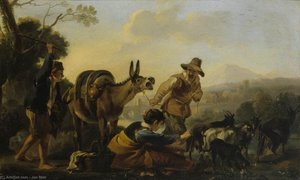
A heavy, ochre light settles over the crumbling stone of ancient ruins. Here, the shadows are thick and deep, swallowing the corners of a chaotic street scene. Figures move through the haze of smoke and dust, their bodies caught in a sudden, sharp glare of sun. A man gestures with urgency, his hands carving shapes into the air, while others sit in the dirt, anchored by the weight of their…

2
Hunters at Rest (1650) od Jan Miel

Hunters at Rest

1650 · Oil On Canvas · Hermitáž, Petrohrad

is an oil on canvas painting by the Flemish artist Jan Miel. Created about 1650, the work captures a quiet moment within a pastoral scene. It depicts a hunting party finding respite amidst the landscape. The scene is anchored by the presence of horses and the sturdy silhouette of a fortified tower.

3
Carnival Entertainment (1635) od Jan Miel

Carnival Entertainment

1635 · Oil On Canvas · Bavarské štátne múzeá výtvarného umenia, Mních

In "Carnival Entertainment" by Jan Miel, we find ourselves amidst a dense and dynamic urban scene. The composition is crowded, capturing a street festival where a large group of figures occupies the foreground and middle ground. These individuals—musicians, dancers, and various onlookers—are arranged to create a sense of constant movement. The perspective is a ground-level view, which provides a palpable sense of depth through the careful layering of people and…

4
Sine Cerere et Baccho Friget Venus (1645) od Jan Miel

Sine Cerere et Baccho Friget Venus

1645 · Oil

The oil painting titled Sine Cerere et Baccho Friget Venus presents a mythological scene of abundance. Jan Miel rendered this work in 1645. It captures a moment where classical deities gather amidst the symbols of harvest and intoxication. The figures exist within a lush, Baroque-style arrangement of life and plenty.

5
The Veneration of St. Lambert (1648) od Jan Miel

The Veneration of St. Lambert

1648 · Oil On Canvas · Fitzwilliam Museum

The air in the grand, classical space feels heavy with the scent of incense and the weight of sudden grief. In the center of this dramatic scene, St. Lambert lies in repose, his body a pale, still anchor amidst a sea of movement. Above him, the celestial realm breaks through the gloom; an angel descends with fluid, sweeping drapery that seems to catch a wind from another world. The light…

6
Soothsayer at an inn (1644) od Jan Miel

Soothsayer at an inn

1644 · Oil

The air at the roadside inn feels heavy with the scent of dust and old stone. Under a rugged stone archway, a group of travelers huddles in a moment of quiet tension. A woman in a garment of lapis blue leans toward a man, her presence a cool contrast to the earthy ochre and deep crimson that define the crowd. He is the soothsayer, a figure caught in the flickering…

7
Two hunters resting in a landscape (the standing hunter is a woman in men's clothes) (1639) od Jan Miel

Two hunters resting in a landscape (the standing hunter is a woman in men's clothes)

1639 · Oil On Canvas · New York Historical Society, New York

The scene unfolds within the oil on canvas work titled Two hunters resting in a landscape (the standing hunter is a woman in men's clothes). This composition emerges from the hand of Jan Miel, a painter who brings a sense of immediate life to the quietude of the hunt. The work is dated 1639, capturing a specific moment of stillness amidst the natural world.

8
Three peasants having fun with music and dance (1639) od Jan Miel

Three peasants having fun with music and dance

1639 · Oil On Panel · Rafael Valls Limited, City of Westminster

Three peasants having fun with music and dance by Jan Miel presents a lively genre scene centered on three figures engaged in rhythmic activity. The composition is dynamic, utilizing an intimate perspective that places the viewer in close proximity to the subjects. Within this shallow space, the central figure is captured mid-motion, a choice that establishes a sense of rhythmic movement throughout the scene. To the left of the main…

9
The Travelers' Dinner. Peasants Eating Near an Inn or Resting (1650) od Jan Miel

The Travelers' Dinner. Peasants Eating Near an Inn or Resting

1650 · Oil On Canvas

The Travelers' Dinner. Peasants Eating Near an Inn or Resting is a genre painting by Jan Miel. This work emerged around 1650, a period when the artist was active within the artistic circles of the seventeenth century. The canvas captures a specific slice of rural life through the eyes of a painter who understood the weight of stone and the texture of coarse cloth.

10
An Italianate Landscape with Peasants Dancing (1650) od Jan Miel

An Italianate Landscape with Peasants Dancing

1650 · Oil On Canvas · Nostell Priory, Wakefield

We are looking at An Italianate Landscape with Peasants Dancing, a work by Jan Miel. This piece dates to about 1650, a period when the artist was deeply engaged with the stylistic shifts occurring within the Italian Baroque. It is a significant example of how Miel navigated the transition from the gritty, everyday observations of the Bamboccianti to more expansive, classical compositions.

Slávne obrazy umelca Jan Miel, čísla 11 až 71

11Falcon hunters in front of an inn in a ruin (1650) od Jan MielFalcon hunters in front of an inn in a ruin1650 12The beggar (1650) od Jan MielThe beggar1650 13Barber and roulette players (1650) od Jan MielBarber and roulette players1650 14Military resting with a fortune teller (1650) od Jan MielMilitary resting with a fortune teller1650 15Carnival parade in Rome (1660) od Jan MielCarnival parade in Rome1660 16Hannibal's dream (1661) od Jan MielHannibal's dream1661 17Figures in the vicinity of architectural ruins (1650) od Jan MielFigures in the vicinity of architectural ruins1650 18The gathering of the hunters (1660) od Jan MielThe gathering of the hunters1660 · Galleria Sabauda 19Boar hunt (1660) od Jan MielBoar hunt1660 · Palác Venaria Reale 20Bear hunt (1659) od Jan MielBear hunt1659 · Palác Venaria Reale 21Diana the Huntress (1658) od Jan MielDiana the Huntress1658 · Palác Venaria Reale 22Adoration of the Shepherds (1650) od Jan MielAdoration of the Shepherds1650 · Pushkin State Museum 23Serenade with dancers and musician (1650) od Jan MielSerenade with dancers and musician1650 24The Race of the Berber Horses in Rome (1664) od Jan MielThe Race of the Berber Horses in Rome1664 25Traveling theatre (1700) od Jan MielTraveling theatre1700 26Harbour (1652) od Jan MielHarbour1652 · Hermitáž 27La curea - curée - con corte Regale, Carlo Emanuele II e Franesca d (1661) od Jan MielLa curea - curée - con corte Regale, Carlo Emanuele II e Franesca d1661 · Palác Venaria Reale 28Dance in the Trattoria (1647) od Jan MielDance in the Trattoria1647 · Academy of Fine Arts Vienna 29LE BARBIER NAPOLITAIN od Jan MielLE BARBIER NAPOLITAINLouvre 30St John the Baptist Preaching in the Desert od Jan MielSt John the Baptist Preaching in the DesertNárodné múzeum 31The Arch of Constantine in Rome (1648) od Jan MielThe Arch of Constantine in Rome1648 · Barber Institute of Fine Arts 32Scene in front of a tavern (1638) od Jan MielScene in front of a tavern1638 · Národné múzeum vo Varšave 33Figures Feasting at a Fair in Prati, Outside the Walls of Rome, with the Saint Peter's Basilica and Monte Mario Beyond (1650) od Jan MielFigures Feasting at a Fair in Prati, Outside the Walls of Rome, with the Saint Peter's Basilica and Monte Mario Beyond1650 34Deer hunt (1661) od Jan MielDeer hunt1661 · Palác Venaria Reale 35The death of the deer (1660) od Jan MielThe death of the deer1660 · Palác Venaria Reale 36The Courtyard of Palazzo Nardini in Rome (1650) od Jan MielThe Courtyard of Palazzo Nardini in Rome1650 · Palazzo Barberini 37Hunters at Rest od Jan MielHunters at RestMuseo del Prado 38Architectural Landscape (1638) od Jan MielArchitectural Landscape1638 · Hermitáž 39Carnival Time in Rome (1653) od Jan MielCarnival Time in Rome1653 · Museo del Prado 40The snack od Jan MielThe snackMuseo del Prado 41Cottage with inhabitants od Jan MielCottage with inhabitantsMuseo del Prado 42The local Barber od Jan MielThe local BarberMuseo del Prado 43Popular scene od Jan MielPopular sceneMuseo del Prado 44The Flight into Egypt od Jan MielThe Flight into EgyptStatens Museum For Kunst 45Soldiers Resting od Jan MielSoldiers RestingNárodné múzeum 46Peasants Resting od Jan MielPeasants RestingNárodné múzeum 47Hunters Resting od Jan MielHunters RestingNárodné múzeum 48Fox hunting od Jan MielFox huntingPalác Venaria Reale 49Jugglers passing – Carnival od Jan MielJugglers passing – CarnivalNárodné múzeum vo Varšave 50MARCHAND D'ESCARGOTS od Jan MielMARCHAND D'ESCARGOTS 51Road in the Roman Campagna od Jan MielRoad in the Roman CampagnaHermitáž 52PAYSAGE AVEC FIGURES od Jan MielPAYSAGE AVEC FIGURES 53Maraudeurs italiens Une halte (autre titre) od Jan MielMaraudeurs italiens Une halte (autre titre) 54Pastorale avec bergère endormie od Jan MielPastorale avec bergère endormie 55The fugitive Erminia asks a fellow countryman for admission od Jan MielThe fugitive Erminia asks a fellow countryman for admission 56Schádzanie (1660) od Jan MielSchádzanie1660 · Château de Versailles 57The vihuela player od Jan MielThe vihuela playerMuseo del Prado 58LA DINEE DES VOYAGEURS od Jan MielLA DINEE DES VOYAGEURSLouvre 59Genre Scene (1650) od Jan MielGenre Scene1650 · Hermitáž 60Landscape with herders od Jan MielLandscape with herdersMuseo del Prado 61LA HALTE MILITAIRE od Jan MielLA HALTE MILITAIRELouvre 62Landscape with a Battle between Two Rams (1640) od Jan MielLandscape with a Battle between Two Rams1640 · Metropolitné múzeum umenia 63Hunters at Rest od Jan MielHunters at RestHermitáž 64Shepherds and herd in a mountainous landscape od Jan MielShepherds and herd in a mountainous landscapeMusée Calvet 65Carnival in the Piazza Colonna, Rome od Jan MielCarnival in the Piazza Colonna, RomeWadsworth Atheneum 66Roman Lime Kiln with Peasants Gambling od Jan MielRoman Lime Kiln with Peasants Gambling 67Italian Peasants outside a Tavern od Jan MielItalian Peasants outside a TavernRoyal Collection 68Un savetier od Jan MielUn savetier 69The bowls players od Jan MielThe bowls players 70LE MENDIANT od Jan MielLE MENDIANTLouvre 71Charlatan od Jan MielCharlatanHermitáž

Slávne obrazy umelca Jan Miel podľa jednotlivých období

Motívy, ktoré zaujali Jan Miel

Štyri témy, ktoré sa v týchto origináloch najčastejšie vracajú, každá s jej najvychybenejším príkladom.

Múzeá, ktoré uchovávajú originály umelca Jan Miel

8 múzeá, v ktorých sa nachádza najviac obrazov z tejto stránky.

Múzeá Mesto Diela umelca Jan Miel Obrazy z tohto zoznamu
Hermitáž, PetrohradHermitáž Petrohrad 8 Scene from the Life of Tramps (Lazzaroni), Hunters at Rest, Harbour
Museo del Prado, MadridMuseo del Prado Madrid 8 Hunters at Rest, Carnival Time in Rome, The snack
Palác Venaria Reale, Venaria RealePalác Venaria Reale Venaria Reale 7 Boar hunt, Bear hunt, Diana the Huntress
Louvre, ParížLouvre Paríž 4 LE BARBIER NAPOLITAIN, LA DINEE DES VOYAGEURS, LA HALTE MILITAIRE
Národné múzeum, StockholmNárodné múzeum Stockholm 4 St John the Baptist Preaching in the Desert, Soldiers Resting, Peasants Resting
Národné múzeum vo Varšave, VaršavaNárodné múzeum vo Varšave Varšava 2 Scene in front of a tavern, Jugglers passing – Carnival
Bavarské štátne múzeá výtvarného umenia, MníchBavarské štátne múzeá výtvarného umenia Mních 1 Carnival Entertainment
Fitzwilliam MuseumFitzwilliam Museum 1 The Veneration of St. Lambert

Jan Miel naprieč dekádami: jeden jedinečný originál pre každý

Diela podľa dekád

Vyberte si dekádu a pozrite si originál, ktorý ju definuje.

Obrazy umelca Jan Miel: otázky pre galériu

Akým najznámejším dielom sa pýta Jan Miel?Odhaľte odpoveď

Scene from the Life of Tramps (Lazzaroni) (1650), Hermitáž, Petrohrad. Nasledujú Hunters at Rest (1650) a Carnival Entertainment (1635).

V akom veku vytvoril/a Jan Miel dielo Scene from the Life of Tramps (Lazzaroni)?Odhaľte odpoveď

51 rokov: Scene from the Life of Tramps (Lazzaroni) vzniklo v roku 1650 a Jan Miel sa narodil/a v roku 1599.

Ktorých desať obrazov Jan Miel je najznámejších?Odhaľte odpoveď

Scene from the Life of Tramps (Lazzaroni), Hunters at Rest, Carnival Entertainment, Sine Cerere et Baccho Friget Venus, The Veneration of St. Lambert, Soothsayer at an inn, Two hunters resting in a landscape (the standing hunter is a woman in men's clothes), Three peasants having fun with music and dance, The Travelers' Dinner. Peasants Eating Near an Inn or Resting a An Italianate Landscape with Peasants Dancing. Vyššie uvedené hodnotenie uvádza rok a múzeu pre každé z nich.

Koľko je známych diel umelca Jan Miel?Odhaľte odpoveď

Náš katalóg obsahuje 71 diel od umelca Jan Miel z perioda od 1635 do 1661.

Kde možno vidieť najznámejšie originály od Jan Miel?Odhaľte odpoveď

Väčšinou v Hermitáž (Petrohrad), Museo del Prado (Madrid) a Palác Venaria Reale (Venaria Reale). Tabuľka múzeí vyššie ich všetky uvádza.

V akom období vytvoril/a Jan Miel svoje najznámejšie obrazy?Odhaľte odpoveď

V období 1650s: 18 z 71 diel na tejto stránke bolo vytvorených vtedy, pričom Scene from the Life of Tramps (Lazzaroni) z nich.

Ktorý z najslávnejších obrazov autora Jan Miel je najstarší a ktorý najnovší?Odhaľte odpoveď

Na tejto stránke je najstaršie dielo z Carnival Entertainment (1635) a najnovšie z Hannibal's dream (1661).

Aké témy obľúbené Jan Miel?Odhaľte odpoveď

People (21), Landscape (15) a Architecture (14), v rámci 71 diel na tejto stránke.

S akými materiálmi mal(a) Jan Miel najčastejšie pracuje?Odhaľte odpoveď

Oil On Canvas, pre 34 z 71 diel na tejto stránke.

Do ktorého smeru patrí tvorba umelca Jan Miel?Odhaľte odpoveď

Baroque, podľa originálov na tejto stránke.

Aké originály od Jan Miel môžem vidieť v Hermitáž?Odhaľte odpoveď

Scene from the Life of Tramps (Lazzaroni), Hunters at Rest a Harbour: múzeá Hermitáž, Petrohrad uchovávajú 8 z diel na tejto stránke.

Jan Miel: portrét umelca

Jan Miel: Most medzi holandským realizmom a barokným veľkolepstvom

Jan Miel (1599–1663) predstavuje kľúčovú postavu umeleckej krajiny siedemnasteho storočia, zosobňujúcu fascinujúce spojenie flamandskej tradície a talianske inovácie. Narodený v belgickom Beverene – hoci Antverpy a ’s-Hertogenbosch ostávajú kandidátmi na jeho miesto narodenia – Mielov raný život zostáva zahalený do pomernej nejasnosti, čo zanecháva biografické detaily vzácnymi. To, čo však z odborného výskumu vychádza, je však mimoriadna umelecká cesta poznačená štylistickou evolúciou a kolaboratívnymi snahami, ktoré upevnili jeho miesto v živobudnej kultúrnej atmosfére Ríma a Turína.

Svoje formujúce roky strávil zdokonaľovaním svojho remesla primárne v Antverpách, kde vstrebával vplyvy významných flamandských majstrov, ako bol Anthony van Dyck. Hoci presný rozsah jeho výučby zostáva nejasný, nepochybne v ňom zakorenil záujem o dôsledné pozorovanie a vyvinutú techniku – vlastnosti, ktoré by charakterizovali veľkú časť jeho neskoršieho diela. Toto základné vzdelanie v oblasti klasickej kresby a portrétnej maľby mu poskytlo nevyhnutný umelecký repertoár pre kariéru, ktorá nakoniec prekročila regionálne hranice.

Rímska transformácia a duch Bamboccianti

Mielov príchod do Ríma okolo roku 1636 signalizoval transformačný moment v jeho umeleckej trajektórii. Rýchlo sa pripojil k Bentvueghels, vplyvnému združeniu holandských a flamandských umelcov pôsobiacich v Večnom meste. V rámci tohto bratstva si osvojil nezabudnuteľnú prezývku „bieco“, čo bol okamžik odrážajúci jeho charakteristický sklon oču – vlastnosť, ktorá sa stala synonymom pre jeho umeleckú osobnosť. Toto pripájanie mu umožnilo vytvoriť hlboké väzby v širšej umeleckej komunite, ktorá bola silne ovplyvnená štýlom Bamboccianti od Pietera van Laera.

Toto hnutie sa venovalo zachytávaniu scén každodenného života nižších vrstiev v Ríme a jeho okolí, pričom sa vyhýbalo idealizovanej veľkoleposti umeleckého vysokeho renesančného obdobia v prospech niečo oveľa vizcerálnejšieho a okamžitého. Miel tento trend prijal celým srdcom a vytváral pútavé žánrové maľby, ktoré zachytávali ducha urbánnej existencie s pozoruhodným realizmom a citom. Jeho diela často obsahovali:

  • Živých pouličných scén obývaných cestovateľmi, obchodníkmi a robotníkmi.
  • Majstrovské použitie svetla na vyvolanie prašnej, slnecom zalanej atmosféry rímskych uličiek.
  • Subtelnú hru ľudských emócií v preplnených a chaotických prostredí.
  • Dôslednú pozornosť venovanú textúram tkanín, kameňa a zeme.

Evolúcia smerom k klasicizmu a dvorského veľkolepstva

S postupom jeho kariéry prešla Mielova umelecká vízia významnou metamorfózou. Hoci zostal majstrom žánrových scén, začal sa vzdalať drsného realizmu štýlu Bambocciadus smerom k viac klasicizujúcim historickým malbám. Tento posun odrážal širší trend v európskom umení, kde bola surová energia baroka čoraz viac vyvážená túžbou po poriadku, vznešenosť a klasickou alegoriou.

Táto evolúcia ho nakoniec priviedla k prestížnym funkciám, najvýraznejšie ako dvorského umelca u Charlesa Emanuela II, vojvoda Savoyského. V službách turínskych dvorov nadobudla Mielova práca formálnejší a majestátnejší charakter. Intimita jeho ranších rímskych scén ustúpila kompozíciám väčšieho rozsahu a komplexnosti, navrhnutým tak, aby odrážali moc a prestíž jeho kráľovského patrona. Toto obdobie predstavuje vrchol jeho profesionálnych úspechov, kde sa jeho flamandské korene v detailoch stretli s veľkolepými, rozvisnutými príbehmi vyžadovanými európskou aristokraciou.

Historický význam Jana Miela spočíva v jeho schopnosti navigovať medzi týmito odlišnými svetmi. Bol umelcom, ktorý dokázal nájsť krásu v pokorných bojoch rímskeho pouličného dieťaťa aj dôstojnosť v epických príbehoch antiky. Premostením priepasti medzi dôsledným realizmom Severu a dramatickým klasicizmom Juhu zanechal Miel nezmazateľnú stopu v umeleckom deji siedmeho storočia a zabezpečil si svoje oddedičné miesto ako skutočného kosmopolita baroknej éry.