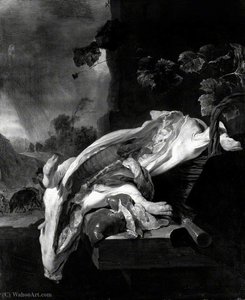
Portrét Jan Baptist Weenix

78 najznámejších obrazov od Jan Baptist Weenix, výber z galérie

Aktualizované november 2026 · zoradené podľa našej miery popularity (vyhľadávanie, návštevy a objednávky pre každou prácu) · 86 dielov umelca Jan Baptist Weenix v našom katalógu

Stručne povedané

Z všetkých originálov, ktoré Jan Baptist Weenix zanechal, je najznámejší Tobit, asleep under a vine, is blinded (1642), ktorý sa nachádza v zbierkach Museum Boijmans Van Beuningen v meste Rotterdam. Hneď za ním nasledujú Italian landscape with shelter and antiques ruins (1658) a Still Life with a Dead Swan (1651). Náš katalóg obsahuje 86 diel od Jan Baptist Weenix; galéria si zachovala tých 78, ktoré obdivuje celý svet, pričom každý z nich je prezentovaný spolu s jeho dátumom, múzeou a príbehom.

1621 – 1659, Amsterdam Dutch golden age Najviac diel: Bavarské štátne múzeá výtvarného umenia

Top 10 obrazov umelca Jan Baptist Weenix: výber galérie

1
Tobit, asleep under a vine, is blinded (1642) od Jan Baptist Weenix

Tobit, asleep under a vine, is blinded

1642 · Oil On Canvas · Museum Boijmans Van Beuningen, Rotterdam

A single man reclines in the heavy shade of a vine. He is Tobit, lost to a deep, unsuspecting sleep. The air around him feels thick, weighted by the muted tones of ochre and forest green. Sunlight does not flood this scene; instead, it pierces through the foliage in sharp, controlled beams, illuminating the textures of his slumped posture and the coarse fabric of his clothing. He rests amidst a…

2
Italian landscape with shelter and antiques ruins (1658) od Jan Baptist Weenix

Italian landscape with shelter and antiques ruins

1658 · Oil On Panel · Mauritshuis, Haag

The oil on panel painting titled Italian landscape with shelter and antiques ruins was executed by the artist Jan Baptist Weenix in 1658. This landscape painting depicts a specific pastoral setting within an Italianate environment. The scene is populated by a group of peasants and various livestock, including sheep and goats. These figures are situated near a rustic cottage and several ancient architectural ruins that occupy the landscape.

3
Still Life with a Dead Swan (1651) od Jan Baptist Weenix

Still Life with a Dead Swan

1651 · Oil On Canvas · Detroit Institute of Arts, Detroit

The painting Still Life with a Dead Swan by Jan Baptist Weenix captures a heavy, silent moment of the hunt. Created about 1651, the work presents a collection of fallen game as a trophy of the chase. A white swan rests at the center, its pale plumage a stark contrast to the darker forms surrounding it. This central figure is accompanied by a turkey, two partridges, and a small finch,…

4
Tobit Sleeping Under the Vine (1641) od Jan Baptist Weenix

Tobit Sleeping Under the Vine

1641 · Oil · Museum Catharijneconvent, Utrecht

In this work, titled Tobit Sleeping Under the Vine, we encounter a significant piece by the Dutch Golden Age painter Jan Baptist Weenix. Created around 1642, the painting belongs to the Baroque period, a time when the interplay of light and shadow began to define the dramatic tension of Northern European art. Weenix, born in Amsterdam, Netherlands, brought a disciplined approach to his subjects, often blending meticulous observation with a…

5
The Scissors Grinder (1641) od Jan Baptist Weenix

The Scissors Grinder

The air feels heavy with the scent of damp stone and the rhythmic, metallic scrape of steel against stone. Under a vast, expansive sky, a group of figures gathers within the skeletal remains of a classical ruin. A man leans into his work, operating a grinding wheel that cuts through the quietude of the scene. Beside him, a woman sits in repose, while a small child stands close by, watching…

6
Hunters Near Ruins (1648) od Jan Baptist Weenix

Hunters Near Ruins

1648 · Oil On Canvas · Cleveland Museum of Art, Cleveland

Hunters Near Ruins is an oil on canvas painting by Jan Baptist Weenix. The work is dated 1648. This piece belongs to the Dutch Golden Age, a period during which the artist developed a specific approach to landscape and human figures.

7
Portrait of René Descartes (1647) od Jan Baptist Weenix

Portrait of René Descartes

1647 · Oil · Centraal Museum, Utrecht

In this 1647 oil painting, Jan Baptist Weenix captures the French philosopher René Descartes. The subject appears in a medium close-up, his presence defined by a heavy, somber stillness. He is an elderly man, his face marked by the weight of thought and the passage of years. A bright white collar cuts through the darkness of his attire, framing a pale countenance that emerges from a deep, umber shadow.

8
Monument at a Harbour (1648) od Jan Baptist Weenix

Monument at a Harbour

1648 · Oil · Statens Museum For Kunst, Kodaň

The composition relies on strong vertical elements, primarily through imposing columns and a central, highly ornate pedestal topped with a large urn. These structures anchor the scene, providing a sense of scale against the scattered human figures in the foreground and middle ground. Through a use of deep recession, the perspective draws the eye past a colonnade toward a distant, hazy horizon where the masts of ships are visible.

9
Harbour with Antique Ruins (1648) od Jan Baptist Weenix

Harbour with Antique Ruins

1648 · Oil On Canvas · Národné múzeum, Stockholm

The scene unfolds in 1648, a moment captured in the oil on canvas known as Harbour with Antique Ruins. This work belongs to the hand of Jan Baptist Weenix, an artist who brings the weight of history into a living, breathing maritime setting. The painting presents a world where the weathered stone of classical antiquity meets the constant, rhythmic movement of a working harbor. It is a vision of a…

10
The Angel Raphael Leaving Tobias's Family (1648) od Jan Baptist Weenix

The Angel Raphael Leaving Tobias's Family

1648 · Oil · Národné múzeum, Stockholm

In "The Angel Raphael Leaving Tobias's Family" by Jan Baptist Weenix, a divine departure unfolds with sudden, celestial energy. The scene captures the exact moment the Angel Raphael ascends toward the heavens, leaving the family below in a state of profound awe and reverence. A powerful diagonal movement pulls the eye from the lower left foreground upward toward the upper left, where the angelic figure climbs into a swirling formation…

Výber umelcov Jan Baptist Weenix pokračuje, od 11 do 78

11vegetable-sellers at the house-door, 5 figures (1646) od Jan Baptist Weenixvegetable-sellers at the house-door, 5 figures1646 12caravane near the shore (1646) od Jan Baptist Weenixcaravane near the shore1646 13Mother and Child (1647) od Jan Baptist WeenixMother and Child1647 14Circumcision of Moses' son (1640) od Jan Baptist WeenixCircumcision of Moses' son1640 · Národné múzeum vo Varšave 15Still Life with Game, Hunter and Two Dogs (1652) od Jan Baptist WeenixStill Life with Game, Hunter and Two Dogs1652 · Bavarské štátne múzeá výtvarného umenia 16Butterfly Dog and Dead Bird (1649) od Jan Baptist WeenixButterfly Dog and Dead Bird1649 · Museum Mayer van den Bergh 17Pleasure boating (1650) od Jan Baptist WeenixPleasure boating1650 18The Sleeping Shepherdess (1658) od Jan Baptist WeenixThe Sleeping Shepherdess1658 · National Gallery of Ireland 19Roman Tinker (1656) od Jan Baptist WeenixRoman Tinker1656 · Städel Museum 20The love letter (1650) od Jan Baptist WeenixThe love letter1650 · Národné múzeum umenia, architektúry a dizajnu 21Italian Harbour (1651) od Jan Baptist WeenixItalian Harbour1651 · Hermitáž 22Italian Peasants among Ruins (1650) od Jan Baptist WeenixItalian Peasants among Ruins1650 · Detroit Institute of Arts 23Sleeping girl (1656) od Jan Baptist WeenixSleeping girl1656 · Bavarské štátne múzeá výtvarného umenia 24Rest on the Flight into Egypt (1657) od Jan Baptist WeenixRest on the Flight into Egypt1657 · Museum Boijmans Van Beuningen 25Merry Company on a Ferry (1649) od Jan Baptist WeenixMerry Company on a Ferry1649 · Museum Gouda 26Battle at the foot of the mountain. (1650) od Jan Baptist WeenixBattle at the foot of the mountain.1650 · Národné múzeum vo Varšave 27Christina Lepper de Kempenaer and Her Children (1653) od Jan Baptist WeenixChristina Lepper de Kempenaer and Her Children1653 28Italian port scene, 1649 (1649) od Jan Baptist WeenixItalian port scene, 16491649 · Centraal Museum 29Italian Landscape with Horsemen by a Spring (1657) od Jan Baptist WeenixItalian Landscape with Horsemen by a Spring1657 · Centraal Museum 30Before the walls of Rome (1650) od Jan Baptist WeenixBefore the walls of Rome1650 · National Museum in Wrocław 31Portrait of a man with a letter (1650) od Jan Baptist WeenixPortrait of a man with a letter1650 · Agnes Etherington Art Center 32A Landscape with a Ford (1660) od Jan Baptist WeenixA Landscape with a Ford1660 · Regionálna galéria v Liberici 33In the Campagna (1669) od Jan Baptist WeenixIn the Campagna1669 · National Gallery of Ireland 34Dead Fowl Being Eaten by a Cat (1653) od Jan Baptist WeenixDead Fowl Being Eaten by a Cat1653 · Städel Museum 35Departure of an Oriental Entourage (1647) od Jan Baptist WeenixDeparture of an Oriental Entourage1647 · Louvre 36Display of Dead Game (1641) od Jan Baptist WeenixDisplay of Dead Game1641 · Petit Palais 37Dead Game (1641) od Jan Baptist WeenixDead Game1641 38River Landscape with a Ferry (1650) od Jan Baptist WeenixRiver Landscape with a Ferry1650 · Montreal Museum of Fine Arts 39Still Life with Dead Game and Poultry (1656) od Jan Baptist WeenixStill Life with Dead Game and Poultry1656 · Centraal Museum 40Still Life with Fowl (1650) od Jan Baptist WeenixStill Life with Fowl1650 · Museum of Fine Arts Ghent (MSK) 41Marine with a Venetian Bucintoro (1650) od Jan Baptist WeenixMarine with a Venetian Bucintoro1650 · Staatliche Kunsthalle Karlsruhe 42The Dutch Ambassador on his Way to Isfahan, Jan Baptist Weenix, 1653 - 1659 (1659) od Jan Baptist WeenixThe Dutch Ambassador on his Way to Isfahan, Jan Baptist Weenix, 1653 - 16591659 · Rijksmuseum 43After the Hunt, Jan Baptist Weenix, c. 1656 (1656) od Jan Baptist WeenixAfter the Hunt, Jan Baptist Weenix, c. 16561656 · Rijksmuseum 44Still Life with White Mouse (1680) od Jan Baptist WeenixStill Life with White Mouse1680 · Galéria umenia Ernesta Zmetáka v Nových Zámkoch 45Still Life with Game od Jan Baptist WeenixStill Life with GameHarvard Art Museums 46The Ford in the River (1647) od Jan Baptist WeenixThe Ford in the River1647 · Hermitáž 47Harbor View with Rider in Oriental Dress, od Jan Baptist WeenixHarbor View with Rider in Oriental Dress,Groninger Museum 48The Holy Women at the Tomb od Jan Baptist WeenixThe Holy Women at the TombNational Gallery of Ireland 49An Italian Seaport od Jan Baptist WeenixAn Italian SeaportKráľovské múzeum výtvarných umení Antverpy 50Architectural interior with foreign shippers, ruins and a shipyard beyond od Jan Baptist WeenixArchitectural interior with foreign shippers, ruins and a shipyard beyond 51Study of a sheep od Jan Baptist WeenixStudy of a sheep 52A pig's carcase od Jan Baptist WeenixA pig's carcase 53The Tinker and His Dog od Jan Baptist WeenixThe Tinker and His Dog 54Landscape with Peasants and Animals od Jan Baptist WeenixLandscape with Peasants and Animals 55Dead Partridge (1650) od Jan Baptist WeenixDead Partridge1650 · Mauritshuis 56Goat Lying Down, Jan Baptist Weenix, 1645 - 1660 (1660) od Jan Baptist WeenixGoat Lying Down, Jan Baptist Weenix, 1645 - 16601660 · Rijksmuseum 57A Dog and a Cat near a partially disembowelled Deer, Jan Baptist Weenix, 1645 - 1660 (1660) od Jan Baptist WeenixA Dog and a Cat near a partially disembowelled Deer, Jan Baptist Weenix, 1645 - 16601660 · Rijksmuseum 58Still Life with Dead Poultry, Lidded Pitcher and Passglas od Jan Baptist WeenixStill Life with Dead Poultry, Lidded Pitcher and PassglasBavarské štátne múzeá výtvarného umenia 59Game-piece od Jan Baptist WeenixGame-pieceNational Gallery of Ireland 60Dead game and hunting tackle in landscape od Jan Baptist WeenixDead game and hunting tackle in landscape 61Hound with a Joint of Meat and a Cat Looking on od Jan Baptist WeenixHound with a Joint of Meat and a Cat Looking on 62Bouquet of flowers od Jan Baptist WeenixBouquet of flowersGemäldegalerie 63Shipping in Harbour od Jan Baptist WeenixShipping in Harbour 64Herons and Lapwings od Jan Baptist WeenixHerons and Lapwings 65Still Life of Dead Game in a Landscape with a Huntsman od Jan Baptist WeenixStill Life of Dead Game in a Landscape with a Huntsman 66An italian port scene od Jan Baptist WeenixAn italian port scene 67Shepherds and Flocks among Classical Ruins od Jan Baptist WeenixShepherds and Flocks among Classical Ruins 68A Coast Scene with Classical Ruins od Jan Baptist WeenixA Coast Scene with Classical RuinsWallace Collection 69Still Life with Dead Game od Jan Baptist WeenixStill Life with Dead Game 70Hounds and an Owl with Dead Birds and Sculptures in a Landscape od Jan Baptist WeenixHounds and an Owl with Dead Birds and Sculptures in a Landscape 71Still Life with Dead Birds od Jan Baptist WeenixStill Life with Dead Birds 72Family in a Mediterranean Seaport od Jan Baptist WeenixFamily in a Mediterranean Seaport 73Figures near a Seaport od Jan Baptist WeenixFigures near a SeaportScottish National Gallery 74A Huntsman cutting up a Dead Deer, with Two Deerhounds od Jan Baptist WeenixA Huntsman cutting up a Dead Deer, with Two DeerhoundsNational Gallery 75Ancient Ruins od Jan Baptist WeenixAncient RuinsSzépművészeti Múzeum 76Figures among ruins od Jan Baptist WeenixFigures among ruinsThe Kremer Collection 77Ancient Ruins (detail) od Jan Baptist WeenixAncient Ruins (detail)Szépművészeti Múzeum 78Girl as Shepherdess (1650) od Jan Baptist WeenixGirl as Shepherdess1650 · Musée de Picardie

Slávne obrazy umelca Jan Baptist Weenix podľa jednotlivých období

Motívy, ktoré zaujali Jan Baptist Weenix

Štyri témy, ktoré sa v týchto origináloch najčastejšie vracajú, každá s jej najvychybenejším príkladom.

Múzeá, ktoré uchovávajú originály umelca Jan Baptist Weenix

8 múzeá, v ktorých sa nachádza najviac obrazov z tejto stránky.

Múzeá Mesto Diela umelca Jan Baptist Weenix Obrazy z tohto zoznamu
Bavarské štátne múzeá výtvarného umenia, MníchBavarské štátne múzeá výtvarného umenia Mních 4 The Scissors Grinder, Still Life with Game, Hunter and Two Dogs, Sleeping girl
Centraal Museum, UtrechtCentraal Museum Utrecht 4 Portrait of René Descartes, Italian port scene, 1649, Italian Landscape with Horsemen by a Spring
National Gallery of Ireland, DublinNational Gallery of Ireland Dublin 4 The Sleeping Shepherdess, In the Campagna, The Holy Women at the Tomb
Rijksmuseum, AmsterdamRijksmuseum Amsterdam 4 The Dutch Ambassador on his Way to Isfahan, Jan Baptist Weenix, 1653 - 1659, After the Hunt, Jan Baptist Weenix, c. 1656, Goat Lying Down, Jan Baptist Weenix, 1645 - 1660
Museum Boijmans Van Beuningen, RotterdamMuseum Boijmans Van Beuningen Rotterdam 2 Tobit, asleep under a vine, is blinded, Rest on the Flight into Egypt
Mauritshuis, HaagMauritshuis Haag 2 Italian landscape with shelter and antiques ruins, Dead Partridge
Detroit Institute of Arts, DetroitDetroit Institute of Arts Detroit 2 Still Life with a Dead Swan, Italian Peasants among Ruins
Národné múzeum, StockholmNárodné múzeum Stockholm 2 Harbour with Antique Ruins, The Angel Raphael Leaving Tobias's Family

Jan Baptist Weenix rok po roku: originály, ktoré definujú každú éru

Od 1640 do 1659, Jan Baptist Weenix tvoril po dobu 20 rokov: výber sleduje túto dlhú kariéru rok po roku prostredníctvom jeho najlepších originálnych diel.

Diela podľa roku

Vyberte si rok a pozrite si originály.

Otázky zberateľov o obrazoch od Jan Baptist Weenix

Ktorým dielom je Jan Baptist Weenix najznámejší/najznámejšia?Odhaľte odpoveď

Tobit, asleep under a vine, is blinded (1642), Museum Boijmans Van Beuningen, Rotterdam. Nasledujú Italian landscape with shelter and antiques ruins (1658) a Still Life with a Dead Swan (1651).

V akom veku bol/a Jan Baptist Weenix, keď vzniklo dielo Tobit, asleep under a vine, is blinded?Odhaľte odpoveď

21 rokov: Tobit, asleep under a vine, is blinded vzniklo v roku 1642 a Jan Baptist Weenix sa narodil/a v roku 1621.

Ktorých desať najznámejších obrazov má Jan Baptist Weenix?Odhaľte odpoveď

Tobit, asleep under a vine, is blinded, Italian landscape with shelter and antiques ruins, Still Life with a Dead Swan, Tobit Sleeping Under the Vine, The Scissors Grinder, Hunters Near Ruins, Portrait of René Descartes, Monument at a Harbour, Harbour with Antique Ruins a The Angel Raphael Leaving Tobias's Family. Vyššie uvedené hodnotenie uvádza rok a múzeu pre každé z nich.

Koľko obrazov zanechal umenec Jan Baptist Weenix?Odhaľte odpoveď

Náš katalóg obsahuje 86 diel od umelca Jan Baptist Weenix z perioda od 1640 do 1659.

V ktorých múzeách visia majstrovské diela umelca Jan Baptist Weenix?Odhaľte odpoveď

Väčšinou v Bavarské štátne múzeá výtvarného umenia (Mních), Centraal Museum (Utrecht) a National Gallery of Ireland (Dublin). Tabuľka múzeí vyššie ich všetky uvádza.

V ktorých rokoch vytvoril Jan Baptist Weenix svoje najznámejšie diela?Odhaľte odpoveď

V období 1650: 11 z 78 diel na tejto stránke bolo vytvorených vtedy, pričom Pleasure boating z nich.

Aké sú prvé a posledné známe originály od Jan Baptist Weenix?Odhaľte odpoveď

Na tejto stránke je najstaršie dielo z Circumcision of Moses' son (1640) a najnovšie z The Dutch Ambassador on his Way to Isfahan, Jan Baptist Weenix, 1653 - 1659 (1659).

Aké témy si Jan Baptist Weenix najčastejšie vyberal/a?Odhaľte odpoveď

Landscape (18), Ruins (17) a Sky (13), v rámci 78 diel na tejto stránke.

Ktorú techniku používal(a) Jan Baptist Weenix najčastejšie?Odhaľte odpoveď

Oil On Canvas, pre 30 z 78 diel na tejto stránke.

Do ktorého umeleckého smeru patrí Jan Baptist Weenix?Odhaľte odpoveď

Dutch golden age a Baroque, podľa originálov na tejto stránke.

Aké diela umelca Jan Baptist Weenix sa nachádzajú v múzeu Bavarské štátne múzeá výtvarného umenia?Odhaľte odpoveď

The Scissors Grinder, Still Life with Game, Hunter and Two Dogs a Sleeping girl: múzeá Bavarské štátne múzeá výtvarného umenia, Mních uchovávajú 4 z diel na tejto stránke.

Jan Baptist Weenix: život a dielo

Vizionár holandského zlatého veku

Jan Baptist Weenix predstavuje výnimočnú postać holandského zlatého veku, oslavovanú pre svoje nezamiteľné spojenie precízneho pozorovania a predstavivej vízie. Hoci jeho umelecká tvorba bola v porovnaní s jeho súčasníkmi, akými boli Rembrandt či Vermeer, pomerne skromná, prínos Weenixa do dejín holandského umenia je nepoprchateľný. Najmä jeho revolučné skúmanie talianskych krajín prepletených s ľudskými postavami vytvorilo štylistický precedens, ktorý rezonoval v mnohých nasledujúcich generáciách. Narodený v roku 1621 v Amsterdame v blízkosti rušného prístavu, Weenix pochádzal z rodiny architektov, čo pravdepodobne formovalo jeho rané roky v prostredí intelektuálneho a štrukturálneho rozmachu tej doby.

Napriek osobnému vyzvaniu – historické záznamy naznačujú, že kvôli zdravotnému stavu mal problémy s rečou – Weenix disponoval vášnivým záľubou v literatúre a umení. Túto vášeň mu v niačo podниovala matka, ktorá pre него aktívne zabezpečila učňovstvo u Jana Mickera, švagročného Rembrandta. Toto skoré tréning vôde mu vplietlo do duše disciplinovaný prístup k kresleniu a pozorovaniu, ktorý sa neskôr stal neoddeliteľnou súčasťou jeho diela. Svoje schopnosti ďalej zdokonaloval v Utrechti pod vedením Abrahama Bloemaerta a následne sa vrátil do Amsterdamu, aby študoval u Claes Corneliiszoona Moeyaerta, čím si upevnil svoje základy v dominantných umeleckých prudenoch Holandska.

Cesta svetlom a krajinou

Trajektória Weenixovej kariéry bola zásadne zmenená jeho cestovami, najmä jeho púťou do Ríma v roku 1643 sprevádzanou Nicolaesom Pieterszoonom Berchemom. Táto expedícia mu umožnila ponoriť sa do živého intelektuálneho a umeleckého prostredia cechu Bentvueghels, čo bol zážitok, ktorý ho posunul k oveľa širšiemu štylistickému vyjadreniu. V Ríme sa nechal pohltiť talianskou štýlom, ktorý charakterizovalo teplé, zlatisté svetlo a klasické krajiny kontrastujúce s chladnejšími, temnejšími tónmi tradičného holandského maliarstva. Toto obdobie rímskeho vplyvu mu umožnilo ovládať umenie „talianskej krajiny“, kde sa drsná krása Južnej Európy preobrazila cez severoeurópsku optiku.

Jeho tvorba v tejto ére často spájala veľkoleposť klasických scenérií s intímnymi, ľudskými prvkami. Či už zachytával prístavné scény, ktoré šepkali o námornom obchode, alebo rozľahlé výhledy vyvolávajúce pocit nadčasovosti, Weenix mal jedinečnú schopnosť zachytiť atmosféru miesta. Jeho majstvo sa však neuzatvorilo len na vzdialené horizonty; rovnako dokázal zachytiť tichú, často až hmatateľnú realitu života prostredníctvom svojich záložiek. Jeho zobrazenia lovenej koristi a zvierat boli poznačené ohromujúci realizmom, kde každá textúra – od hrubšej srsti loveckého psa až po jemný lesk peria – bola vykreslená s dychberúcou presnosťou.

Odkaz realismu a umeleckého majstrovstva

Význam Jana Baptista Weenixa spočíva v jeho schopnosti premostiť priepast medzi drsným realizmom holandskej tradície a idealizovanou krásou talianskeho hnutia. Jeho všestrannosť mu umožnila pohybovať sa medzi rôznym tematickým obsahom, od dramatického napätia v díloch ako Po lovoch až po tichú, takmer smútočnú intenzitu jeho zvieracích štúdií. Prostredníctvom jeho štetca je divák pozvaný do sveta, kde sa hranice medzi pozorovaným prírodným svetom a predstavovanou klasickou minulosťou nádherne rozostrujujú.

Keď pripomíname jeho život a dielo, niekoľko kľúčových prvkov definuje jeho trvajúcu dôležitosť:

  • Štylistická inovácia: Bol pionierom v integrácii prvkov talianskej krajiny do holandskej tradície, čím vytvoril nový vizuálny jazyk pre svojich súčasníkov.
  • Technické majstvo: Jeho disciplinovaný výcvik umožnil mimoriadne úroveň detailu v krajinách veľkých rozmerov aj v intímnych záložkách.
  • ujú
  • Všestrannosť: Jeho schopnosť plynule prechádzať medzi prístavnými scenami, loveckými motívmi a portrétmi zvierat demonštruje vzácnu šírku talentu.
  • Historický dopad: Ako člen cechu Bentvueghels pomáhal podporovať medzinárodnú výmenu umeleckých myšlienok, ktoré definovali svet umenia 17. storočia.

Hoci jeho život bol relatívne krátky a skončil sa v roku 1661, otlačok, ktorý Jan Baptist Weenix zanechal, zostáva viditeľný v evolúcii krajinárskeho maliarstva. Naučil budúce generácie, ako sa pozerať na horizont nielen ako na hranicu, ale ako na plátno pre svetlo, históriu a ľudské emócie.