A Life Interrupted: The Poetic Vulnerability of Eva Hesse
Eva Hesse’s story is one of profound displacement and a relentless pursuit of artistic expression in the face of personal tragedy. Born in 1936 in Hamburg, Germany, her early life was irrevocably altered by the looming shadow of Nazism. Fleeing persecution, her family sought refuge in the United States in 1938, an act that would forever shape Hesse’s identity as a displaced person navigating two worlds. This sense of rootlessness, coupled with the emotional trauma of her parents' separation and her mother’s subsequent suicide when Hesse was just ten years old, became a subtle yet powerful undercurrent in her art—a haunting exploration of fragility, loss, and the ephemeral nature of existence. Her formal artistic training began at the Pratt Institute in Brooklyn, followed by studies at Cooper Union and Yale University School of Art and Architecture, where she encountered the rigorous material explorations championed by Josef Albers. However, it was not within the confines of traditional painting that Hesse found her true voice; rather, she embarked on a path of radical experimentation with materials and form, ultimately becoming a pivotal figure in the development of Postminimalism and Eccentric Abstraction.
From Painting to Materiality: A Sculptural Revolution
Initially drawn to abstract painting, Hesse soon felt constrained by its conventional limitations. She yearned for a more direct engagement with materiality—a way to imbue her work with the raw immediacy of feeling and experience. This desire led her to explore a diverse range of artistic influences, from the Surrealist explorations of form and subconscious imagery to the gestural energy of Abstract Expressionism and the biomorphic sculptures of artists like Hans Arp and Jean Dubuffet. A particularly formative moment came during an exhibition featuring the work of Louise Bourgeois; Bourgeois’s psychologically charged sculptures resonated deeply with Hesse, revealing the potential for art to confront personal trauma and explore the complexities of the human psyche. Moving to New York in the late 1950s placed her at the heart of a vibrant artistic community, further fueling her experimentation. By the mid-1960s, Hesse decisively turned towards sculpture, embracing unconventional materials like latex, fiberglass, resin, and rope—materials often associated with industrial production or everyday life. She wasn’t interested in their intended purpose; instead, she manipulated them in unexpected ways, brushing latex like paint to create layered surfaces, allowing materials to sag, droop, and defy conventional notions of form and stability.
Fragility and Repetition: Defining a Unique Aesthetic
Hesse’s sculptures are characterized by a distinctive aesthetic—one that embraces imperfection, vulnerability, and organic irregularity. Often featuring repetitive forms arranged in grid structures or clustered arrangements, her work evokes a sense of both order and chaos, control and surrender.
“Hang Up” (1966) is a striking early exploration of these themes—a seemingly simple arrangement of painted circles suspended from cords that Hesse herself described as expressing “absurdity or extreme feeling.” The
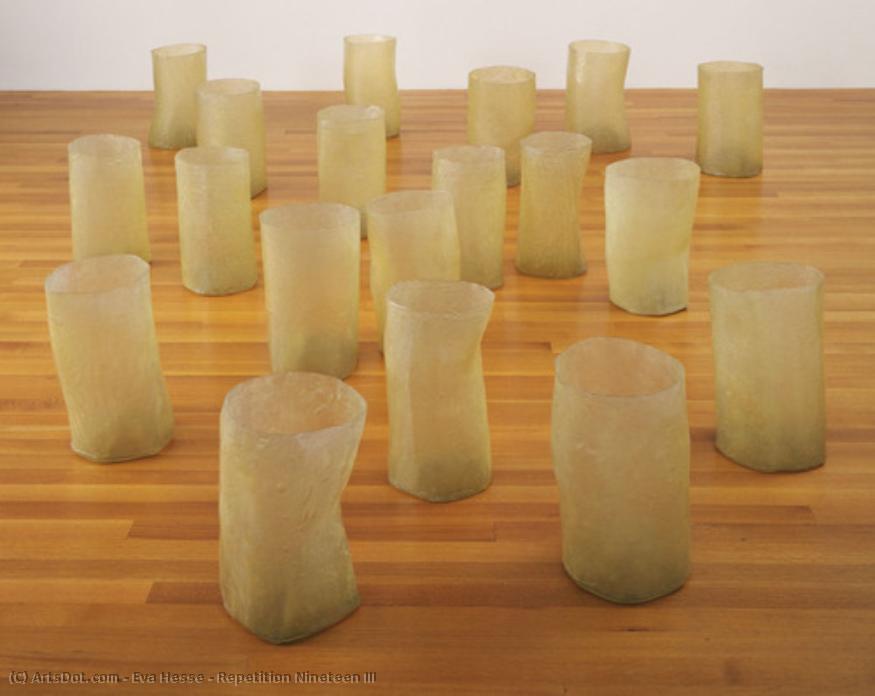
Repetition Nineteen III series (1968) further exemplifies her fascination with repetition and material properties, showcasing translucent fiberglass buckets arranged in a grid, each containing subtly different forms. Works like
“Schema and Sequel” (1967-68) demonstrate Hesse’s innovative use of the material, pushing its boundaries and revealing its inherent qualities.
“Accession II” (1968) features translucent fiberglass boxes containing phallic forms, delving into themes of the body and sexuality with a frankness that was groundbreaking for the time.
“Contingent” (1969) showcases her mastery of space and form, creating an immersive environment that invites contemplation and emotional response. Hesse’s sculptures are marked by a profound sensitivity to material texture and surface—a deliberate rejection of polished surfaces and idealized forms in favor of materials that convey their own inherent qualities.
Influences and Artistic Development
Hesse’s artistic journey was shaped by encounters with influential figures and movements within the art world. Her formative years were spent studying under Josef Albers at Yale University, where she absorbed his teachings on color theory and perceptual illusion—principles that would inform her later explorations of materiality and form. She drew inspiration from Surrealist artists like René Magritte and Salvador Dalí, whose dreamlike imagery challenged conventional notions of reality and explored the subconscious mind. Furthermore, Hesse admired the expressive gestures of Abstract Expressionists such as Willem de Kooning and Jackson Pollock, recognizing their ability to convey emotion through spontaneous action. However, it was Louise Bourgeois’s psychologically charged sculptures that truly captivated her imagination—Bourgeois’s willingness to confront difficult emotions and explore themes of trauma and vulnerability resonated deeply with Hesse’s own experiences as a displaced person. This influence is evident in Hesse’s preoccupation with the body, sexuality, and repetition—elements that would become central to her distinctive artistic style.
Legacy and Significance
Eva Hesse remains an artist whose work continues to inspire debate and admiration. Her pioneering use of unconventional materials—latex, fiberglass, resin—revolutionized sculpture and paved the way for new forms of artistic expression. Hesse’s rejection of formalism and embrace of imperfection challenged prevailing aesthetic conventions, advocating for a more subjective and emotionally resonant approach to artmaking. She is considered a cornerstone of Postminimalism and Eccentric Abstraction, contributing significantly to the development of these movements and establishing herself as one of the most important sculptors of her generation. Hesse’s sculptures explore themes of fragility, vulnerability, and loss—themes that reflect the profound impact of personal trauma on artistic creativity. Her legacy extends beyond her individual artworks; she championed a vision of art as a vehicle for confronting difficult emotions and engaging in dialogue with existential questions. Hesse's work continues to provoke contemplation and inspire artists today, cementing her place as an enduring figure in the history of modern art.