Portrét Caesar Van Everdingen

41 najznámejších obrazov od umelca Caesar Van Everdingen, každý jedinečný

Aktualizované november 2026 · zoradené podľa našej miery popularity (vyhľadávanie, návštevy a objednávky pre každou prácu) · 41 dielov umelca Caesar Van Everdingen v našom katalógu

Stručne povedané

Woman praying (1650) je obrazom umelca Caesar Van Everdingen, ktorý priťahuje najviac pohľadov; originál sa nachádza v múzeu Rijksmuseum, Amsterdam. Potom sa pohľad presunie na Jupiter and Callisto (1655) a Winter (1646). Z 41 diel umelca Caesar Van Everdingen v našom katalógu je týchto 41 najznámejších; každá z nich je jedinečným originálom prezentovaným s jeho rokom vzniku, múzeom a dôvodom, prečo pretrváva.

1616 – 1678, Alkmaar Baroque Najviac diel: Stedelijk Museum

Top 10 obrazov umelca Caesar Van Everdingen podľa výberu galérie

1
Woman praying (1650) od Caesar Van Everdingen

Woman praying

1650 · Oil On Panel · Rijksmuseum, Amsterdam

The quiet intensity of Woman praying draws the viewer into a private moment of devotion. Attributed to the hand of Caesar van Everdingen, this intimate portrait captures a figure lost in contemplation. The work is also known by the title Mary Praying, as the subject is identified as the Virgin Mary. She exists in a space of profound stillness, her presence felt through the weight of her silent plea.

2
Jupiter and Callisto (1655) od Caesar Van Everdingen

Jupiter and Callisto

1655 · Oil On Canvas · Národné múzeum, Stockholm

A single mask lies discarded in the upper corner, a silent witness to a deception. Beneath it, the nymph Callisto reclines upon heavy folds of fabric, her skin catching a pale, directional light that carves her form from the surrounding gloom. She looks upward, her gaze meeting the eyes of a man she believes to be a friend, yet the viewer sees the truth of his divinity. Jupiter stands near…

3
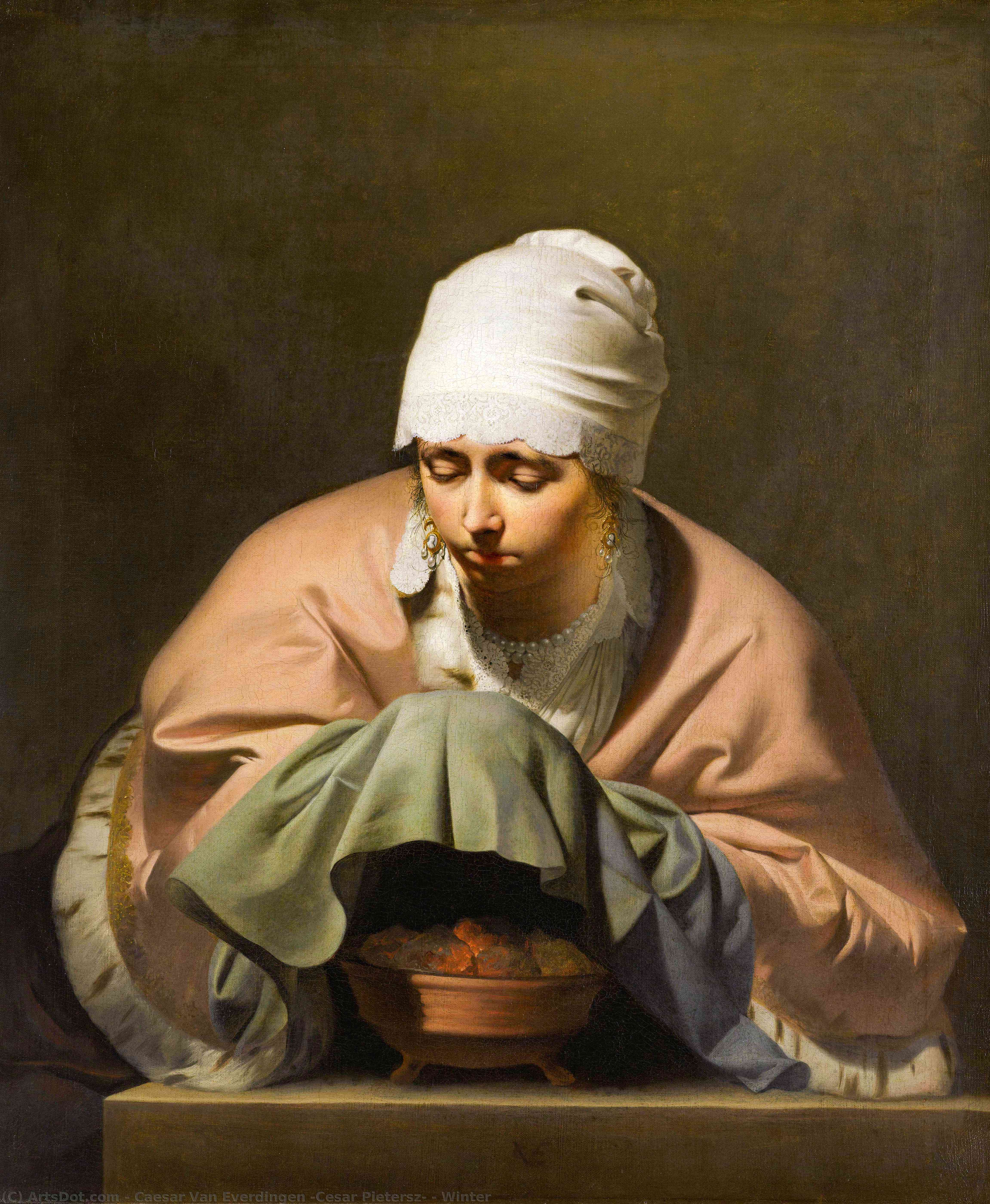
Winter (1646) od Caesar Van Everdingen

Winter

1646 · Oil On Canvas · Rijksmuseum, Amsterdam

To gaze upon Caesar Van Everdingen’s Winter is to step directly into the hushed, contemplative atmosphere of the Dutch Golden Age. This painting, executed in 1646, transcends a mere depiction of a season; it captures an ephemeral moment—a pause in the rhythm of daily life under the soft dominion of winter's breath. The composition immediately draws the eye to the central figure: a young woman whose presence is both delicate…

4
Vertumnus and Pomona (1631) od Caesar Van Everdingen

Vertumnus and Pomona

1631 · Oil

In this 1631 oil painting, the tension of a mythological pursuit unfolds within a dense, shadowed landscape. Vertumnus, the god of seasons, is depicted as an older man seated upon the earth, his gaze directed upward toward Pomona. She is positioned to the right, her back turned to the viewer, her sculptural physique partially draped in white cloth. The composition relies on a heavy use of chiaroscuro, where dramatic light…

5
Vertumnus and Pomona (1638) od Caesar Van Everdingen

Vertumnus and Pomona

1638 · Oil On Canvas · Thyssen-Bornemisza Museum, Madrid

This work, titled Vertumnus and Pomona, is a significant example of the mythological painting produced by Caesar van Everdingen. The piece is dated about 1637–1640, a period during which the artist was establishing his presence within the Dutch Golden Age. It is a work that captures a specific moment of classical narrative, rendered with the precision characteristic of his training in Utrecht.

6
Officers of the Orange Compagny of the Old Civic Guard (1641) od Caesar Van Everdingen

Officers of the Orange Compagny of the Old Civic Guard

1641 · Oil On Canvas · Stedelijk Museum, Alkmaar

In this 1641 portrait, we find ourselves standing before a dense assembly of men, the officers of the Orange Company of the Old Civic Guard. There is a certain weight to the composition, a horizontal arrangement that feels both crowded and deeply organized. These men are not merely subjects; they are a collective force, their postures providing a structural rhythm to the canvas. The lighting, descending from the upper left,…

7
Portret van Aechje Claesdr. Moer (1585-1640) (1636) od Caesar Van Everdingen

Portret van Aechje Claesdr. Moer (1585-1640)

1636 · Oil · Stedelijk Museum, Alkmaar

This 1636 oil portrait presents a three-quarter length view of an elderly woman, Aechje Claesdr. Moer, set against a somber, atmospheric backdrop. The composition relies on a sharp tonal contrast between her dark, light-absorbing gown and a large, bright white ruff collar. This millstone ruff, with its rhythmic pleats, directs the eye toward the subject's face, which is rendered with naturalistic precision. A soft, directional light enters from the upper…

8
Portrait of Pieter Cornelisz. van Everdingen (1575-1662) (1636) od Caesar Van Everdingen

Portrait of Pieter Cornelisz. van Everdingen (1575-1662)

1636 · Photography · Stedelijk Museum, Alkmaar

A woman occupies the foreground, her gaze directed toward the viewer from a waist-up perspective. She is positioned within a rural, village setting characterized by traditional thatched-roof huts and sparse vegetation. The composition utilizes linear perspective to draw the eye toward these structures, creating a sense of depth behind the central figure. Natural, bright daylight illuminates the scene, casting soft shadows that define the textures of her skin and the…

9
Vertumnus and Pomona (1650) od Caesar Van Everdingen

Vertumnus and Pomona

1650 · Oil · J. Paul Getty Museum, Los Angeles

This Baroque-style oil painting presents an intimate mythological scene featuring two figures, Vertumnus and Pomona, set against a dark and atmospheric landscape. The composition centers on a tactile exchange of fruit between a seated figure on the left and a woman on the right. The scene is characterized by a dramatic use of chiaroscuro, where light highlights the faces and hands of the subjects while casting much of the background…

10
Portrait of an unknown girl (1651) od Caesar Van Everdingen

Portrait of an unknown girl

1651 · Oil On Canvas · Herzog Anton Ulrich Museum, Brunšvik

The work before us is the Portrait of an unknown girl, a quiet study by the Dutch Golden Age painter Caesar van Everdingen. This portrait, which is also known by the titles Girl in a Large Hat or Meisje met brede hoed, offers a glimpse into the meticulous portraiture practiced during the mid-17th century. It captures a sense of individual presence through a restrained and dignified approach to the subject.

Slávne obrazy umelca Caesar Van Everdingen, čísla 11 až 41

11Officers and standard-bearers of New Civic Guard in Alkmaar (1657) od Caesar Van EverdingenOfficers and standard-bearers of New Civic Guard in Alkmaar1657 · Stedelijk Museum 12Portrait of Cornelis Jacobsz. Groot (?-1661) (1656) od Caesar Van EverdingenPortrait of Cornelis Jacobsz. Groot (?-1661)1656 · Kunsthandel P. de Boer 13Four Muses and Pegasus on Parnassus (1650) od Caesar Van EverdingenFour Muses and Pegasus on Parnassus1650 · Huis ten Bosch 14Lycurgus Demonstrates the Benefits of Education (1660) od Caesar Van EverdingenLycurgus Demonstrates the Benefits of Education1660 · Stedelijk Museum 15Self-portrait of Caesar van Everdingen (?-1678) (1670) od Caesar Van EverdingenSelf-portrait of Caesar van Everdingen (?-1678)1670 · Stedelijk Museum 16Portrait of a woman, possibly a sister of Cornelis Jacobsz. Groot (1664) od Caesar Van EverdingenPortrait of a woman, possibly a sister of Cornelis Jacobsz. Groot1664 · Kunsthandel P. de Boer 17Portrait of Wollebrand Geleynsz de Jongh (1594-1674), with a servant and a child (1674) od Caesar Van EverdingenPortrait of Wollebrand Geleynsz de Jongh (1594-1674), with a servant and a child1674 · Stedelijk Museum 18Four Evangelists: John (1676) od Caesar Van EverdingenFour Evangelists: John1676 · Stedelijk Museum 19Four Evangelists: Luke (1676) od Caesar Van EverdingenFour Evangelists: Luke1676 · Stedelijk Museum 20Four Evangelists: Mark (1676) od Caesar Van EverdingenFour Evangelists: Mark1676 · Stedelijk Museum 21Joueuse de Cistre (1678) od Caesar Van EverdingenJoueuse de Cistre1678 · Musée des Beaux-Arts de Rouen 22Allegory of the Birth of Frederik Hendrik (1650) od Caesar Van EverdingenAllegory of the Birth of Frederik Hendrik1650 · Huis ten Bosch 23Female Figure, possibly Lucretia (1793) od Caesar Van EverdingenFemale Figure, possibly Lucretia1793 · Národné múzeum 24Diogenes Seeks a True Man (1652) od Caesar Van EverdingenDiogenes Seeks a True Man1652 · Mauritshuis 25Still-Life with a Bust of Venus (1665) od Caesar Van EverdingenStill-Life with a Bust of Venus1665 · Mauritshuis 26View of the Oranjezaal (1650) od Caesar Van EverdingenView of the Oranjezaal1650 · Huis ten Bosch 27Amor Holding a Glass Orb (1660) od Caesar Van EverdingenAmor Holding a Glass Orb1660 28Count Willem II of Holland Granting Privileges (1655) od Caesar Van EverdingenCount Willem II of Holland Granting Privileges1655 · Gemeenlandshuis 29Officers and Standard-Bearers of the Old Civic Guard (1657) od Caesar Van EverdingenOfficers and Standard-Bearers of the Old Civic Guard1657 · Stedelijk Museum 30Nymphs Offering the Young Bacchus Wine, Fruit and Flowers (1670) od Caesar Van EverdingenNymphs Offering the Young Bacchus Wine, Fruit and Flowers1670 · Museum Kunstpalast 31Holy Family (1660) od Caesar Van EverdingenHoly Family1660 · Museum Catharijneconvent 32Portrait of a Girl as a Huntress (1665) od Caesar Van EverdingenPortrait of a Girl as a Huntress1665 · Koninklijk Museum voor Schone Kunsten 33Portrait of a Two-Year-Old Boy (1664) od Caesar Van EverdingenPortrait of a Two-Year-Old Boy1664 · Cannon Hall Museum 34Elisabeth van Kessel (1640-1717), Wife of Willem Jacobsz Baert, Caesar Boëtius van Everdingen, 1671 (1671) od Caesar Van EverdingenElisabeth van Kessel (1640-1717), Wife of Willem Jacobsz Baert, Caesar Boëtius van Everdingen, 16711671 · Rijksmuseum 35Willem Jacobsz Baert (1636-84), Burgomaster of Alkmaar and Amsterdam, Caesar Boëtius van Everdingen, 1671 (1671) od Caesar Van EverdingenWillem Jacobsz Baert (1636-84), Burgomaster of Alkmaar and Amsterdam, Caesar Boëtius van Everdingen, 16711671 · Rijksmuseum 36The four muses with pegasus od Caesar Van EverdingenThe four muses with pegasusHuis ten Bosch 37Portrait of a Dutch Commander od Caesar Van EverdingenPortrait of a Dutch CommanderNational Gallery 38Bacchus with Two Nymphs And Cupid od Caesar Van EverdingenBacchus with Two Nymphs And Cupid 39Pan and Syrinx, Caesar Boëtius van Everdingen, c. 1637 - c. 1640 (1640) od Caesar Van EverdingenPan and Syrinx, Caesar Boëtius van Everdingen, c. 1637 - c. 16401640 · Rijksmuseum 40Girl in a Large Hat (1647) od Caesar Van EverdingenGirl in a Large Hat1647 · Rijksmuseum 41Bacchus with Nymphs and Cupid (1660) od Caesar Van EverdingenBacchus with Nymphs and Cupid1660 · Gemäldegalerie

Slávne obrazy umelca Caesar Van Everdingen podľa jednotlivých období

Motívy, ktoré zaujali Caesar Van Everdingen

Štyri témy, ktoré sa v týchto origináloch najčastejšie vracajú, každá s jej najvychybenejším príkladom.

Múzeá, ktoré uchovávajú originály umelca Caesar Van Everdingen

8 múzeá, v ktorých sa nachádza najviac obrazov z tejto stránky.

Múzeá Mesto Diela umelca Caesar Van Everdingen Obrazy z tohto zoznamu
Stedelijk Museum, AlkmaarStedelijk Museum Alkmaar 11 Officers of the Orange Compagny of the Old Civic Guard, Portret van Aechje Claesdr. Moer (1585-1640), Portrait of Pieter Cornelisz. van Everdingen (1575-1662)
Rijksmuseum, AmsterdamRijksmuseum Amsterdam 6 Woman praying, Winter, Elisabeth van Kessel (1640-1717), Wife of Willem Jacobsz Baert, Caesar Boëtius van Everdingen, 1671
Huis ten Bosch, The HagueHuis ten Bosch The Hague 4 Four Muses and Pegasus on Parnassus, Allegory of the Birth of Frederik Hendrik, View of the Oranjezaal
Národné múzeum, StockholmNárodné múzeum Stockholm 2 Jupiter and Callisto, Female Figure, possibly Lucretia
Kunsthandel P. de BoerKunsthandel P. de Boer 2 Portrait of Cornelis Jacobsz. Groot (?-1661), Portrait of a woman, possibly a sister of Cornelis Jacobsz. Groot
Mauritshuis, HaagMauritshuis Haag 2 Diogenes Seeks a True Man, Still-Life with a Bust of Venus
Thyssen-Bornemisza Museum, MadridThyssen-Bornemisza Museum Madrid 1 Vertumnus and Pomona
J. Paul Getty Museum, Los AngelesJ. Paul Getty Museum Los Angeles 1 Vertumnus and Pomona

Caesar Van Everdingen naprieč dekádami: jeden jedinečný originál pre každý

Diela podľa dekád

Vyberte si dekádu a pozrite si originál, ktorý ju definuje.

Obrazy umelca Caesar Van Everdingen: otázky pre galériu

Akým najznámejším dielom sa pýta Caesar Van Everdingen?Odhaľte odpoveď

Woman praying (1650), Rijksmuseum, Amsterdam. Nasledujú Jupiter and Callisto (1655) a Winter (1646).

V akom veku vytvoril/a Caesar Van Everdingen dielo Woman praying?Odhaľte odpoveď

34 rokov: Woman praying vzniklo v roku 1650 a Caesar Van Everdingen sa narodil/a v roku 1616.

Ktorých desať obrazov Caesar Van Everdingen je najznámejších?Odhaľte odpoveď

Woman praying, Jupiter and Callisto, Winter, Vertumnus and Pomona, Vertumnus and Pomona, Officers of the Orange Compagny of the Old Civic Guard, Portret van Aechje Claesdr. Moer (1585-1640), Portrait of Pieter Cornelisz. van Everdingen (1575-1662), Vertumnus and Pomona a Portrait of an unknown girl. Vyššie uvedené hodnotenie uvádza rok a múzeu pre každé z nich.

Koľko je známych diel umelca Caesar Van Everdingen?Odhaľte odpoveď

Náš katalóg obsahuje 41 diel od umelca Caesar Van Everdingen z perioda od 1631 do 1678.

Kde možno vidieť najznámejšie originály od Caesar Van Everdingen?Odhaľte odpoveď

Väčšinou v Stedelijk Museum (Alkmaar), Rijksmuseum (Amsterdam) a Huis ten Bosch (The Hague). Tabuľka múzeí vyššie ich všetky uvádza.

V akom období vytvoril/a Caesar Van Everdingen svoje najznámejšie obrazy?Odhaľte odpoveď

V období 1650s: 12 z 41 diel na tejto stránke bolo vytvorených vtedy, pričom Woman praying z nich.

Ktorý z najslávnejších obrazov autora Caesar Van Everdingen je najstarší a ktorý najnovší?Odhaľte odpoveď

Na tejto stránke je najstaršie dielo z Vertumnus and Pomona (1631) a najnovšie z Joueuse de Cistre (1678).

Aké témy obľúbené Caesar Van Everdingen?Odhaľte odpoveď

Woman (13), Man (11) a Drapery (5), v rámci 41 diel na tejto stránke.

S akými materiálmi mal(a) Caesar Van Everdingen najčastejšie pracuje?Odhaľte odpoveď

Oil On Canvas, pre 15 z 41 diel na tejto stránke.

Do ktorého smeru patrí tvorba umelca Caesar Van Everdingen?Odhaľte odpoveď

Baroque a Dutch golden age, podľa originálov na tejto stránke.

Aké originály od Caesar Van Everdingen môžem vidieť v Stedelijk Museum?Odhaľte odpoveď

Officers of the Orange Compagny of the Old Civic Guard, Portret van Aechje Claesdr. Moer (1585-1640) a Portrait of Pieter Cornelisz. van Everdingen (1575-1662): múzeá Stedelijk Museum, Alkmaar uchovávajú 11 z diel na tejto stránke.

Caesar Van Everdingen: portrét umelca

Odkaz svetla a línie: Život Caesara van Everdingena

V zlatom období holandského maliarstva, kde hra svetla a tieňa definovala vizuálnu identitu národa, sa Caesar van Everdingen vynikol ako majster jemných emócií a atmosférickej hĺbky. Narodený okolo roku 1616 v historickom meste Alkmaar v Holandsku, bol jeho umelecký príbeh hlboko prepletený s prestížnou líniou jeho rodiny. Hoci je často spomínaný spolu so svojimi uznávanými bratmi, Allartom a Janom, Caesar si vo viedach holandského zlatého veku vybojil vlastné, odlišné miesto. Jeho rané školenie pod ctiteľným Janom Gerritszom van Bronckhorstom v Utrechte mu poskytlo prísne základy klasickej estetiky, čo doňho vtmlalo precíznosť, ktorá mu neskôr umožnila prekonať čistú technickú zručnosť a dosiahnuť skutočnú umeleckú víziu.

Jeho profesionálny vzostup začal naplno v roku 1632, keď sa oficiálne stal členom cechu v Alkmaare. Počas týchto formujúcich rokov bol jeho repertoár charakterizovaný dôslednými portrétmi a evokatívnymi žánrovými scénami, dielami, ktoré si vyžadovali intenzívne pozorovanie ľudskej kondície. Avšak spolu s dozretím jeho talentu rástla aj jeho ambícia. Presunul sa za hranice doslovnej reprezentácie a vyvinul jedinečnú schopnosť manipulovať s ťahmi štetca tak, aby zachytil prchavé nuansy svetla a váhu atmosféry. Táto evolúcia znamenala jeho prechod od zdatného remeselníka k vizionárnemu maliarovi, schopnému vdechnúť plátnu život.

Haarlemské roky a veľké ambície

Kľúčová kapitola Van Everdingenho života sa odohrala v roku 1648, keď sa presťahoval do živého a kultúrne bohatého mesta Haarlem. Tento krok bol viac než len zmenou prostredia; bolo to ponorenie sa do samého srdca holandského umeleckého sveta. Prípadom do prestížneho haarlemskeho cechu svätého Lukáša a aktívnou činnosťou v rámci schutterij (mestská stráž) sa Caesar vtÁvol do samotnej tkaniny sociálnej a politickej elity mesta. Tieto väzby sa ukázali ako kľúčové pri získavaní objednávok, ktoré by neskôr definovali jeho historický význam.

Možno najúchvatnejším úspechom jeho kariéry bola jeho zásahy do dekorácie Oranje Zaal (Oranžovej salónnej) v paláci Huis ten Bosch. Tento monumentálny podnik vyžadoval majstvo v historickom maliarstve veľkého formátu, žánre, ktoré si vyžadovalo både naratívnu komplexnosť a grandiózny rozsah. V tomto prostredí Caesar продемонšoval svoju schopnosť komponovať epické scény, pričom spojil historickú vážnosť s jemným dotykom. Jeho práca počas tohto obdobia ukázala rastúcu schopnosť zvládať zložité kompozície, čím zabezpečila, že jeho meno sa vyrytí do architektonickej histórie Holandska.

Umelecká zrelosť a trvalý vplyv

V svojich neskorších rokoch sa Caesar vrátil k svojim koreňom v Alkmaare, kde založil dielňu, ktorá sa stala útočiskom pre umeleckú výuku. Toto obdobie jeho života bolo poznačené hlbokým oddaním sa zdokonaľovaniu svojho remesla a mentorovaním novej generácie maliarov. Jeho neskoré diela odrážajú celoživotne nahromadenú múdrosť, charakterizovanú opakovanej fascináciou nebeskými a éterickými témami. Stal sa obzvlášť známy svojimi zobrazeniami krídlatých bytostí – anjelov a božských entít – vykreslených s takou jemnosťou, ktorá naznačovala prítomnosť toho vznešeného.

Význam Caesara van Everdingena spočíva nielen v jeho jednotlivých majstrovských dielach, ale aj v jeho úlohe ako premostenia medzi prísnymi tradíciami raného 17. storočia a po následujúcimi érami nasledovanými emotívnejšími, atmosférickými štýlmi. Jeho schopnosť spojiť precíznosť holandského portrétneho maliarstva s veľkoleposťou historického naratívu zostáva dôkazom jeho všestrannosti. Dnes slúžia jeho diela ako dôležité okná do duše holandského zlatého veku, pripomínajúc nám časy, kedy každý ťah štetca bol pokusom zachytiť večnosť v rámci toho, čo je pomíjavé.