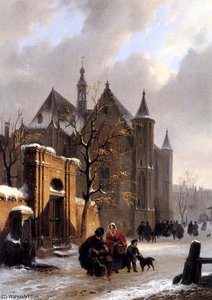
A Master of the Hague Academy
Bartholomeus Johannes van Hove stands as a monumental figure in the nineteenth-century Dutch art scene, not merely for the canvases he produced, but for the vast lineage of talent he nurtured. Born in The Hague, Netherlands, his life was deeply intertwined with the artistic pulse of his home city. As a pupil of his father, Hubertus van Hove the Elder, and the theater painter JHAA Breckenheijmer, he inherited a profound technical foundation that would later allow him to shape the trajectory of Dutch painting. His career was marked by a remarkable duality; while he possessed the skill for fine, detailed compositions, he also embraced the grand, sweeping scale required for stage scenery, succeeding his teacher as a stage painter at the Hague Theatre in 1829.
His influence extended far beyond his own brushstrokes through his role as an educator. Appointed headmaster in 1820 at the Hague Academy Teeken, van Hove became a cornerstone of artistic instruction. He possessed a rare ability to transmit his mastery to a diverse group of disciples, many of whom would eventually ascend to the heights of the Hague School. Through his studio and academy, he guided the hands of artists such as Johannes Bosboom and Jan Hendrik Weissenbruch, ensuring that his technical precision and romantic sensibilities would permeate the next generation of Dutch masters.
Style and Artistic Legacy
The work of van Hove is characterized by a captivating tension between the intimate and the expansive. In his personal oeuvre, he moved away from the broad, colorful strokes used in theatrical sets to embrace a more meticulous and romantic approach. He found his true expression in the quiet dignity of cityscapes and the solemn atmosphere of church interiors. These works often reflect a romantic sensibility, capturing the historical essence of Dutch architecture with a fine, detailed painting style that invites the viewer into a meticulously reconstructed past.
Beyond the canvas, his leadership within the artistic community solidified his historical significance. He was a foundational figure in the cultural fabric of The Hague, serving as one of the founders of the prestigious Pulchri Studio and holding the position of its first president until 1851. His reach even extended to Amsterdam, where he became an honorary chairman of the Arti et Amicitiae. Whether through his delicate depictions of urban life or his role in establishing the institutions that define Dutch art history, Bartholomeus Johannes van Hove remains a vital link between the classical traditions of his predecessors and the burgeoning modern movements of his era.
Otázky a odpovede
Ako sa tvorba umelca Bartholomeus van Hove časom vyvíjala?
Kariéra umelca Bartholomeus van Hove sa na jeho stránke Chronológia odvíja obdobie po období v podobe horizontálnej časovej osi diel, ktoré sú rozdelené do kapitol podľa jednotlivých období jeho tvorby.
V akom historickom období tvoril/a Bartholomeus van Hove?
Bartholomeus van Hove tvoril v období .. Toto obdobie zasazuje umeleckú činnosť umelca do historického kontextu.
Ako nájdem diela od Bartholomeus van Hove v konkrétnej farebnej palete?
Stránka Podľa palety fariebလေး zhrupuje diela umelca Bartholomeus van Hove podľa ich farebnej palety.
Existuje prehľad všetkých tém, ktoré Bartholomeus van Hove nakreslil/a?
Stránka Atlas predmetov mapuje diela umelca Bartholomeus van Hove podľa tém.