A Baroque Masterpiece Illuminated
Nestled within the historic heart of Rome, Sant'Andrea al Quirinale stands as a breathtaking testament to the artistic fervor and spiritual ambition of the Counter-Reformation. This is not merely a place of worship, but a meticulously choreographed theatrical experience designed by the legendary Gian Lorenzo Bernini between 1658 and 1670. To step inside this relatively small church is to encounter a space that defies its physical dimensions, offering a monumental scale that overwhelms the senses. The architecture itself serves as a prelude to the divine, where every curve and shadow has been calculated to evoke a sense of profound spiritual awe.
The genius of Bernini’s architectural innovation is immediately palpable upon entry. Eschewing the traditional rectangular layouts of many contemporary churches, he employed an ingenious oval plan for the nave, creating a dynamic energy that pulls the viewer inward. The exterior façade employs a colossal order—massive pilasters that lend an illusion of immense stability and height—while the steps leading to the porch spiral outward in concentric ovals. This deliberate use of asymmetry and movement mirrors the very essence of the Baroque style, transforming the approach to the church into a rhythmic, unfolding drama.
Celestial Splendor and Sculptural Grace
As one lifts their gaze toward the heavens, the interior reveals its most luminous triumph: the magnificent dome. Adorned with breathtaking frescoes by Giovanni Lanfranco and Domenichino , the ceiling depicts the Ascension of Christ through masterful use of illusionistic perspective. This technique creates an immersive panorama, a window into the celestial realm that seems to dissolve the physical boundary between earth and sky. The interplay of light and color within the dome is nothing short of miraculous, as Bernini’s manipulation of natural illumination breathes life into the painted figures, making the divine presence feel tangibly near.
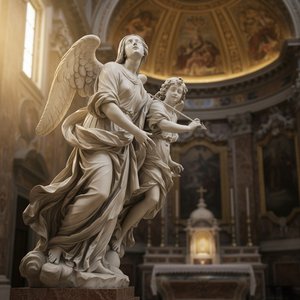
Complementing this aerial splendor are the sculptural treasures that anchor the church's emotional depth. Beyond the altar, Bernini’s sculptures command the space with their expressive dynamism and raw emotion. His depictions of saints embody the Baroque ideal of capturing a pivotal, breathless moment in time. The collection is further enriched by the works of Giacinto Brandi , whose frescoes contribute to an atmosphere of solemn beauty. A particular highlight for any art enthusiast is the presence of Courtois’ “Martyrdom of Saint Andrew,” a painting that utilizes dramatic lighting and emotive gestures to convey a profound spiritual narrative through pure visual spectacle.
A Legacy of Faith and Artistic Vision
The history of Sant'Andrea al Quirinale is deeply intertwined with the broader cultural landscape of Rome. Commissioned by Cardinal Camillo Francesco Maria Pamphili for the nearby Jesuit seminary, the church was born from a period of intense religious devotion and a desire to reaffirm Catholic dogma following the Protestant Reformation. This era of patronage fueled an unprecedented wave of creativity, making the church a vital landmark in the evolution of Italian Baroque art. It remains a site where architectural innovation meets sculptural brilliance, offering a timeless sanctuary for those captivated by the grandeur of the past.
Today, Sant'Andrea al Quirinale continues to captivate scholars and travelers alike, frequently hosting notable exhibitions that showcase the breadth of Baroque artistry. For collectors and interior designers, the church serves as an eternal reference point for the harmonious fusion of light, movement, and structural elegance. It is a place where the boundaries between art and architecture vanish, leaving behind a lasting impression of a world where every stone and brushstroke was dedicated to the pursuit of the sublime.