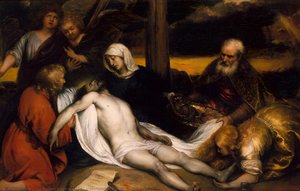
Jan Andrea Lievens: A Shadowed Master of the Dutch Golden Age
Jan Andrea Lievens, born in Leiden in 1607 and tragically passing away in Berlin in 1674, remains a fascinating enigma within the pantheon of Dutch Masters. Often overshadowed by his more celebrated contemporary, Rembrandt van Rijn, Lievens’s artistic journey is one of remarkable talent, intense collaboration, and ultimately, relative obscurity—a story that now deserves renewed attention. His life embodies the complexities of the Dutch Golden Age, marked by both immense promise and a frustrating lack of recognition during his own lifetime.Early Years and Artistic Foundations
Lievens’s early life was steeped in the traditions of Leiden, a city renowned for its artistic heritage. He was the son of Lieven Hendriksze, a skilled embroiderer – a craft that instilled within him an appreciation for meticulous detail and vibrant color. At the tender age of eight, he began his formal training under Joris van Schooten, a respected local artist who provided him with the foundational principles of drawing and painting. This early apprenticeship was followed by a crucial two-year period spent in Amsterdam, where he honed his skills under the tutelage of the renowned history painter, Pieter Lastman. Lastman’s influence is palpable in Lievens's later work – particularly in his dramatic compositions and masterful use of light and shadow, elements that would become hallmarks of his style. It was during this time that Lievens began to develop a distinctive approach, one characterized by a bold theatricality and an inclination towards capturing the psychological depth of his subjects.A Collaborative Spark: The Rembrandt Connection
Lievens’s career truly ignited in the early 1620s when he moved back to Leiden and entered into a remarkable partnership with Rembrandt. For nearly a decade, from 1626 to 1631, they worked side-by-side, producing over two dozen paintings, drawings, and etchings—a period of intense creative exchange and, inevitably, some degree of artistic rivalry. This collaboration is particularly noteworthy because it occurred during a time when Rembrandt was still establishing himself as an independent artist. Lievens’s experience and technical skill provided a valuable counterbalance to Rembrandt's innovative spirit, resulting in a diverse body of work that reflects both artists’ individual styles. However, the exact attribution of these works remains a subject of ongoing scholarly debate—a testament to the close stylistic similarities between the two masters.The Influence of Caravaggisti and Rubens
Lievens’s artistic development was profoundly shaped by several key influences. Initially, he embraced the dramatic flair of the *Caravaggisti* – Italian painters who had brought a new intensity of light and shadow, known as *chiaroscuro*, to European art. This influence is evident in his early works, characterized by dynamic compositions and a heightened sense of theatricality. Furthermore, Lievens’s work demonstrates a clear debt to Peter Paul Rubens, the towering figure of Flemish Baroque painting. The opulent colors, dramatic gestures, and allegorical themes found in Rubens's paintings—particularly *Judith with the Head of Holofernes* – resonated deeply with Lievens, shaping his approach to large-scale religious and mythological scenes.A Journey Beyond Leiden: London, Antwerp, and Berlin
Following his collaboration with Rembrandt, Lievens embarked on a series of journeys that took him far beyond the familiar landscapes of Leiden. He spent time in London, where he was invited to the British court—a testament to his growing reputation. He then settled in Antwerp, a vibrant center of artistic activity during this period, and later found patronage in The Hague and Berlin. Each location contributed to his evolving style, exposing him to new influences and broadening his artistic horizons. Despite these travels, Lievens never achieved the same level of fame or recognition as Rembrandt—a tragic irony for an artist whose talent was so consistently praised by his contemporaries.Legacy and Rediscovery
Today, Jan Andrea Lievens is finally receiving the recognition he deserves. His works, characterized by their dramatic intensity, technical brilliance, and profound psychological insight, are increasingly being appreciated for their artistic merit. Museums across Europe—including the Mauritshuis in The Hague and the Kremer Collection—are showcasing his paintings, allowing a new generation of viewers to experience the beauty and power of his art. Lievens’s story serves as a poignant reminder that history can be shaped by circumstance, and that even the most talented artists can remain hidden from view for centuries—until their work is rediscovered and celebrated anew.Вопросы и ответы
В какой исторический период работал(а) Ян Ливенс?
Ян Ливенс работал в период — Эпоха раннего Нового времени. Эта эпоха позволяет определить место творчества художника в истории.
Сколько произведений искусства Ян Ливенс доступно для просмотра?
Вы можете просмотреть 142 произведений искусства работ художника Ян Ливенс на странице Все произведения искусства.
Можно ли искать работы Ян Ливенс по ключевым словам?
Страница По ключевым словам художника Ян Ливенс группирует произведения автора по ключевым словам.