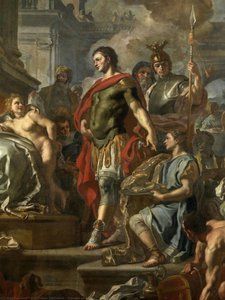
A Neapolitan Master of Baroque Grandeur
Francesco Solimena, born in the small Italian town of Canale di Serino near Avellino in 1657, emerged as one of the most significant figures in Neapolitan painting during the late Baroque period. His artistic journey began within a family already steeped in artistic tradition; his father, Angelo Solimena, served as his initial instructor, collaborating with him on early projects like the Paradise fresco for the cathedral of Nocera. This foundational experience instilled in young Francesco a deep appreciation for technique and composition – an understanding that would profoundly shape his later work. He further honed his skills under the tutelage of Francesco di Maria and Giacomo del Po, absorbing diverse influences from across Italy, particularly those emanating from Rome and Venice. The patronage of Cardinal Vincenzo Orsini proved crucial, providing encouragement and opportunities that allowed Solimena to establish himself as an independent artist by the 1680s, undertaking increasingly ambitious fresco commissions for prominent churches and palaces throughout Naples.Forging a Style: Echoes of Rome in Neapolitan Splendor
Solimena’s artistic voice is immediately recognizable through its distinctive qualities – a warm, brownish shadowing combined with a dramatic use of light. These elements are deeply indebted to the Roman Baroque masters, particularly Luca Giordano and Giovanni Lanfranco, whose techniques he meticulously studied and adapted. However, Solimena didn't merely imitate; instead, he synthesized these influences into a uniquely Neapolitan aesthetic – a style that retained the grandeur and theatricality characteristic of the Baroque period while simultaneously incorporating local traditions and sensibilities. His paintings are characterized by dynamic compositions brimming with emotional intensity, reflecting the spirit of the age. He possessed an exceptional ability to capture movement and drama within his scenes, drawing viewers directly into the narratives he depicted—whether they were sacred tales or mythological adventures. The influence of Mattia Preti, known for his dramatic lighting and intense color palettes, is also evident in Solimena’s work, adding another layer of complexity to his artistic vocabulary.The Workshop and a School of Artists
From the 1690s onward, Solimena's studio became a dominant force in Naples, shaping the artistic landscape of the city for decades. It wasn’t just a place of production; it was a veritable academy, nurturing a generation of talented painters. His workshop churned out an astonishing volume of work – altarpieces, frescoes, and canvases that adorned churches, palaces, and private residences throughout the region. A key characteristic of his compositional approach involved suggesting settings with minimal detail—a few strategically placed steps, archways, or balustrades—allowing the viewer’s eye to be drawn directly to the figures within the scene and their richly detailed draperies. These draperies were often illuminated by carefully positioned light sources, creating a sense of drama and highlighting the figures' emotional states. The influence of Solimena extended far beyond his own artistic creations; he mentored numerous pupils who went on to become prominent artists in their own right – including Francesco de Mura, Giuseppe Bonito, Pietro Capelli, and Corrado Giaquinto—solidifying his position as a central figure in 18th-century Italian art.Major Works and Artistic Themes
Francesco Solimena’s artistic output spanned a wide range of subjects and formats. He excelled in large-scale fresco cycles, transforming the interiors of Neapolitan churches and palaces into vibrant displays of religious fervor and aristocratic splendor. His altarpieces are particularly noteworthy for their ability to convey complex theological narratives with both emotional depth and technical brilliance. Beyond his religious works, Solimena also demonstrated a mastery of mythological scenes, imbuing classical tales with dramatic energy and sensuous beauty. Among his most celebrated pieces is the *Allegory of Rule*, currently housed in the State Hermitage Museum in St. Petersburg – a testament to his skill in allegorical representation and sophisticated composition. His depictions of weddings and courtly events further showcase his versatility, capturing the elegance and opulence of Neapolitan society. Works like “St John the Baptist” and “The Assumption and Coronation of the Virgin” exemplify his mastery of chiaroscuro and dynamic compositions.Legacy and Historical Significance
Francesco Solimena’s impact extended far beyond his own artistic creations. He achieved considerable financial prosperity during his lifetime, being bestowed with the title of baron and living a life commensurate with his fame. He died in 1747 at Barra, near Naples, leaving behind an enduring legacy that continues to be celebrated through exhibitions, scholarly studies, and reproductions available today. Solimena stands as one of the most important figures in Neapolitan Baroque painting, successfully synthesizing Roman influences with local traditions to create a distinctive style that defined artistic production in Naples for generations. His works remain admired for their dramatic flair, technical mastery, and enduring beauty – a testament to his genius and lasting contribution to art history.Вопросы и ответы
Есть ли общий обзор всех сюжетов, которые писал Франческо Солимена?
Атлас сюжетов для Франческо Солимена — это страница, на которой произведения художника распределены по темам.
Можно ли просматривать работы Франческо Солимена по цветовой палитре?
На странице По цветовым палитрам работы Франческо Солимена сгруппированы по их цветовым палитрам.
Какие настроения передают работы Франческо Солимена?
Работы Франческо Солимена можно просматривать по настроению на странице Комната настроения, где произведения распределены в соответствии с их эмоциональной окраской.