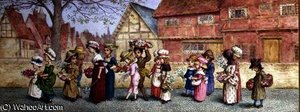
A Childhood Reverie: The Life and Art of Kate Greenaway
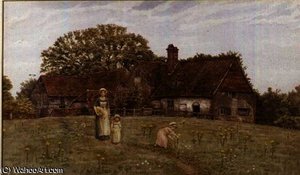
Kate Greenaway, born in the bustling heart of Victorian London in 1846, emerged as a luminous figure within the artistic landscape—a gentle artist who captured the essence of childhood innocence and idyllic beauty. Her story is one intricately woven with threads of familial creativity, a deep-seated longing for tranquility, and an unwavering determination to forge her own unique artistic path. The daughter of John Greenaway, a skilled draughtsman and wood-engraver whose illustrations graced the pages of the esteemed *Illustrated London News* and *Punch*, and Elizabeth, a talented dressmaker, Kate’s early life was profoundly shaped by the visual world around her. Her father's profession exposed her to the subtle nuances of line and form, while her mother’s expertise in fabrics and fashion instilled within her a keen eye for detail, color, and texture—qualities that would become hallmarks of her distinctive style. Crucially, Kate spent summers immersed in the serene beauty of Rolleston, Nottinghamshire, a rural haven where she developed an enduring love for the countryside, its wildflowers, and the simple pleasures of childhood. These formative experiences – the vibrant colors of nature, the tactile quality of textiles, and the unburdened joy of play – served as the wellspring of her artistic inspiration throughout her career.
Forging a Unique Style: Influences and Artistic Development
Kate Greenaway’s artistic journey wasn't simply a reflection of idyllic memories; it was also shaped by rigorous academic training. She embarked on her artistic education at several prestigious institutions – the South Kensington School of Art, the Royal Female School of Art, and ultimately, the Slade School of Fine Art in London. While these schools provided her with invaluable technical skills in graphic design and fine arts, Greenaway found herself increasingly frustrated by the rigid conventions and emphasis on copying that characterized much of the curriculum. She yearned to break free from these constraints, seeking a more expressive and imaginative approach to art—a desire that fueled her determination to develop her own distinctive voice. This pursuit of artistic independence led her initially to designing Christmas and Valentine’s cards – a burgeoning market at the time – where she could experiment with color, composition, and illustration techniques. A pivotal moment arrived through her collaboration with Edmund Evans, a renowned wood-block engraver and printer. Their partnership proved remarkably fruitful, resulting in a series of publications that would catapult Greenaway to national recognition. Early influences included artists like John Leech, John Gilbert, and Kenny Meadows, whose work she admired and studied—artists who had previously graced the pages of *Illustrated London News* and *Punch*. However, it was Greenaway’s ability to synthesize these influences with her own unique sensibility – a sensitivity honed by her childhood experiences in Rolleston – that truly set her apart. She wasn't merely imitating; she was transforming familiar subjects into something entirely new and captivating.
The “Kate Greenaway Style” and Lasting Achievements
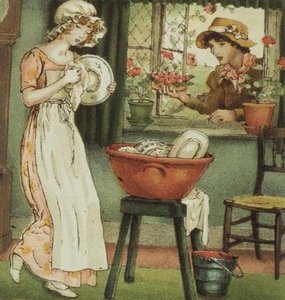
The publication of *Under the Window* in 1879 marked a watershed moment, not only for Kate Greenaway but for the entire landscape of children’s literature. The book's immediate success established her signature style—a whimsical depiction of children adorned in elaborate 18th-century costumes, set against the backdrop of a charmingly idealized Queen Anne aesthetic. This “Kate Greenaway Style” – characterized by its delicate watercolor technique, meticulous detail, and an almost dreamlike quality – quickly became immensely popular, imitated widely and influencing fashion, interior design, and decorative arts. *Under the Window* wasn’t just a book; it was a portal to a world of gentle fantasy and timeless grace. Following this initial triumph, Greenaway continued to produce a prolific body of work throughout the 1880s and 1890s, including titles like *A Posy Book*, *The Baby’s Book of Songs and Nursery Rhymes*, and an alphabet book that further cemented her reputation as one of the foremost illustrators for children. Her ability to capture a sense of innocence, nostalgia, and quiet joy resonated deeply with Victorian audiences—offering a comforting escape from the often-harsh realities of industrial life. She didn’t simply illustrate stories; she created worlds that invited readers to step into a realm of gentle fantasy and timeless grace.
A Legacy of Charm and Innovation
Kate Greenaway's historical significance extends far beyond her artistic achievements. Her work reflected—and subtly challenged—the Victorian fascination with childhood innocence and idealized domesticity. While embracing traditional themes, she infused them with a sense of imaginative storytelling and expressive characterization that broke from strict realism. She revolutionized children’s book illustration, establishing a new standard for artistic quality and narrative depth. Moreover, Greenaway's success as a female artist in a male-dominated field paved the way for future generations of women illustrators and artists. Her illustrations continue to be celebrated today for their beauty, charm, and enduring appeal—a testament to her unique vision and lasting impact on Victorian aesthetics. Her work remains a poignant reminder of a bygone era, capturing the fleeting moments of childhood joy with exquisite detail and heartfelt emotion.
Major Works:Under the Window, A Posy Book, The Baby’s Book of Songs and Nursery Rhymes.
Key Characteristics: Depictions of children in 18th-century attire, Queen Anne style settings, delicate watercolor technique.
Lasting Influence: Revolutionized children's book illustration, impacted fashion and design, inspired future generations of female artists.
Редакцией OriginalUniqueArt.com
Тест по искусству
В каждом вопросе только один правильный ответ.
Вопрос 1:
В каком городе родилась Екатерина Гринэвей?
Вопрос 2:
Какая профессия была у отца Екатерины Гринэвей?
Вопрос 3:
Какой роман считается главным произведением Екатерины Гринэвей и определил ее стиль в литературе для детей?
Вопрос 4:
В каком стиле изображены дети в иллюстрациях Екатерины Гринэвей?
Вопрос 5:
С каким гравером сотрудничала Екатерина Гринэвей, что стало ключевым фактором ее успеха?
Explore the captivating world of Kay Rasmus Nielsen, a celebrated Golden Age illustrator renowned for his Art Nouveau fairy tale art & Disney contributions. Discover his unique style, enduring legacy, and how to collect his enchanting works.
Explore the exquisite world of Victorian Illustration. Discover the masters of the Golden Age, from Arthur Rackham to Edmund Dulac, through an in-depth historical journey into the era's unparalleled detail and narrative artistry.
Explore the life & art of Hablot Knight Browne ('Phiz'), Dickens's iconic illustrator. Discover his masterful social commentary, technical innovations, and enduring legacy in Victorian illustration. A critical examination for history lovers.