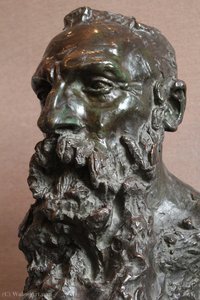
Camille Claudel: A Sculptor's Passion and Shadow
Camille Claudel (1864-1943) remains a figure of enduring fascination—a sculptor whose extraordinary talent was tragically overshadowed by personal turmoil and societal prejudice. Born in Fère-en-Tardenois, Aisne, France, into a family rooted in rural tradition yet embracing intellectual curiosity, Claudel’s early life foreshadowed her destiny as an artist who would forge her own path against prevailing norms. Her father, Louis-Prosper Claudel, was involved in financial dealings—a profession that contrasted sharply with the artistic inclinations blossoming within his daughter. Louise-Athanaïse Cerveaux, Claudel's mother, descended from Champagne’s aristocratic lineage, imbuing Camille with a connection to heritage and refinement. Despite familial pressures, Claudel possessed an innate fascination for working with natural materials—clay, soil, stone—a preoccupation that would become central to her artistic vision. From a young age, she demonstrated an unparalleled sensitivity to form and texture, instinctively responding to the world around her with sculptural expression.Early Years and Artistic Influences
Claudel’s formative years were marked by a profound encounter with Alfred Boucher, a sculptor who recognized her exceptional talent and became her first teacher in Paris. Boucher instilled in Claudel a disciplined approach to art—a focus on anatomical accuracy and the mastery of classical techniques—influences that would subtly shape her subsequent work. However, it was Auguste Rodin’s arrival in her life that irrevocably altered her trajectory. Drawn to Rodin's monumental sculptures and his exploration of human emotion, Claudel joined his workshop as a model, quickly surpassing this role through collaboration, mentorship, and ultimately, passionate love. This relationship proved transformative—Rodin nurtured Claudel’s artistic sensibilities while simultaneously presenting her with the complexities of romantic partnership. The dynamic between Rodin and Claudel fueled their creative endeavors but was shadowed by Rodin's existing commitments and inherent power imbalances. Claudel absorbed Rodin’s stylistic principles—particularly his emphasis on expressive gesture and psychological depth—yet she steadfastly pursued her own distinctive voice, rejecting imitation in favor of genuine artistic exploration.Collaboration with Rodin: The Burghers of Calais and Beyond
Claudel's contribution to Rodin’s magnum opus, *The Burghers of Calais*, exemplifies her meticulous craftsmanship and understanding of sculptural form. She skillfully modeled the hands and feet of the figures—a task requiring unparalleled precision—demonstrating a mastery of anatomy that belied her youth. This collaboration solidified Claudel’s reputation as a sculptor of exceptional skill and cemented her place within the artistic landscape of Belle Époque Paris. Beyond *The Burghers of Calais*, Claudel worked on numerous other projects alongside Rodin, including *Gates of Hell* and *Bal du Moulin Rouge*, immersing herself in the exploration of human emotion and dramatic composition. Her involvement in these monumental undertakings underscored her commitment to pushing the boundaries of sculptural expression—challenging conventions and embracing innovation.A Singular Style: Emotion and Form
Claudel’s artistic style is characterized by its raw emotional intensity, dynamic compositions, and profound engagement with human relationships. Unlike many sculptors of her time who adhered to idealized forms rooted in classical tradition, Claudel prioritized capturing genuine emotion—love, longing, despair—through sculptural representation. Her figures are imbued with movement—a palpable sense of energy and dynamism—reflecting her belief that sculpture should convey not merely appearance but also psychological state. Claudel’s sculptures eschewed polished surfaces and meticulous detail—favoring instead expressive textures and asymmetrical forms—a stylistic choice that distinguished her work from prevailing trends. Notable works include *The Waltz*, which captures the fleeting beauty of movement and emotion; *Young Girl with a Sheaf*, portraying innocence and vulnerability; and *Sakuntala*, inspired by Indian mythology, demonstrating Claudel’s willingness to draw inspiration from diverse cultural sources. Her sculptures are imbued with an unmistakable spirit—a conviction that art should illuminate the complexities of human experience.Legacy and Rediscovery
Despite facing considerable obstacles throughout her life—including professional setbacks stemming from gender discrimination and personal struggles exacerbated by mental illness—Claudel achieved recognition as a sculptor of unparalleled originality and talent. Her tragic fate—institutionalization following a breakdown fueled by familial pressures and societal biases—served as a poignant reminder of the challenges faced by female artists in a patriarchal society. However, Claudel’s work experienced a resurgence of interest in the late 20th century—driven by biographical research and exhibitions that illuminated her artistic achievements and underscored her enduring legacy. The opening of the Musée Camille Claudel in Nogent-sur-Seine in 2017 stands as a testament to this belated but fitting tribute—a celebration of Claudel’s extraordinary artistry and a poignant reflection on the elusive pursuit of creative fulfillment. Today, Camille Claudel is rightfully regarded as one of France's most significant sculptors—an artist whose passionate work continues to inspire admiration and provoke contemplation.Вопросы и ответы
Сколько произведений искусства Камиль Клодель доступно для просмотра?
Вы можете просмотреть 13 произведений искусства работ художника Камиль Клодель на странице Все произведения искусства.
Как найти все работы Камиль Клодель, выполненные в определенной технике?
На странице Все техники работы Камиль Клодель сгруппированы по технике исполнения.
Где я могу увидеть работы Камиль Клодель в хронологическом порядке?
Существует хронология работ Камиль Клодель: на странице Хронология произведений произведения художника расположены в порядке даты их создания.