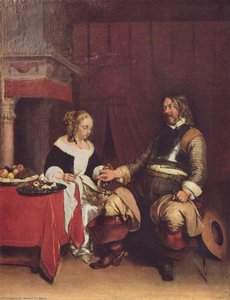
Gerard ter Borch - A Pioneer of Dutch Genre Painting
Gerard ter Borch (Dutch: Gerard Terburg; December 1617 – 8 December 1681) was an influential and pioneering Dutch genre painter who lived in the Dutch Golden Age. He influenced fellow Dutch painters Gabriel Metsu, Gerrit Dou, Eglon van der Neer and Johannes Vermeer.According to Arthur K. Wheelock Jr., Ter Borch “established a new framework for subject matter, taking people into the sanctum of the home”, showing the figures’ uncertainties and expertly hinting at their inner lives. His influence as a painter, however, was later surpassed by Vermeer.
Biography
Gerard ter Borch was born in December 1617 in Zwolle in the province of Overijssel in the Dutch Republic. He received an excellent education from his father Gerard ter Borch the Elder, also an artist, and developed his talent very early. The inscription on a study of a head proves that Ter Borch was at Amsterdam in 1632, where he studied possibly under Willem Cornelisz Duyster or Pieter Codde. Duyster's influence can be traced in a picture bearing the date 1638, in the lonides Bequest (Victoria and Albert Museum), London. In 1634 he studied under Pieter de Molijn in Haarlem. A record of this Haarlem period is the Consultation (1635) at the Berlin Gallery. In 1635 he was in London, and subsequently he travelled in Germany, France, Spain and Italy. His sister Gesina also became a painter. It is certain that he was in Rome in 1641, when he painted the small portraits on copper of Jan Six ,A Young Lady (Six Collection, Amsterdam) and the portrait of a Gentleman (DMK Collection Nuermberg).At this time Ter Borch was invited to visit Madrid, where he received employment and the honour of knighthood from Philip IV, but, in consequence of an intrigue, it is said, he was obliged to return to the Netherlands. He seems to have resided for a time in Haarlem; but he finally settled in Deventer, where he became a member of the town council, as which he appears in the portrait now in the gallery of the Hague.
Notable Works and Achievements
- The Letter: A masterpiece showcasing ter Borch's skill in capturing texture and light.
- The Gallant Conversation: Engraved by johann georg wille, this piece exemplifies the artist’s ability to convey nuanced emotions.
- Man on horseback (1634): An early work demonstrating ter Borch's emerging talent.
- Adrian Pauw's arrival in münster (1646): A significant piece that highlights the artist’s narrative capabilities.
Museums and Collections Featuring Ter Borch’s Work
- The Hermitage: With six of his works, it boasts one of the largest collections.
- Berlin Museum: Features six pieces, showcasing ter Borch's international appeal.
- Getty Center: Three of his paintings are part of this esteemed collection.
Legacy and Impact
Ter Borch’s influence on Dutch painters like Gabriel Metsu, Gerrit Dou, Eglon van der Neer, and Johannes Vermeer is well-documented. His innovative approach to genre painting has made him a pivotal figure in the history of art.
Вопросы и ответы
Под какими еще именами известен Геррит тер Борх?
Геррит тер Борх также известен как Геррд тер Бёрг, Герард тер Бёрг.
Какие работы Геррит тер Борх просматривают чаще всего?
Для Геррит тер Борх существует страница Статистика, на которой представлены статистические данные о произведениях этого художника на этот сайт.
Можно ли просматривать работы Геррит тер Борх по технике исполнения?
Чтобы найти все работы Геррит тер Борх в определенной технике, воспользуйтесь страницей Все техники художника.