Портрет William James Blacklock

12 самых известных картин William James Blacklock, каждая из которых уникальна

Обновлено Ноябрь 2026 · рейтинг на основе нашего показателя популярности (количество поисковых запросов, посещений и заказов для каждой работы) · 14 работ William James Blacklock в нашем каталоге

Вкратце

Landscape with Bridge and Figures (1858) — это картина William James Blacklock, которая привлекает больше всего взглядов. Затем взгляд переходит на The Terrace, Haddon Hall (1845) и On the Banks of Derwentwater Silver Birch (1843). Из 14 работ William James Blacklock в нашем каталоге эти 12 являются самыми известными: каждая из них — уникальный оригинал с указанием года создания, музея и причины ее бессмертия.

1816 – 1858, Shoreditch Больше всего работ: Национальная галерея Ирландии

Топ-10 картин William James Blacklock глазами галереи

6
The Ruins of Kirkoswald Castle, Cumberland (1854) работы William James Blacklock

The Ruins of Kirkoswald Castle, Cumberland

1854 · Laing Art Gallery, Ньюкасл-апон-Тайн

In the quiet corners of Cumberland, where history breathes through the cracks of weathered stone, William James Blacklock captured a moment of profound stillness in his 1854 masterpiece, The Ruins of Kirkoswald Castle. This evocative landscape does more than merely document a crumbling structure; it invites the viewer into a romantic dialogue between man-made grandeur and the inexorable persistence of nature. The painting presents the skeletal remains of the castle,…

8
Catbells and Causey Pike, Derwentwater (1854) работы William James Blacklock

Catbells and Causey Pike, Derwentwater

1854

The majestic landscape of Catbells and Causey Pike, Derwentwater is a testament to the artistic genius of William James Blacklock, a renowned British artist. This stunning oil on canvas painting, created in 1854, measures 32 x 55 cm and is currently housed at the Tullie House Museum and Art Gallery in the United Kingdom. A Glimpse into the Painting's Details The painting depicts a serene valley surrounded by snow-capped mountains,…

9
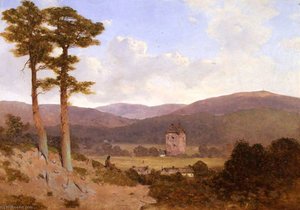
Gilnockie Tower (1843) работы William James Blacklock

Gilnockie Tower

1843

The Gilnockie Tower painting by William James Blacklock is a beautiful representation of a peaceful landscape. Created in 1843, this oil on canvas piece measures 49 x 69 cm and is currently housed at the Tullie House Museum and Art Gallery in the United Kingdom. The scene features a man standing between two trees, with mountains in the background and a castle-like structure, possibly a church or tower, surrounded by…

10
Buit's Castle, Bewcastle (1844) работы William James Blacklock

Buit's Castle, Bewcastle

1844

The painting Buit's Castle, Bewcastle by William James Blacklock is a stunning representation of the English landscape. Created in 1844, this oil on canvas piece measures 32 x 55 cm and is currently housed at the Tullie House Museum and Art Gallery in the United Kingdom. A Glimpse into the Artist's Style William James Blacklock was an English landscape painter known for his scenery depictions in Cumbria, the Lake District,…

Знаменитые картины William James Blacklock, с 11 по 12

Сюжеты, которые вдохновляли William James Blacklock

Четыре темы, которые чаще всего встречаются в этих оригиналах, каждая из которых представлена своим лучшим образцом.

Музеи, в которых хранятся оригиналы работ William James Blacklock

3 музеев, в которых находится большинство картин со страницы.

Музей Город Работы William James Blacklock Картины из этого списка
Национальная галерея Ирландии, ДублинНациональная галерея Ирландии Дублин 1 Naworth Castle, Cumbria
Abbot Hall Art Gallery, КендалAbbot Hall Art Gallery Кендал 1 Devock Water
Laing Art Gallery, Ньюкасл-апон-ТайнLaing Art Gallery Ньюкасл-апон-Тайн 1 The Ruins of Kirkoswald Castle, Cumberland

William James Blacklock сквозь года: уникальные оригиналы каждой работы

Долгий творческий путь в 16 лет, с 1843 по 1858: самые известные оригинальные работы William James Blacklock, представленные по годам.

Работы по годам

Выберите год, чтобы увидеть оригиналы.

Картины William James Blacklock: вопросы к галерее

Какая работа William James Blacklock является самой известной?Узнать ответ

Landscape with Bridge and Figures (1858). Далее следуют The Terrace, Haddon Hall (1845) и On the Banks of Derwentwater Silver Birch (1843).

В каком возрасте William James Blacklock создал(а) Landscape with Bridge and Figures?Узнать ответ

42 лет: Landscape with Bridge and Figures датируется 1858 годом, а William James Blacklock родился в 1816.

Какие десять картин William James Blacklock являются самыми известными?Узнать ответ

Landscape with Bridge and Figures, The Terrace, Haddon Hall, On the Banks of Derwentwater Silver Birch, Naworth Castle, Cumbria, Devock Water, The Ruins of Kirkoswald Castle, Cumberland, Scene on the Wear, Catbells and Causey Pike, Derwentwater, Gilnockie Tower и Buit's Castle, Bewcastle. В рейтинге выше указаны год создания и музей для каждой работы.

Сколько известно работ William James Blacklock?Узнать ответ

В нашем каталоге представлено 14 работ William James Blacklock, созданных в период с 1843 по 1858.

Где можно увидеть подлинники, созданные William James Blacklock?Узнать ответ

В основном в Национальная галерея Ирландии (Дублин), Abbot Hall Art Gallery (Кендал) и Laing Art Gallery (Ньюкасл-апон-Тайн). В таблице выше перечислены все музеи.

В какой период William James Blacklock создал свои самые известные картины?Узнать ответ

В 1854: 3 из 12 работ на этой странице были созданы в этот период, The Ruins of Kirkoswald Castle, Cumberland из них.

Какая из знаменитых картин William James Blacklock была написана раньше, а какая — позже?Узнать ответ

На этой странице самая ранняя работа датирована On the Banks of Derwentwater Silver Birch (1843), а самая поздняя — Landscape with Bridge and Figures (1858).

Какие сюжеты предпочитал William James Blacklock?Узнать ответ

Landscape (4), Trees (2) и River (2) в 12 работах на этой странице.

William James Blacklock: портрет художника

A Life Immersed in Landscape: The Evocative World of William James Blacklock

William James Blacklock, born in the bustling heart of Shoreditch, London, in 1816, was an artist whose life became inextricably linked with the serene beauty of the British countryside. Though initially rooted in the urban landscape of his birth, a pivotal relocation as a young boy would forever shape his artistic vision. In 1818, his family returned to their ancestral Cumberland roots, settling in Cumwhitton near Carlisle, where they embraced farming and a quieter existence. This immersion into the natural world proved transformative for Blacklock, igniting within him a passion for landscape painting that would define his career. His early training began with an apprenticeship to a local bookseller, but his innate artistic talent soon led him to formal studies at the Carlisle Academy of Art under Matthew Ellis Nutter. Even in these formative years, Blacklock demonstrated a remarkable sensitivity to nature, earning recognition as a “rising artist” upon exhibiting his work locally in 1833 and subsequently at the prestigious Royal Academy from 1836 onwards.

Bridging Romanticism and Pre-Raphaelite Sensibilities

Blacklock’s artistic development unfolded against a backdrop of shifting aesthetic currents. His time in London, beginning in 1836, exposed him to the influences of prominent artists such as William Mulready, J.M.W. Turner, David Roberts, and Thomas Creswick. While his style initially echoed the traditions of Romantic landscape painting—characterized by dramatic compositions and emotional intensity—Blacklock soon began to forge a unique path. He possessed an exceptional eye for detail and atmospheric light, qualities that set him apart. A crucial moment in this evolution came with the cleaning of old master paintings at the National Gallery in 1844-45. This experience provided Blacklock with invaluable insights into artistic techniques and the subtle nuances of color and form. It was during this period that he began experimenting with a groundbreaking “white ground” technique, applying luminous glazes over a white base layer to achieve an extraordinary sense of luminosity and depth in his paintings.

The White Ground Technique and Artistic Innovation

This innovative approach did not go unnoticed. Blacklock’s "white ground" technique became the subject of intense study among artists associated with the burgeoning Pre-Raphaelite movement, including William Bell Scott and Dante Gabriel Rossetti. The Steps at Haddon Hall (1848), is considered a prime example of this technique, showcasing its ability to capture light and texture with remarkable fidelity. While Blacklock’s meticulous attention to detail often drew comparisons to the Pre-Raphaelites, he consciously rejected Ruskin's emphasis on strict naturalism. He believed that art should not merely replicate nature but rather express the artist’s inner thoughts and imagination. This distinction is crucial to understanding Blacklock’s unique position within 19th-century British art—he stood at a fascinating intersection between Romantic ideals, Pre-Raphaelite precision, and his own deeply personal vision. His notable paintings include Buit’s Castle, Bewcastle, Gilnockie Tower, Landscape with Bridge and Figures, and The Rookery (1854).

Recognition, Decline, and Lasting Legacy

Blacklock’s talent garnered recognition from influential figures of his time. William Ewart Gladstone acquired his painting *Lanercost Abbey*, a testament to the artist's growing reputation. Further patronage came from Tyneside industrialists James Leathart and Lord Armstrong, facilitated by the support of William Bell Scott. However, Blacklock’s success was tragically cut short by declining health and eyesight. By 1850, he returned to Cumwhitton, continuing to work in his studio as long as possible. Sadly, he succumbed to mental health challenges, attributed to syphilis, and was admitted to the Crichton Royal Hospital in Dumfries in 1855. Despite his condition, he continued to draw until mid-1857, a poignant testament to his unwavering dedication to art. He passed away in 1858 at the age of 42. Though his life was relatively short, William James Blacklock left an indelible mark on British landscape painting. His work represents a pivotal moment between the early 19th-century landscape school and the innovative spirit of the Pre-Raphaelite movement. As Geoffrey Grigson observed, he belonged to a generation bridging Romanticism and Impressionism, deeply influenced by Italian Renaissance masters like Giorgione and Giovanni Bellini. Today, his paintings are treasured for their evocative beauty, technical mastery, and unique contribution to the rich tapestry of British art history.

A Pioneer Remembered

  • Early Influences: Turner, Creswick, Roberts, Mulready.
  • Key Technique: The “white ground” technique – luminous glazes over a white base.
  • Notable Works: *Lanercost Abbey*, *Gilnockie Tower*, *The Steps at Haddon Hall*.
  • Patrons: William Ewart Gladstone, James Leathart, Lord Armstrong.
  • Historical Significance: Bridged Romanticism and Pre-Raphaelitism; influenced by Italian Renaissance masters.