Портрет Уильям Мейсон Браун

44 самых известных картин Уильям Мейсон Браун, каждая из которых уникальна

Обновлено Ноябрь 2026 · рейтинг на основе нашего показателя популярности (количество поисковых запросов, посещений и заказов для каждой работы) · 44 работ Уильям Мейсон Браун в нашем каталоге

Вкратце

Summer Pastures (1856) — это картина Уильям Мейсон Браун, которая привлекает больше всего взглядов. Затем взгляд переходит на Still Life (also known as Fruit and Art Objects) (1888) и Landscape with Two Indians (1855). Из 44 работ Уильям Мейсон Браун в нашем каталоге эти 44 являются самыми известными: каждая из них — уникальный оригинал с указанием года создания, музея и причины ее бессмертия.

1823 – 1899, Нью-Йорк Hudson river school Больше всего работ: Музей искусств Толедо

Топ-10 картин Уильям Мейсон Браун глазами галереи

1
Summer Pastures (1856) работы Уильям Мейсон Браун

Summer Pastures

1856 · Oil On Canvas

The scene unfolds within the quiet expanse of Summer Pastures, a work that captures a specific moment of pastoral peace. Painted in 1856, this piece brings the viewer into a lush, green world where the air feels heavy with the warmth of a midsummer afternoon. The artist, William Brown, also known by his full name William Mason Brown, directs our gaze across a landscape that feels both vast and intimately…

Знаменитые картины Уильям Мейсон Браун, с 11 по 44

Знаменитые картины Уильям Мейсон Браун по периодам творчества

Сюжеты, которые вдохновляли Уильям Мейсон Браун

Четыре темы, которые чаще всего встречаются в этих оригиналах, каждая из которых представлена своим лучшим образцом.

Музеи, в которых хранятся оригиналы работ Уильям Мейсон Браун

7 музеев, в которых находится большинство картин со страницы.

Музей Город Работы Уильям Мейсон Браун Картины из этого списка
Музей искусств Толедо, ТоледоМузей искусств Толедо Толедо 1 Landscape with Two Indians
Yale Center for British Art, Нью-ХейвенYale Center for British Art Нью-Хейвен 1 Tiptree Hall and Farm, Essex
Crystal Bridges Museum of American Art, БентонвиллCrystal Bridges Museum of American Art Бентонвилл 1 Raspberries in a Wooded Landscape
Кливлендский музей искусств, КливлендКливлендский музей искусств Кливленд 1 Still Life with Cantaloupe
Birmingham Museum of Art, БирмингемBirmingham Museum of Art Бирмингем 1 Still Life with Cantaloupe
Национальная галерея искусств, ВашингтонНациональная галерея искусств Вашингтон 1 Mound of Cherries
Fries Museum, ЛеуварденFries Museum Леуварден 1 Still Life with Melon, Peach, Fruit-Filled Compote and Glass of Wine on a Marble Table Top

Уильям Мейсон Браун сквозь десятилетия: по одному уникальному оригиналу на каждое десятилетие

Произведения по десятилетиям

Выберите десятилетие, чтобы увидеть шедевр, определяющий его.

Картины Уильям Мейсон Браун: вопросы к галерее

Какая работа Уильям Мейсон Браун является самой известной?Узнать ответ

Summer Pastures (1856). Далее следуют Still Life (also known as Fruit and Art Objects) (1888) и Landscape with Two Indians (1855).

В каком возрасте Уильям Мейсон Браун создал(а) Summer Pastures?Узнать ответ

33 лет: Summer Pastures датируется 1856 годом, а Уильям Мейсон Браун родился в 1823.

Какие десять картин Уильям Мейсон Браун являются самыми известными?Узнать ответ

Summer Pastures, Still Life (also known as Fruit and Art Objects), Landscape with Two Indians, Tiptree Hall and Farm, Essex, Untitled (also known as Landscape with Indians), Three Men in a Landscape, Landscape with Two Indians, Raspberries in a Wooded Landscape, Still Life with Watermelon, Grapes, Peaches, Plums and Cantaloupe и Still Life with Melon, Grapes, Peaches, Pears and Black Raspberries. В рейтинге выше указаны год создания и музей для каждой работы.

Сколько известно работ Уильям Мейсон Браун?Узнать ответ

В нашем каталоге представлено 44 работ Уильям Мейсон Браун, созданных в период с 1850 по 1888.

Где можно увидеть подлинники, созданные Уильям Мейсон Браун?Узнать ответ

В основном в Музей искусств Толедо (Толедо), Yale Center for British Art (Нью-Хейвен) и Crystal Bridges Museum of American Art (Бентонвилл). В таблице выше перечислены все музеи.

В какой период Уильям Мейсон Браун создал свои самые известные картины?Узнать ответ

В 1850s: 7 из 44 работ на этой странице были созданы в этот период, Summer Pastures из них.

Какая из знаменитых картин Уильям Мейсон Браун была написана раньше, а какая — позже?Узнать ответ

На этой странице самая ранняя работа датирована Tiptree Hall and Farm, Essex (1850), а самая поздняя — Still Life (also known as Fruit and Art Objects) (1888).

Какие сюжеты предпочитал Уильям Мейсон Браун?Узнать ответ

Landscape (8), Life (8) и Fruits (6) в 44 работах на этой странице.

К какому направлению относится творчество Уильям Мейсон Браун?Узнать ответ

Hudson river school, судя по оригиналам на этой странице.

Уильям Мейсон Браун: портрет художника

The Meticulous Vision of William Mason Brown

Born in Troy, New York, William Mason Brown emerged as a distinctive voice within the American art landscape, carving out a legacy defined by an extraordinary devotion to detail. His artistic journey began under the tutelage of Abel Buell Moore, the preeminent portraitist of Troy, which laid the foundation for a career that would traverse several captivating genres. While his early training was rooted in the intimate realm of portraiture, Brown’s creative spirit eventually expanded into the sweeping vistas of the landscape and the hyper-realistic precision of still life painting.

As a prominent member of the second generation of the Hudson River School, Brown’s early work reflected the romantic traditions established by masters such as Thomas Cole. During his time in Newark, New Jersey, starting around 1850, he specialized in landscapes that captured the grandeur and serenity of the natural world. These works often featured a striking balance between vast, atmospheric backgrounds—such as distant mountains and flowing rivers—and an exacting, almost photographic precision in the foreground elements. This duality allowed him to evoke both the sublime scale of nature and a profound sense of tranquility.

A Transition to Hyper-Realistic Still Life

A pivotal shift occurred in 1858 when Brown moved to Brooklyn, New York, a transition that saw him move away from the expansive horizons of landscape painting toward the concentrated intensity of still life. This period marked his emergence as a master of trompe-l'œil, a technique designed to deceive the eye into perceiving three-dimensional reality on a flat canvas. Influenced by the Pre-Raphaelite movement and the teachings of John Ruskin, Brown developed a style characterized by an almost obsessive attention to texture and light.

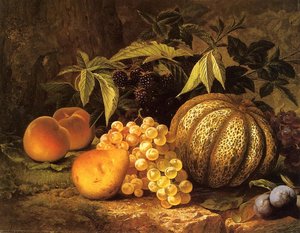
His still lifes became celebrated for their ability to replicate the tactile essence of the subjects they depicted. He possessed a rare talent for textural duplication, capturing the delicate fuzz on a peach or the intricate rind of a cantaloupe with such clarity that his work was often compared to the precision of French academician Jean-Léon Gérôme. In these compositions, Brown avoided visible brushwork, preferring a smooth, seamless finish that allowed the viewer to lose themselves in the luminous highlights and organic weights of fruit, berries, and flowers.

Legacy and Artistic Significance

Throughout his long career, Brown was a consistent and respected presence in the American art community, exhibiting annually at the National Academy of Design for over three decades. His ability to reach a wide audience through chromolithographic reproductions ensured that his meticulous renderings of nature were admired far beyond the gallery walls. His work remains preserved in prestigious institutions, including:

The historical significance of William Mason Brown lies in his unique ability to bridge the gap between the romanticism of the Hudson River School and the rigorous, scientific observation of the Pre-Raphaelite influence. By mastering both the sweeping emotion of the landscape and the quiet, intense reality of the still life, he left behind a body of work that celebrates the profound beauty found in both the vastness of the earth and the smallest details of its bounty.