Портрет Уильям Моррис

26 самых известных картин Уильям Моррис: подборка галереи

Обновлено Октябрь 2026 · рейтинг на основе нашего показателя популярности (количество поисковых запросов, посещений и заказов для каждой работы) · 37 работ Уильям Моррис в нашем каталоге

Вкратце

Из всех оригинальных работ, оставленных Уильям Моррис, самой известной является Strawberry Thief (1936) из коллекции Кливлендский музей искусств, Кливленд. Сразу за ними следуют The Little Tree (Hammersmith Rug) (1895) и Snakeshead (1900). В нашем каталоге представлено 37 работ Уильям Моррис; галерея сохранила 26 самых почитаемых в мире произведений, каждое из которых сопровождается датой создания, информацией о музее и своей историей.

1834 – 1896, Валтамстёв Arts and crafts Больше всего работ: William Morris Gallery

10 лучших картин Уильям Моррис: выбор галереи

1
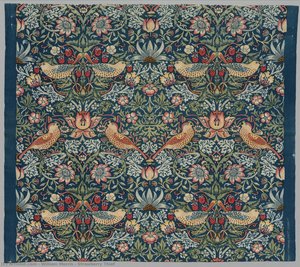
Strawberry Thief (1936) работы Уильям Моррис

Strawberry Thief

1936 · Textile · Кливлендский музей искусств, Кливленд

William Morris's "Strawberry Thief," completed in 1936, isn’t merely a decorative textile; it’s a vibrant distillation of the Arts and Crafts movement’s core tenets – a celebration of nature, a rejection of industrialization, and a subtle yet potent expression of social critique. This iconic design, now instantly recognizable, draws its inspiration from Morris's own garden at Kelmscott Manor in Oxfordshire, specifically the mischievous thrushes that frequented his fruit beds. The…

2
The Little Tree (Hammersmith Rug) (1895) работы Уильям Моррис

The Little Tree (Hammersmith Rug)

1895 · Textile · Музей прикладного искусства, Будапешт

William Morris’s “The Little Tree” (Hammersmith Rug), completed in 1895, isn't merely a decorative textile; it’s a meticulously crafted portal to a world steeped in medieval romance, folklore, and the enduring beauty of nature. Born from the fertile imagination of one of England’s most influential artists and designers, this rug embodies the core tenets of the Arts and Crafts movement – a rejection of mass-produced industrialism in favour of handcrafted…

3
Snakeshead (1900) работы Уильям Моррис

Snakeshead

1900 · Textile · Кливлендский музей искусств, Кливленд

The fabric breathes with a heavy, rhythmic energy, pulling the eye into a dense thicket of color. Deep reds and stark blacks collide in a pattern that feels both grounded and strikingly bold. Small, delicate motifs move across the surface, creating a sense of movement that mimics the swaying of wildflowers in a summer breeze. There is a certain tension here, found in the way the dark tones press against…

4
Design for (1881) работы Уильям Моррис

Design for

1881 · Textile · William Morris Gallery, Уолтемстоу

Before he was a revolutionary socialist, a poet of immense talent, or simply one of the most celebrated textile designers in history, William Morris was a young man captivated by the remnants of a lost world. Born in Walthamstow, Essex, in 1834, his childhood was steeped in the romanticism of medieval chivalry and the beauty of the English countryside—a landscape he would relentlessly strive to capture within his designs. This…

5
Design for (1876) работы Уильям Моррис

Design for

1876 · William Morris Gallery, Уолтемстоу

In the delicate interplay of flora and geometry, Design for stands as a profound testament to the visionary genius of William Morris. Created in 1876, this exquisite piece is far more than a mere decorative pattern; it is a bridge between the artisanal traditions of the past and the burgeoning aesthetic movements of the nineteenth century. The work captures a moment where nature and craftsmanship converge, offering a rhythmic dance…

8
Design for (1862) работы Уильям Моррис

Design for

1862 · Acrylic · William Morris Gallery, Уолтемстоу

A Celebration of Pastoral Harmony: Exploring William Morris’s Watercolor Design The watercolor painting titled “Design for” by William Morris stands as a testament to the Arts and Crafts movement's unwavering belief in the restorative power of nature and its rejection of mass production. Executed in 1862, this artwork isn’t merely a depiction of flora; it’s an embodiment of Morris’s artistic ethos—a deliberate attempt to recapture the idealized beauty of the…

9
Design for woven fabric with birds and palms (1870) работы Уильям Моррис

Design for woven fabric with birds and palms

1870 · William Morris Gallery, Уолтемстоу

This sketch by William Morris was likely intended for a woven textile repeat pattern, but was never realised. It bears a resemblance to a number of bird designs Morris & Co. produced in the late 1870s, including ‘Bird’ and ‘Bird and Dragon’, both designed by Morris in 1878. The fabrics were manufactured at the Morris & Co. premises at Queen Square, London, before subsequently being woven on hand-activated jacquard looms…

10
Qui Bien Aime Tard Oublie (1860) работы Уильям Моррис

Qui Bien Aime Tard Oublie

1860 · Embroidery · William Morris Gallery, Уолтемстоу

In the delicate interplay of thread and color, "Qui Bien Aime Tard Oublie" emerges as a breathtaking testament to the Pre-Raphaelite spirit and the profound connection between art and the natural world. Created in 1860 by the legendary William Morris, this extraordinary embroidery is far more than a mere decorative hanging; it is a window into a romanticized era where craftsmanship served as a vessel for deep emotion. The work…

The Уильям Моррис selection continues, 11 to 26

Сюжеты, которые вдохновляли Уильям Моррис

Четыре темы, которые чаще всего встречаются в этих оригиналах, каждая из которых представлена своим лучшим образцом.

Музеи, в которых хранятся оригиналы работ Уильям Моррис

6 музеев, в которых находится большинство картин со страницы.

Музей Город Работы Уильям Моррис Картины из этого списка
William Morris Gallery, УолтемстоуWilliam Morris Gallery Уолтемстоу 13 Design for, Design for, Design for
Кливлендский музей искусств, КливлендКливлендский музей искусств Кливленд 2 Strawberry Thief, Snakeshead
Музей прикладного искусства, БудапештМузей прикладного искусства Будапешт 1 The Little Tree (Hammersmith Rug)
Boca Raton Museum of Art, Бока-РатонBoca Raton Museum of Art Бока-Ратон 1 Petroglyph Vessel
The Baltimore Museum of Art, БалтиморThe Baltimore Museum of Art Балтимор 1 Роза
Тейт Брититен, ЛондонТейт Брититен Лондон 1 La Belle Iseult

Уильям Моррис по десятилетиям: оригиналы, определяющие каждую эпоху

Произведения по десятилетиям

Выберите десятилетие, чтобы увидеть шедевр, определяющий его.

Вопросы коллекционеров о картинах Уильям Моррис

Какая работа Уильям Моррис наиболее известна?Узнать ответ

Strawberry Thief (1936), Кливлендский музей искусств, Кливленд. Далее следуют The Little Tree (Hammersmith Rug) (1895) и Snakeshead (1900).

Какие десять самых известных картин написал Уильям Моррис?Узнать ответ

Strawberry Thief, The Little Tree (Hammersmith Rug), Snakeshead, Design for, Design for, Fruit, Honeycomb, Design for, Design for woven fabric with birds and palms и Qui Bien Aime Tard Oublie. В рейтинге выше указаны год создания и музей для каждой работы.

Сколько картин оставил(а) Уильям Моррис?Узнать ответ

В нашем каталоге представлено 37 работ Уильям Моррис, созданных в период с 1857 по 1895.

В каких музеях представлены шедевры Уильям Моррис?Узнать ответ

В основном в William Morris Gallery (Уолтемстоу), Кливлендский музей искусств (Кливленд) и Музей прикладного искусства (Будапешт). В таблице выше перечислены все музеи.

В какие годы Уильям Моррис написал свои самые известные работы?Узнать ответ

В 1870s: 5 из 26 работ на этой странице были созданы в этот период, Design for из них.

Каковы первые и последние известные оригинальные работы Уильям Моррис?Узнать ответ

На этой странице самая ранняя работа датирована Sword (1857), а самая поздняя — The Little Tree (Hammersmith Rug) (1895).

Какие сюжеты Уильям Моррис выбирал чаще всего?Узнать ответ

Pattern (5), Floral pattern (4) и Textile design (3) в 26 работах на этой странице.

Какую технику чаще всего использовал(а) Уильям Моррис?Узнать ответ

Textile, для 4 из 26 работ на этой странице.

К какому художественному направлению относится Уильям Моррис?Узнать ответ

Arts and crafts, судя по оригиналам на этой странице.

Какие работы Уильям Моррис представлены в William Morris Gallery?Узнать ответ

Design for, Design for и Design for: в коллекции William Morris Gallery, Уолтемстоу находится 10 работ со страницы.

Можно ли заказать репродукцию картины Уильям Моррис?Узнать ответ

Да, в качестве репродукции: оригинал остается в музее, но любую картину на этой странице можно заказать в ручной работе — индивидуально для вас, непосредственно со страницы самой картины.

Уильям Моррис: жизнь и творчество

William Morris (1834–1896): A Life Rooted in Nature and Romance

William Morris, born on March 24, 1834, in Walthamstow, Essex, emerged from a comfortably affluent middle-class background—a circumstance that afforded him the freedom to pursue passions rather than professions. His father’s success as a financier provided not only security but also an environment where aesthetic sensibilities could flourish. Morris's childhood was deeply shaped by the English countryside surrounding his home and a fascination with tales of medieval chivalry, laying the groundwork for a lifelong devotion to both natural beauty and romantic narratives. These early influences weren’t merely sentimental; they formed the core of his artistic philosophy. He wasn’t simply *inspired* by nature or the past—he believed in their inherent moral and aesthetic superiority to the rapidly industrializing present. His formal education at Oxford University initially steered him toward a clerical path, but it was within the vibrant intellectual circles of the university that his true calling began to take shape. He joined “The Set,” a group of students who shared an intense interest in art, literature, and medieval history, forging friendships—most notably with Edward Burne-Jones—that would profoundly impact his artistic trajectory. It was during this period that he encountered the writings of John Ruskin, whose critique of industrial society and advocacy for craftsmanship resonated deeply with Morris’s burgeoning beliefs.

The Arts & Crafts Revolution

Following Oxford, a brief foray into architecture quickly gave way to painting, as Morris collaborated with Dante Gabriel Rossetti on mural projects. However, it was the founding of Morris, Marshall, Faulkner & Co. in 1861—later known simply as Morris & Co.—that marked a pivotal moment, not just in his career but in the history of design. This wasn’t merely a business venture; it was an attempt to create a new way of life, one where art permeated every aspect of daily existence and craftsmanship was valued above all else. Alongside Burne-Jones, Rossetti, Philip Webb, and others, Morris sought to revive traditional techniques and produce beautiful, well-made objects for the home. The firm’s early work was profoundly influenced by Red House—a rural retreat designed by Webb—where Morris lived from 1859 to 1865. This house embodied the Arts & Crafts ideal of creating a unified aesthetic environment through handcrafted furnishings and decoration, reflecting Morris's belief that beauty should be inseparable from functionality. He championed handmade craftsmanship as an antidote to the dehumanizing effects of mass production—a radical notion at a time when design was often seen as separate from function. This conviction extended beyond mere aesthetics; it was rooted in a deep social conscience and a desire to improve the lives of working people. Morris’s artistic vision wasn't confined to decorative arts; he also produced significant literary works, exploring themes of mythology, folklore, and utopian ideals.

A Literary Voice Amidst Medieval Visions

Morris’s poetic output—including *The Earthly Paradise* and *A Dream of John Ball*—established him as a key figure in the Victorian fantasy genre. His poems captured the spirit of medieval chivalry and romantic idealism, reflecting his lifelong fascination with the past and its moral lessons. He skillfully blended mythology, folklore, and Christian symbolism to create narratives that transported readers to imaginative worlds—a feat remarkable for its time. Furthermore, Morris’s prose writings—such as *News from Nowhere*—presented a utopian vision of society based on communal ownership, ecological harmony, and artistic creativity. This ambitious project aimed to critique Victorian materialism and propose an alternative path toward human flourishing—a testament to his intellectual curiosity and his unwavering belief in the transformative power of art.

Morris & Co.: Craftsmanship Elevated

The Morris, Marshall, Faulkner & Co. firm became synonymous with Arts & Crafts excellence. Under Morris’s leadership, the company produced a breathtaking array of decorative arts—furniture, stained glass windows, textiles, wallpapers, and carpets—each meticulously crafted by skilled artisans using traditional methods. These creations weren't simply aesthetically pleasing; they were imbued with symbolic meaning and reflected Morris’s profound understanding of natural forms and humanist values. The firm’s designs revolutionized interior decoration, rejecting the ornate styles of the Victorian era in favor of understated elegance and harmonious color palettes—a stylistic shift that continues to inspire designers today. Morris’s commitment to preserving historic buildings also cemented his legacy as a champion of cultural heritage. He founded the Society for the Preservation of Ancient Buildings to combat the destructive forces of industrialization and advocate for responsible architectural conservation.

An Enduring Influence on Art and Thought

William Morris died October 3, 1896 in Bexleyheath, Kent. His work continues to resonate with artists and designers across disciplines—a testament to his enduring vision of beauty, craftsmanship, and social justice. He remains a pivotal figure in the Arts & Crafts movement and an inspiration for those who strive to create art that elevates human experience and fosters a deeper connection with the natural world. His legacy extends beyond individual artworks; it encompasses a broader ethos—one that prioritizes ethical production, aesthetic contemplation, and the pursuit of a more humane society.

Все 37 работ Уильям Моррис →