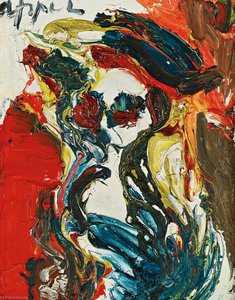
Портрет Кarel Appel

40 самых известных картин Кarel Appel, каждая из которых уникальна

Обновлено Ноябрь 2026 · рейтинг на основе нашего показателя популярности (количество поисковых запросов, посещений и заказов для каждой работы) · 41 работ Кarel Appel в нашем каталоге

Вкратце

Square Man, Karel Appel, 1951 (1951) — это картина Кarel Appel, которая привлекает больше всего взглядов. Затем взгляд переходит на Untitled (1960) и Three Figures (1952). Из 41 работ Кarel Appel в нашем каталоге эти 40 являются самыми известными: каждая из них — уникальный оригинал с указанием года создания, музея и причины ее бессмертия.

1921 – 2006, Амстердам Cobra Больше всего работ: Израильский музей

Топ-10 картин Кarel Appel глазами галереи

1
Square Man, Karel Appel, 1951 (1951) работы Кarel Appel

Square Man, Karel Appel, 1951

1951 · Oil On Canvas

Square Man, Karel Appel, 1951 is an oil on canvas painting created by the artist Karel Appel. This work was executed in Paris in 1951. The physical presence of the piece is defined by its nearly square proportions, measuring 120,5 cm in height and 118 cm in width, with a depth of 4 cm.

2
Untitled (1960) работы Кarel Appel

Untitled

1960 · Screenprint · Тейт Брититен, Лондон

In the landscape of post-war European modernism, few voices resonate with as much raw, unbridled vitality as that of Karel Appel. His 1960 work, Untitled, serves as a breathtaking manifesto of the COBRA movement, an avant-garde collective that sought to strip away the suffocating layers of academic tradition in favor of something far more primal. To encounter this piece is to witness a deliberate rebellion; it is not merely a…

Знаменитые картины Кarel Appel, с 11 по 40

Сюжеты, которые вдохновляли Кarel Appel

Четыре темы, которые чаще всего встречаются в этих оригиналах, каждая из которых представлена своим лучшим образцом.

Музеи, в которых хранятся оригиналы работ Кarel Appel

6 музеев, в которых находится большинство картин со страницы.

Музей Город Работы Кarel Appel Картины из этого списка
Израильский музей, ИерусалимИзраильский музей Иерусалим 3 Three Figures, Man and Woman (Homme et femme), Head Burst on Red
Тейт Брититен, ЛондонТейт Брититен Лондон 2 Untitled, Untitled (from For Jorn)
Королевский музей изящных искусств Антверпена, АнтверпенКоролевский музей изящных искусств Антверпена Антверпен 2 Flying Man, Animal and Child on Blue Background
Институт искусств Чикаго, ЧикагоИнститут искусств Чикаго Чикаго 1 Untitled
Баварские государственные живописные коллекции, МюнхенБаварские государственные живописные коллекции Мюнхен 1 Figure and Suns
Statens Museum For Kunst, КопенгагенStatens Museum For Kunst Копенгаген 1 Uden titel

Кarel Appel сквозь десятилетия: по одному уникальному оригиналу на каждое десятилетие

Произведения по десятилетиям

Выберите десятилетие, чтобы увидеть шедевр, определяющий его.

Картины Кarel Appel: вопросы к галерее

Какая работа Кarel Appel является самой известной?Узнать ответ

Square Man, Karel Appel, 1951 (1951). Далее следуют Untitled (1960) и Three Figures (1952).

В каком возрасте Кarel Appel создал(а) Square Man, Karel Appel, 1951?Узнать ответ

30 лет: Square Man, Karel Appel, 1951 датируется 1951 годом, а Кarel Appel родился в 1921.

Какие десять картин Кarel Appel являются самыми известными?Узнать ответ

Square Man, Karel Appel, 1951, Untitled, Three Figures, Hip, Hip, Hoorah, Questioning Children, Hip, Hip, Hoorah (Hiep, hiep, hoera ), Blauw naakt, Étienne Martin, The Big Ear и Beast. В рейтинге выше указаны год создания и музей для каждой работы.

Сколько известно работ Кarel Appel?Узнать ответ

В нашем каталоге представлено 41 работ Кarel Appel, созданных в период с 1949 по 1976.

Где можно увидеть подлинники, созданные Кarel Appel?Узнать ответ

В основном в Израильский музей (Иерусалим), Тейт Брититен (Лондон) и Королевский музей изящных искусств Антверпена (Антверпен). В таблице выше перечислены все музеи.

В какой период Кarel Appel создал свои самые известные картины?Узнать ответ

В 1950s: 17 из 40 работ на этой странице были созданы в этот период, Square Man, Karel Appel, 1951 из них.

Какая из знаменитых картин Кarel Appel была написана раньше, а какая — позже?Узнать ответ

На этой странице самая ранняя работа датирована Hip, Hip, Hoorah (1949), а самая поздняя — Untitled (from For Jorn) (1976).

Какие сюжеты предпочитал Кarel Appel?Узнать ответ

Organic forms (2), Abstract (2) и Color field (2) в 40 работах на этой странице.

Какими материалами чаще всего пользовался Кarel Appel?Узнать ответ

Oil On Canvas, для 4 из 40 работ на этой странице.

К какому направлению относится творчество Кarel Appel?Узнать ответ

Cobra, судя по оригиналам на этой странице.

Какие оригинальные работы Кarel Appel можно увидеть в Израильский музей?Узнать ответ

Three Figures, Man and Woman (Homme et femme) и Head Burst on Red: в коллекции Израильский музей, Иерусалим находится 3 работ со страницы.

Кarel Appel: портрет художника

Christiaan Karel Appel: A Life Painted in Bold Strokes

Karel Appel, affectionately known as ‘Kik’ from childhood, burst onto the post-war art scene like a vibrant explosion of color and energy. Born in Amsterdam in 1921, his early life was steeped in the everyday rhythms of working-class Holland – his father a barber, his lineage tracing back to French Huguenots through his mother. This grounding, however, would soon be superseded by an irrepressible artistic drive that defied convention and ultimately reshaped the landscape of European art. A pivotal moment arrived at age fourteen with his first painting, a still life of fruit, followed shortly after by a paint set and easel gifted by his uncle Karel Chevalier, who also provided early instruction. These gifts weren’t merely tools; they were keys unlocking a world where imagination reigned supreme. The shadow of the Second World War loomed large over Appel’s formative years. Studying at the Rijksakademie van Beeldende Kunsten in Amsterdam during the German occupation proved challenging, yet it was there he forged lifelong bonds with fellow artists Corneille and Constant, friendships that would prove crucial to his artistic evolution. Facing opposition from his parents regarding his chosen path and fearing forced labor under Nazi rule, Appel bravely left home, choosing a life dedicated to art over conformity.

Early Life and Artistic Beginnings

Christiaan Karel Appel was born on April 25, 1921, in Amsterdam’s Dapperstraat 7, the son of Jan Appel, who ran a barbershop, and Johanna Chevallier, descended from Huguenot refugees. He had three brothers. From a young age, Appel demonstrated an innate fascination with art—a passion ignited by his uncle Karel Chevalier, who gifted him a paint set and easel at fourteen. This simple act profoundly shaped Appel’s artistic trajectory, fostering a belief in spontaneous expression and rejecting academic constraints. His first painting, a still life of fruit, served as a formative experience, establishing the foundation for his distinctive style.

The CoBrA Revolution: Embracing Childlike Vision

Appel’s artistic journey truly blossomed with the formation of the CoBrA group in 1948 – an acronym derived from Copenhagen, Brussels, and Amsterdam—representing the movement’s core cities. Alongside Corneille Guillaume Beverloo and Constant Nieuwenhuys, Appel spearheaded a radical departure from established artistic norms. CoBrA wasn’t merely a style; it was a philosophy rooted in spontaneity, experimentation, and a profound embrace of the untamed creativity found in children's art and primitive cultures. Influenced by masters like Pablo Picasso and Henri Matisse, as well as the raw energy of Jean Dubuffet, Appel rejected rigid formalism in favor of intuitive expression. He began sculpting in 1947, utilizing assemblage techniques – constructing works from found materials painted in a bold palette of white, red, yellow, blue, and black—a technique that would become synonymous with his artistic vision. The CoBrA group’s manifesto declared “La cause était entendue,” rejecting the conventions of Surrealism and De Stijl.

International Recognition and Artistic Development

Appel’s relocation to Paris in 1950 marked a pivotal moment, propelling him into an era of prolific international travel and exposure. He explored Mexico, the USA, Yugoslavia, and Brazil, absorbing diverse cultural influences that enriched his artistic vocabulary. His debut American gallery exhibition at Martha Jackson Gallery in 1954 garnered significant acclaim, followed by inclusion in MoMA’s “The New Decade” exhibition in 1955—a testament to CoBrA's influence on the broader art landscape. Appel’s monumental murals continued to solidify his reputation as a visionary artist, demonstrating his ability to translate his dynamic style onto grand scales. Despite initial resistance from critics and institutions, Appel experienced a resurgence of popularity in the Netherlands after 1990, culminating in major exhibitions organized by Rudy Fuchs in Amsterdam and Brussels—affirming his legacy within his homeland.

Legacy and Enduring Influence

Karel Appel’s contribution to post-war European art is undeniable. He established the Karel Appel Foundation to safeguard his artworks and promote public awareness of his oeuvre, ensuring that future generations could appreciate the power of his distinctive aesthetic. His unwavering belief in spontaneity and childlike vision—inspired by children's art—continues to resonate with contemporary artists who champion experimentation and reject traditional boundaries. Appel’s work remains a significant testament to the transformative potential of artistic expression and serves as an enduring inspiration for artists worldwide.