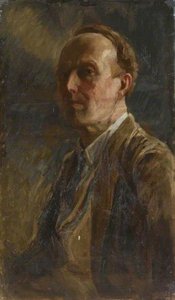
Henry Mitton Wilson: A Quiet Observer of British Landscape
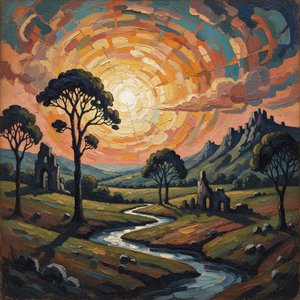
Henry Mitton Wilson (born circa 1869, died Living) stands as a testament to the understated beauty found within British Impressionism and the enduring legacy of the Arts and Crafts movement. Though often overshadowed by more flamboyant contemporaries like Philip Wilson Steer, Wilson’s meticulous dedication to capturing the essence of rural tranquility—particularly in scenes surrounding Teddington Lock and St Albans Cathedral—reveals an artist deeply attuned to both visual observation and moral contemplation. His canvases whisper tales of Victorian England, imbued with a profound respect for craftsmanship and a fascination with the transformative power of natural light.
Early Life & Artistic Beginnings
Information regarding Wilson’s formative years remains elusive, hinting at a childhood nurtured by artistic pursuits—a characteristic that would undoubtedly shape his future endeavors. He pursued formal training at Slade School of Fine Art in London, immersing himself in the stylistic currents championed by luminist painters such as Frederic Church. This exposure instilled within him an appreciation for monumental landscapes and fostered a technique focused on conveying grandeur through careful tonal manipulation – principles that would become foundational to his artistic practice. The influence of Church’s expansive vistas undoubtedly contributed to Wilson's own ambition to depict nature with unwavering accuracy and emotional resonance.
The Arts and Crafts Movement: A Foundation of Values
Wilson’s early works firmly establish him as a devotee of the Arts and Crafts movement—a cultural reaction against industrialization that prioritized artistic integrity and ethical considerations alongside aesthetic beauty. His landscapes frequently incorporate vernacular architectural elements, reflecting a desire to honor tradition and celebrate the tangible connections between humanity and its environment. These paintings aren't merely representations of places; they embody a belief in the moral significance of craftsmanship and an aspiration to infuse art with spiritual depth—values that resonated deeply within the broader Arts and Crafts ethos.
Teddington Lock: Capturing Dusk’s Gentle Embrace
Wilson achieved considerable renown for his depictions of Teddington Lock, capturing the serene luminescence of the Thames estuary as twilight descended. Employing Impressionistic techniques—loose brushstrokes blended with broken color palettes—he skillfully blurred edges to convey not just visual fidelity but also a palpable sense of mood and atmosphere. These canvases transcend mere topographical accuracy; they evoke the quiet contemplation inherent in observing nature’s rhythms, mirroring the spirit of Impressionism itself. The subtle tonal harmonies achieved by Wilson exemplify the movement's commitment to capturing fleeting moments of beauty—a feat accomplished with remarkable sensitivity and precision.
Notable Achievements & Exhibitions
Wilson’s artistic vision was recognized throughout his lifetime through regular participation in prestigious exhibitions at London’s Royal Academy and Tate Gallery. Among his most celebrated pieces are ‘Canal in a Landscape,’ showcasing masterful tonal blending that captures the idyllic serenity of rural life, and numerous depictions of St Albans Cathedral—a subject he revisited repeatedly with unwavering dedication. These works solidified Wilson's position as a respected artist within the British art scene and ensured that his artistic legacy would endure beyond his own lifetime.
Legacy & Continuing Influence
Today, Henry Mitton Wilson’s paintings reside in collections at Musée Thomas-Henry in Évreux and The Wilson Art Gallery & Museum in Cheltenham—providing visitors with invaluable opportunities to experience firsthand the understated elegance of his oeuvre. His work continues to inspire admiration for its quiet contemplation and its ability to evoke the spirit of Victorian Britain, reminding us that beauty can be found not only in grand gestures but also in meticulous observation and profound respect for the natural world. Examining Philip Wilson Steer’s artistic trajectory offers a compelling comparative perspective on the broader context of British Impressionism during his era—illuminating the shared values and stylistic approaches that defined this pivotal moment in art history.