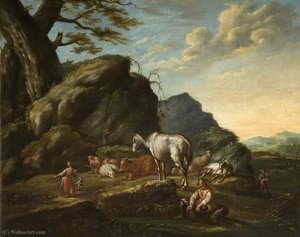
Goats and Flock of Sheep
Goats and Flock of Sheep is an oil painting by Philipp Peter Roos. The artist, who was also known by the moniker Rosa di Tivoli, produced this work about 1681. He was a German Baroque painter born in Sankt Goar, Germany.
Вкратце
Из всех оригинальных работ, оставленных Филипп Петер Роос, самой известной является Goats and Flock of Sheep (1681) из коллекции Баварские государственные живописные коллекции, Мюнхен. Сразу за ними следуют Piece of Livestock (1681) и Landscape with Cattle and Shepherd (1681). В нашем каталоге представлено 93 работ Филипп Петер Роос; галерея сохранила 92 самых почитаемых в мире произведений, каждое из которых сопровождается датой создания, информацией о музее и своей историей.
Goats and Flock of Sheep is an oil painting by Philipp Peter Roos. The artist, who was also known by the moniker Rosa di Tivoli, produced this work about 1681. He was a German Baroque painter born in Sankt Goar, Germany.
Piece of Livestock is an oil painting by Philipp Peter Roos, executed in 1681. The work originates from the Baroque period, a time when the artist was establishing his presence within the Italianate landscape tradition.
Landscape with Cattle and Shepherd is a work by the German Baroque painter Philipp Peter Roos. Created about 1681, the painting reflects the artist's specialized focus on pastoral scenes and animal subjects. Roos was a significant figure in the development of Italianate landscapes, often characterized by his intimate study of livestock and the natural environment.
In Piece of Livestock, Philipp Peter Roos organizes a pastoral scene through a close-up, ground-level perspective that establishes an immediate intimacy with the subjects. The composition is dominated by a large, seated cow positioned slightly to the right of the center. To the left, a smaller lamb or calf provides a sense of scale, while a woman interacts with a dog in the space behind the primary subject. This arrangement…
Resting Flock with Shepherds is an oil painting by the German Baroque artist Philipp Peter Roos. Created about 1681, this work captures a quiet moment within a rugged landscape. The composition focuses on a group of livestock and a shepherd, rendered with a sense of immediate presence that draws the viewer into the scene.
Resting Flock with Shepherds is an oil painting by Philipp Peter Roos. The canvas captures a heavy stillness among livestock and their guardian. This work was created about 1681. It presents a scene of animals and men gathered in a quiet, layered space under a turbulent sky.
In this Baroque-style oil painting, the mythological drama of the Liberation of Io unfolds with a sudden, heavy intensity. Created by Philipp Peter Roos about 1681, the scene captures a moment of profound tension between the divine and the mortal. A massive, powerful bull dominates the foreground, its muscular form rendered with a weight that feels almost tangible. This central figure looms over the landscape, its presence commanding the space…
This oil on canvas painting, dated 1681, presents a monochromatic scene rendered in various shades of gray. In the foreground, a young woman is positioned amidst a group of livestock, including sheep or goats. The composition is a medium shot, placing the human subject and the animals in the immediate front and middle ground. The terrain is undulating, forming rolling hills that recede into a background of hazy mountains and…
Returning Flock with Shepherds is an oil painting by Philipp Peter Roos. Created about 1681, the work captures a quiet moment of pastoral movement. The artist, a German Baroque painter, was born in Sankt Goar. He would later become known by the moniker Rosa di Tivoli.
The scene unfolds in Shepherd with Cow, Sheep and Goats in Italian Mountain Landscape, a work that captures a quiet moment of pastoral life. This painting, created about 1680, brings together a shepherd and his diverse herd amidst a rugged, mountainous setting. The figures and animals exist within a landscape that feels both immediate and deeply rooted in the natural world.
Четыре темы, которые чаще всего встречаются в этих оригиналах, каждая из которых представлена своим лучшим образцом.
8 музеев, в которых находится большинство картин со страницы.
| Музей | Город | Работы Филипп Петер Роос | Картины из этого списка |
|---|---|---|---|
| Мюнхен | 15 | Goats and Flock of Sheep, Piece of Livestock, Landscape with Cattle and Shepherd | |
| Копенгаген | 5 | Cattle Piece, Landscape with a Bull, Sheep and Goats, A Shepherd with his Herd | |
| Буэнос-Айрес | 4 | Landscape with shepherd and animals, Landscape with figures and animals, Shepherd and animals in a landscape | |
| Братислава | 3 | Goat Herd with a Goatherd, Shepherd's Idyl in a Romantic Landscape with Ruins, Herd by an Ancient Well | |
| Прага | 3 | Ravine with a Stream, a Shepherd and His Herd, Horse and Goats Grazing, Shepherd with a Herd of Sheep and Goats | |
| Вена | 3 | Herd with Sleeping Shepherds, Rider Meeting, Landscape with Flock of Sheep | |
| Санкт-Петербург | 3 | Landscape with a Grotto, Landscape with a Waterfall, Landscape with a Herd | |
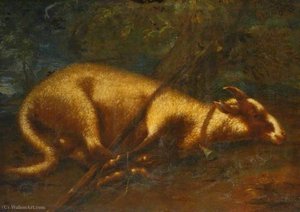
| Стокгольм | 3 | Dead Hare, Landskap med hjord, A Goat Resting |
Выберите десятилетие, чтобы увидеть шедевр, определяющий его.
This large-scale oil painting, dated 1669, presents a crowded, maximalist composition of diverse animal species. The arrangement is packed, with various animals overlapping to create a sense of density and movement. The color palette relies on deep, earthy tones, including rich browns, blacks, and dark ochres. These dark shades are interrupted by specific highlights of white and cream, alongside splashes of red from a rooster and parrots. The lighting follows…
Goats and Flock of Sheep is an oil painting by Philipp Peter Roos. The artist, who was also known by the moniker Rosa di Tivoli, produced this work about 1681. He was a German Baroque painter born in Sankt Goar, Germany.
A heavy, dark-colored cow anchors the center of this scene, its presence felt in the weight of its silhouette. To the left, two goats rest upon the ground, one a pale contrast of white and light tan against the shadows. A man sits nearby, leaning back in a moment of stillness, his gaze directed toward the animals or perhaps the viewer. The air in the enclosure feels thick and dim,…
In this work, titled Shepherd's Idyl in a Romantic Landscape with Ruins, the artist Philipp Peter Roos presents a quiet moment of rural existence. Created about 1700, the painting captures a shepherd tending to his flock amidst a landscape of rolling hills and weathered stone structures. There is a sense of stillness in the way the figures and animals occupy the space, suggesting a life governed by the rhythms of…
Goats and Flock of Sheep (1681), Баварские государственные живописные коллекции, Мюнхен. Далее следуют Piece of Livestock (1681) и Landscape with Cattle and Shepherd (1681).
24 лет: Goats and Flock of Sheep датируется 1681 годом, а Филипп Петер Роос родился в 1657.
Goats and Flock of Sheep, Piece of Livestock, Landscape with Cattle and Shepherd, Piece of Livestock, Resting Flock with Shepherds, Resting Flock with Shepherds, Liberation of Io, Piece of Cattle, Returning Flock with Shepherds и Shepherd with Cow, Sheep and Goats in Italian Mountain Landscape. В рейтинге выше указаны год создания и музей для каждой работы.
В нашем каталоге представлено 93 работ Филипп Петер Роос, созданных в период с 1669 по 1700.
В основном в Баварские государственные живописные коллекции (Мюнхен), Statens Museum For Kunst (Копенгаген) и Национальный музей изобразительных искусств (Буэнос-Айрес). В таблице выше перечислены все музеи.
В 1680s: 21 из 92 работ на этой странице были созданы в этот период, Goats and Flock of Sheep из них.
На этой странице самая ранняя работа датирована Various animals gathered before Noah's Ark (1669), а самая поздняя — Shepherd's Idyl in a Romantic Landscape with Ruins (1700).
Landscape (33), Animals (29) и Goats (19) в 92 работах на этой странице.
Oil On Canvas, для 18 из 92 работ на этой странице.
Baroque, судя по оригиналам на этой странице.
Goats and Flock of Sheep, Piece of Livestock и Landscape with Cattle and Shepherd: в коллекции Баварские государственные живописные коллекции, Мюнхен находится 15 работ со страницы.
В золотом свете итальянского барокко лишь немногие имена вызывают столь же глубокое чувство пасторального спокойствия сельской местности, как имя Филипп Петер Роос. Известный истории под своим выразительным прозвищем, Rosa di Tivoli, этот мастер, рожденный в Германии, преобразил жанр пейзажа через глубокую, почти висцеральную связь с миром природы. Рожденный в 1655 году в регионе Рейнланд — а именно близ Санкт-Коара — Роос был предназначен для кисти с самых ранних лет. Он был сыном Иоганна Генриха Рооса, уважаемого пейзажиста, который заложил основы его мастерства, обучив его тональной гармонии и композиционному балансу, которые позже определят зрелый стиль художника. Это раннее ученичество было не просто обучением технике; это было погружение в способ видения мира через призму света, тени и тихого достоинства земли.
Траектория жизни Рооса резко изменилась в 1677 году благодаря щедрости Карла I, ландграфа Гессен-Кассельского. Заметив растущий талант молодого живописца, ландграф предоставил средства для трансформационного путешествия в Рим. Этот переход от германских традиций к самому сердцу итальянского барокко позволил Роосу впитать живую энергию римского искусства. Именно здесь он искал наставничества у знаменитого Джачинто Бранди, чье влияние помогло отточить способность Рооса сочетать классическую структуру со спонтанным, атмосферным реализмом. Этот период в Риме был также глубоко личным: именно в эти годы Роос влюбился в Изабеллу Бранди, дочь своего наставника. Их союз в конечном итоге привел его к поселению в Тиволи — шаг, который навсегда связал его личность с пейзажем, который он так любил.
Что действительно отличает творчество Rosa di Tivoli, так это беспрецедентная подлинность его животных персонажей. В отличие от многих современников, которые использовали животных лишь как декоративное дополнение к пейзажу, Роос относился к каждому существу — от массивного быка до проворной козы — с почтением портретиста. Его резиденция в Тиволи была знаменита тем, что была организована по принципу живой студии; он содержал обширную коллекцию экзотических и домашних животных, фактически превращая свое окружение в непрерывное исследование движения, анатомии и темперамента. Такая близость позволяла ему улавливать тончайшее движение уха или мышечное напряжение зверя, находящегося в напряжении, придавая своим полотнам захватывающую дух витальность.
Его техническое мастерство проявляется в том, как он ориентировался в сложностях эстетики барокко. Хотя его композиции часто опираются на безмятежные, атмосферные качества Золотого века Голландии, они пронизаны драматической интенсивностью, характерной для итальянской школы. Его работы часто воплощают в себе:
Историческая важность Филиппа Петера Рооса заключается в его способности преодолеть разрыв между структурированными традициями пейзажа Северной Европы и эмоциональной, наполненной светом драмой Италии. Он появился в эпоху, когда научный поиск того времени начал требовать более точных наблюдений за природным миром, даже когда религиозные и мифологические темы все еще доминировали в художественном сознании. В его картинах можно найти как тщательную детализацию натуралиста, так и поэтическую душу романтика. Документируя флору и фауну римской сельской местности с таким рвением, он создал визуальный архив, который в равной степени повествует как о духе эпохи, так и о самих предметах изображения.
Хотя он скончался в 1706 году, оставив после себя наследие, запечатленное в самой почве Тиволи, его влияние сохранилось. Он остается ключевой фигурой для любого, кто изучает эволюцию анималистического жанра и развитие итальянизированного пейзажа. Его глазами мы видим не просто коллекцию скота; мы становимся свидетелями глубокого торжества жизни в ее самых фундаментальных, неприкрашенных формах. Его работа продолжает резонировать как свидетельство силы наблюдения и непреходящей красоты пасторального идеала.