The Sculptor of Shadows and Light: The Life of Olin Levi Warner
In the annals of late 19th-century American sculpture, few names evoke the delicate balance between classical grandeur and intimate realism as poignantly as Olin Levi Warner. Born in 1844 in the quiet town of Suffield, Connecticut, Warner carried within his lineage a sense of historical weight, being a descendant of the Revolutionary War hero Seth Warner. This ancestral connection to American legend perhaps preordained his lifelong devotion to the art of commemoration. Before he ever wielded a chisel against marble or bronze, Warner’s hands were acquainted with the practicalities of the modern age; his early years as an artisan and a telegraph operator provided him with a unique, disciplined precision—a technical dexterity that would later define the meticulous detail of his sculptural masterpieces.
The trajectory of Warner’s life shifted irrevocably in 1869 when he sought the artistic soul of Europe. Arriving in Paris, he immersed himself in the rigorous academic atmosphere of the École nationale supérieure des beaux-arts. Under the tutelage of François Jouffroy, Warner began to master the language of classical form, but it was his association with the legendary Jean-Baptiste Carpeaux that truly ignited his creative spirit. From Carpeaux, Warner learned to infuse the rigid traditions of academic sculpture with a sense of vitality and movement, a stylistic hallmark that would allow him to capture not just the likeness of a subject, but their very essence. Even the turbulence of the Franco-Prussian War could not derail his artistic evolution; having enlisted in the Foreign Legion, he emerged from the conflict with a deepened resolve to bring the sophisticated nuances of French sculpture back to American soil.
A Legacy in Bas Relief and Bronze
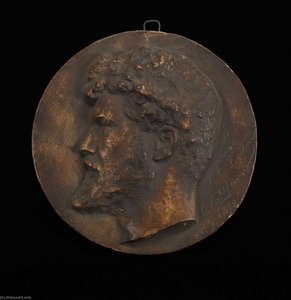
Upon returning to New York City in 1872, Warner established himself as a pioneer of a specific, captivating medium: the bas relief portrait medallion. While many of his contemporaries focused on the monumental scale of large-scale statues, Warner found profound expression in the shallow, elegant contours of relief work. His ability to manipulate light and shadow across bronze and plaster surfaces allowed him to create portraits that felt both timeless and intensely personal. This mastery is perhaps most evident in works such as "Thomas Fenton," a 1878 plaster sculpture that showcases his uncanny ability to render nuanced human expression, capturing a sense of quiet, intellectual contemplation through the subtle textures of hair and skin.
Warner’s artistic repertoire was far from monolithic. While he was a master of the neoclassical, his later explorations revealed a profound empathy for the diverse tapestry of the American experience. His expeditions to the Northwest Territory led to a transformative fascination with Native American culture. This period resulted in some of his most poignant achievements, including the 1891 bronze relief of Chief Ya Tin Ee Ah Witz of the Cayuse. In these works, Warner moved beyond mere documentation; he utilized his refined technique to bestow a sense of dignity, solemnity, and historical permanence upon his subjects, bridging the gap between classical European tradition and the raw, powerful reality of the American frontier.
Artistic Eminence and Historical Significance
The significance of Olin Levi Warner extends far beyond the physical objects he left behind. He was a foundational figure in the institutionalization of American art, playing a vital role in the establishment of professional artistic communities. His contributions to the following organizations cemented his status as a leader of his generation:
- The Society of American Artists: As a founder of this influential group in 1877, Warner helped create a platform for artists to move beyond conservative constraints and embrace more modern, expressive styles.
- The National Academy of Design: His affiliation with this prestigious institution reflected his standing among the elite practitioners of American sculpture.
Though his life was cut short in 1896, Warner’s impact remains etched in the bronze and plaster of the world's most esteemed collections, including the Smithsonian American Art Museum and The Walters Art Museum. He remains a pivotal figure who successfully translated the sophisticated techniques of the French Beaux-Arts tradition into a uniquely American sculptural vernacular—one that honored the past through the meticulous beauty of the portrait medallion while looking forward toward a more realistic and inclusive representation of humanity.