Louis Comfort Tiffany (1848–1933): A Life Illuminated
Tiffany’s journey began in New York City, the son of Charles Lewis Tiffany, a titan of commerce and the visionary founder of Tiffany & Co., a firm synonymous with opulent luxury. This familial legacy instilled within him not merely financial stability but also an inherent appreciation for beauty—a sensibility that would profoundly shape his artistic endeavors. From early childhood, Louis exhibited a fervent passion for painting, nurturing this talent under the tutelage of esteemed artists like George Inness and Samuel Colman, absorbing the tenets of Romanticism and cultivating a fascination with exotic landscapes. These formative influences resonated deeply within his oeuvre, manifesting in evocative depictions of distant lands and capturing the sublime grandeur of nature—a characteristic that would endure throughout his illustrious career.
The Genesis of Innovation: From Painting to Glass
Tiffany’s artistic trajectory took an unexpected turn as he became increasingly captivated by the transformative potential of glassmaking. Dissatisfied with prevailing standards of craftsmanship, which he perceived as lacking in artistic merit and originality, Tiffany embarked on a relentless quest to elevate glass art to the zenith of aesthetic achievement. This wasn't merely a shift in medium; it was a radical reimagining of what glass *could* be—a conviction fueled by his unwavering belief that beauty resided not only in form but also in technique and material exploration. His initial experiments with stained glass, honed during collaborations with fellow artists like Lockwood de Forest and Candace Wheeler within the Associated Artists collective (1879–1884), solidified this perspective. These formative partnerships fostered a shared vision—a desire to transcend conventional artistic boundaries and forge new paths toward expressive innovation.
A Landmark Commission: Hartford’s House of Twain
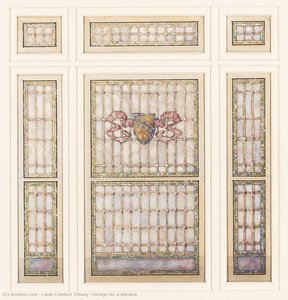
Tiffany’s burgeoning reputation garnered significant acclaim when he secured the prestigious commission to design the interior décor for Mark Twain's iconic residence in Hartford, Connecticut (1881). This undertaking represented a pivotal moment—a demonstration of his burgeoning artistic prowess and an embodiment of his commitment to crafting immersive environments that resonated with profound aesthetic beauty. The resulting stained-glass windows—characterized by their intricate geometric patterns and vibrant hues—became emblems of Tiffany’s stylistic innovation, establishing him as a pioneer in the Art Nouveau movement. Simultaneously, he pursued ambitious projects in metalwork and ceramics, reflecting his multifaceted artistic sensibilities and furthering his exploration of diverse materials and techniques.
Revolutionizing Glass: Techniques and Aesthetic Vision
Tiffany’s legacy rests upon a series of groundbreaking innovations that fundamentally altered the landscape of glass art—transforming it from a purely functional craft into an expressive medium capable of capturing the sublime beauty of nature and conveying complex emotions. Perhaps most transformative was his pioneering development of “copper foil” technique, whereby each piece of glass was enveloped in copper foil before undergoing meticulous soldering—a method that enabled unprecedented levels of detail and intricacy, surpassing the limitations imposed by traditional lead came methods. Yet Tiffany’s ambition extended far beyond mere technical advancement; he envisioned glass as a canvas for artistic exploration—a medium capable of capturing fleeting moments of light and color with breathtaking precision. This vision culminated in his creation of Favrile glass—a term derived from Old English *fabrile*, signifying “hand-wrought”—characterized by its iridescent surface and unparalleled luminosity. Each Favrile vase was conceived as a singular masterpiece, imbued with the artist’s personal touch and reflecting his profound understanding of material science and artistic expression.
A Lasting Legacy: Influence and Recognition
Louis Comfort Tiffany stands as an undisputed titan in American art history—widely regarded as the most influential figure in both the Art Nouveau and Aesthetic movements within the United States. His unwavering dedication to elevating decorative arts to the level of fine art challenged prevailing conventions—establishing him as a visionary whose artistic innovations reverberated throughout subsequent generations. Tiffany’s impact extended far beyond his own creations; he profoundly shaped the aesthetic sensibilities of his era, inspiring artists and designers alike with his bold experimentation and uncompromising pursuit of beauty. Today, Tiffany’s masterpieces are celebrated in museums across the globe—including the New Orleans Museum of Art and the Bergstrom-Mahler Museum of Glass—serving as enduring testaments to his unparalleled genius and cementing his place among the most revered figures in American artistic heritage. His designs continue to captivate audiences worldwide, demonstrating that true artistry transcends time—illuminating our world with its timeless elegance and inspiring generations to come.