Портрет Константин Фёдорович Юон

100 самых известных картин Константин Фёдорович Юон: подборка галереи

Обновлено Ноябрь 2026 · рейтинг на основе нашего показателя популярности (количество поисковых запросов, посещений и заказов для каждой работы) · 277 работ Константин Фёдорович Юон в нашем каталоге

Вкратце

Из всех оригинальных работ, оставленных Константин Фёдорович Юон, самой известной является New Planet (1921). Сразу за ними следуют Morning in Uglich (1913) и The Carousel (1913). В нашем каталоге представлено 277 работ Константин Фёдорович Юон; галерея сохранила 100 самых почитаемых в мире произведений, каждое из которых сопровождается датой создания, информацией о музее и своей историей.

1875 – 1958, Москва Post-impressionism Больше всего работ: Государственная Третьяковская галерея

10 лучших картин Константин Фёдорович Юон: выбор галереи

1
New Planet (1921) работы Константин Фёдорович Юон

New Planet

1921 · Tempera

In the wake of the profound political tremors that reshaped Russia in the early twentieth century, few artists captured the psychological landscape of a nation in flux as poignantly as Konstantin Yuon. His 1921 masterpiece, New Planet, stands as a breathtaking testament to this era of transformation. Originally conceived for the grand stage of the Bolshoi Theatre, this work transcends mere theatrical design to become a profound piece of Symbolist…

7
The Red Army parade (1923) работы Константин Фёдорович Юон

The Red Army parade

1923 · Oil On Canvas

Konstantin Yuon's "The Red Army Parade" is a powerful example of Socialist Realism, capturing the spirit of national pride and unity in post-war Soviet Russia. Created in 1923, this oil on canvas painting (89 x 111 cm) depicts a scene of immense scale and order as soldiers march through Moscow. It's more than just a depiction of an event; it’s a visual embodiment of the ideals of the new Soviet…

9
People (1923) работы Константин Фёдорович Юон

People

1923 · Oil On Canvas

In the quiet, shadowed hours of 1923, Konstantin Yuon captured a moment that defies the boundaries of traditional realism, inviting us into a world where the terrestrial and the celestial collide. His painting, People, presents a hauntingly beautiful nocturnal scene that begins with a group of figures gathered before a simple fence, yet quickly transcends the mundane. As the eye wanders through the composition, it discovers an unexpected narrative: an…

Подборка Константин Фёдорович Юон продолжается, с 11 по 100

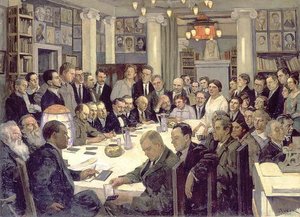
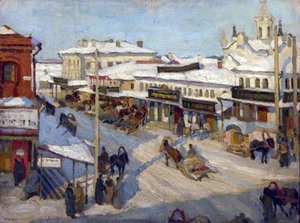
11So be light (1910) работы Константин Фёдорович ЮонSo be light1910 12Depart from Troitsa (1910) работы Константин Фёдорович ЮонDepart from Troitsa1910 13The Winter Landscape (1910) работы Константин Фёдорович ЮонThe Winter Landscape1910 14The Winter. Rostov The Great (1906) работы Константин Фёдорович ЮонThe Winter. Rostov The Great1906 15Night time. Portrait of the artist's wife Klavdiya Yuon (1911) работы Константин Фёдорович ЮонNight time. Portrait of the artist's wife Klavdiya Yuon1911 16Crossing through Oka. Nizhny Novgorod (1909) работы Константин Фёдорович ЮонCrossing through Oka. Nizhny Novgorod1909 17Crossing through Oka. Nizhny Novgorod (1909) работы Константин Фёдорович ЮонCrossing through Oka. Nizhny Novgorod1909 18Stage design for Mussorgsky's opera 'Boris Godunov' (1913) работы Константин Фёдорович ЮонStage design for Mussorgsky's opera 'Boris Godunov'1913 19Green May (1917) работы Константин Фёдорович ЮонGreen May1917 20The Family Portrait (Klavdiya Yuon, artist's wife, and sons Boris and Igor) (1915) работы Константин Фёдорович ЮонThe Family Portrait (Klavdiya Yuon, artist's wife, and sons Boris and Igor)1915 21Portrait of A.A. Bakhrushin (1920) работы Константин Фёдорович ЮонPortrait of A.A. Bakhrushin1920 22Portrait of the writer Vyacheslav Ivanov (1920) работы Константин Фёдорович ЮонPortrait of the writer Vyacheslav Ivanov1920 23Sergiyev Posad. Pancake riding (1923) работы Константин Фёдорович ЮонSergiyev Posad. Pancake riding1923 24The Market's Square (1923) работы Константин Фёдорович ЮонThe Market's Square1923 25Sergiyev Posad. Near The Monastery's Gates (1923) работы Константин Фёдорович ЮонSergiyev Posad. Near The Monastery's Gates1923 26Portrait of I.K. Yuon, the artist's son (1923) работы Константин Фёдорович ЮонPortrait of I.K. Yuon, the artist's son1923 27Portrait of N.D. Zelinsky (1923) работы Константин Фёдорович ЮонPortrait of N.D. Zelinsky1923 28Sergiyev Posad. March (1923) работы Константин Фёдорович ЮонSergiyev Posad. March1923 29Building (1924) работы Константин Фёдорович ЮонBuilding1924 30Sergiyev Posad. Little house in tenements (1923) работы Константин Фёдорович ЮонSergiyev Posad. Little house in tenements1923 31Sergiyev Posad. Refectory (1923) работы Константин Фёдорович ЮонSergiyev Posad. Refectory1923 32Artyom Vesely (1930) работы Константин Фёдорович ЮонArtyom Vesely1930 33Sketch of Gorky's play 'Egor Bulychov and others'. Green dining (1933) работы Константин Фёдорович ЮонSketch of Gorky's play 'Egor Bulychov and others'. Green dining1933 34Meeting of the association 'Nikitinsky subbotniks' (1930) работы Константин Фёдорович ЮонMeeting of the association 'Nikitinsky subbotniks'1930 35Troitsky Tenements. Zagorsk работы Константин Фёдорович ЮонTroitsky Tenements. Zagorsk 36Portrait of Three painters (Kukriniksi). M.V. Kupriyanov, P.N. Krilov, N.A. Sokolov (1930) работы Константин Фёдорович ЮонPortrait of Three painters (Kukriniksi). M.V. Kupriyanov, P.N. Krilov, N.A. Sokolov1930 37Gogol's comedy sketch for the 'Inspector'. Derzhimorda and the postmaster (1938) работы Константин Фёдорович ЮонGogol's comedy sketch for the 'Inspector'. Derzhimorda and the postmaster1938 38Portrait of pilot-woman M.S. Zimova (1937) работы Константин Фёдорович ЮонPortrait of pilot-woman M.S. Zimova1937 39Stage design for Mussorgsky's opera 'Khovanshina' (1940) работы Константин Фёдорович ЮонStage design for Mussorgsky's opera 'Khovanshina'1940 40Requiem (1942) работы Константин Фёдорович ЮонRequiem1942 41Nurses (1945) работы Константин Фёдорович ЮонNurses1945 42Moscow salutes (1945) работы Константин Фёдорович ЮонMoscow salutes1945 43A.S. Pushkin (1945) работы Константин Фёдорович ЮонA.S. Pushkin1945 44Portrait of E.V. Braginsky (1948) работы Константин Фёдорович ЮонPortrait of E.V. Braginsky1948 45Sketch for Glinka's opera ''Ivan Susanin''. Guest (1944) работы Константин Фёдорович ЮонSketch for Glinka's opera ''Ivan Susanin''. Guest1944 46Portrait of actress V.N. Pashenina (1945) работы Константин Фёдорович ЮонPortrait of actress V.N. Pashenina1945 47Pushkin (1950) работы Константин Фёдорович ЮонPushkin1950 48Portrait of E.A. Krilova (1950) работы Константин Фёдорович ЮонPortrait of E.A. Krilova1950 49August Evening. Last Ray. Ligachevo (1948) работы Константин Фёдорович ЮонAugust Evening. Last Ray. Ligachevo1948 50Disappearing Province (1929) работы Константин Фёдорович ЮонDisappearing Province1929 51The Moskvoretsky Bridge (1911) работы Константин Фёдорович ЮонThe Moskvoretsky Bridge1911 52The Night. Tverskoy Boulevard (1909) работы Константин Фёдорович ЮонThe Night. Tverskoy Boulevard1909 53The Komsomol Girls (1926) работы Константин Фёдорович ЮонThe Komsomol Girls1926 54Rainbow. Ligachevo (1925) работы Константин Фёдорович ЮонRainbow. Ligachevo1925 55Near The Novodevichy Monastery in spring (1900) работы Константин Фёдорович ЮонNear The Novodevichy Monastery in spring1900 56To Troyitsa (1903) работы Константин Фёдорович ЮонTo Troyitsa1903 57The Life on The Bank (1904) работы Константин Фёдорович ЮонThe Life on The Bank1904 58To Troyitsa (1903) работы Константин Фёдорович ЮонTo Troyitsa1903 59Landscape (1903) работы Константин Фёдорович ЮонLandscape1903 60Monastery in the snow (1900) работы Константин Фёдорович ЮонMonastery in the snow1900 61Portrait of Z.A. Pertsova (1899) работы Константин Фёдорович ЮонPortrait of Z.A. Pertsova1899 62In the monastery tenements. Near Troitse-Sergiyev (1903) работы Константин Фёдорович ЮонIn the monastery tenements. Near Troitse-Sergiyev1903 63The April Morning (1903) работы Константин Фёдорович ЮонThe April Morning1903 64To Troyitsa (1903) работы Константин Фёдорович ЮонTo Troyitsa1903 65Birches. Petrovskoye (1899) работы Константин Фёдорович ЮонBirches. Petrovskoye1899 66The Celebration Day (1903) работы Константин Фёдорович ЮонThe Celebration Day1903 67The Good Goods (Krasny Tovar). Rostov The Great (1905) работы Константин Фёдорович ЮонThe Good Goods (Krasny Tovar). Rostov The Great1905 · Государственная Третьяковская галерея 68In the monastery tenements. Near Troitse-Sergiyev (1903) работы Константин Фёдорович ЮонIn the monastery tenements. Near Troitse-Sergiyev1903 69The Celebration Day (1903) работы Константин Фёдорович ЮонThe Celebration Day1903 70The Lubyanskaya Square in Winter (1905) работы Константин Фёдорович ЮонThe Lubyanskaya Square in Winter1905 71The Red Sled. The Troitse-Sergiyev Tenements (1903) работы Константин Фёдорович ЮонThe Red Sled. The Troitse-Sergiyev Tenements1903 72The Window. Moscow, artist's parents appartment (1905) работы Константин Фёдорович ЮонThe Window. Moscow, artist's parents appartment1905 73Torjok. The Red Market Outside работы Константин Фёдорович ЮонTorjok. The Red Market Outside 74So be light (1910) работы Константин Фёдорович ЮонSo be light1910 75The Water Kingdom (1910) работы Константин Фёдорович ЮонThe Water Kingdom1910 76The Golden Fleece Magazine. The May (1907) работы Константин Фёдорович ЮонThe Golden Fleece Magazine. The May1907 77The Golden Fleece Magazine. The End (1907) работы Константин Фёдорович ЮонThe Golden Fleece Magazine. The End1907 78The Golden Fleece Magazine. The March (1907) работы Константин Фёдорович ЮонThe Golden Fleece Magazine. The March1907 79The Golden Fleece Magazine. The Utopia (1907) работы Константин Фёдорович ЮонThe Golden Fleece Magazine. The Utopia1907 80Adam and Eve (1909) работы Константин Фёдорович ЮонAdam and Eve1909 81The kingdom of vegetation (1908) работы Константин Фёдорович ЮонThe kingdom of vegetation1908 82Near The Bank of River Pskova (1906) работы Константин Фёдорович ЮонNear The Bank of River Pskova1906 83The Market in Uglich работы Константин Фёдорович ЮонThe Market in Uglich 84The Animal Kingdom (1908) работы Константин Фёдорович ЮонThe Animal Kingdom1908 85Nizhny Novgorod in Winter (1909) работы Константин Фёдорович ЮонNizhny Novgorod in Winter1909 86In Sergiyev Posad (1911) работы Константин Фёдорович ЮонIn Sergiyev Posad1911 87On The Volga работы Константин Фёдорович ЮонOn The Volga 88The bridge across the Oka River in Nizhny Novgorod (1908) работы Константин Фёдорович ЮонThe bridge across the Oka River in Nizhny Novgorod1908 89Podmoskovny landscape (1908) работы Константин Фёдорович ЮонPodmoskovny landscape1908 90The cathederal in Rostov The Great (1906) работы Константин Фёдорович ЮонThe cathederal in Rostov The Great1906 91The View of Monastery fron the Vokzalnaya street (1911) работы Константин Фёдорович ЮонThe View of Monastery fron the Vokzalnaya street1911 92In the Assembly of Nobility (1908) работы Константин Фёдорович ЮонIn the Assembly of Nobility1908 93In Sergiyev Posad (1911) работы Константин Фёдорович ЮонIn Sergiyev Posad1911 94The Pierce ''Samolyot'' on Volga. Nizhny Novgorod (1911) работы Константин Фёдорович ЮонThe Pierce ''Samolyot'' on Volga. Nizhny Novgorod1911 95The Interieur (1907) работы Константин Фёдорович ЮонThe Interieur1907 96The cathederal in Rostov The Great (1906) работы Константин Фёдорович ЮонThe cathederal in Rostov The Great1906 97The Troitse-Sergiyev Monastery. March (1910) работы Константин Фёдорович ЮонThe Troitse-Sergiyev Monastery. March1910 98The Winter Day (1910) работы Константин Фёдорович ЮонThe Winter Day1910 99Spring Evening. Rostov The Great (1906) работы Константин Фёдорович ЮонSpring Evening. Rostov The Great1906 100In the Assembly of Nobility (1908) работы Константин Фёдорович ЮонIn the Assembly of Nobility1908

Знаменитые картины Константин Фёдорович Юон по периодам творчества

Сюжеты, которые вдохновляли Константин Фёдорович Юон

Четыре темы, которые чаще всего встречаются в этих оригиналах, каждая из которых представлена своим лучшим образцом.

Музеи, в которых хранятся оригиналы работ Константин Фёдорович Юон

1 музеев, в которых находится больше всего картин со страницы.

Музей Город Работы Константин Фёдорович Юон Картины из этого списка
Государственная Третьяковская галерея, МоскваГосударственная Третьяковская галерея Москва 1 The Good Goods (Krasny Tovar). Rostov The Great

Константин Фёдорович Юон по десятилетиям: оригиналы, определяющие каждую эпоху

Произведения по десятилетиям

Выберите десятилетие, чтобы увидеть шедевр, определяющий его.

Вопросы коллекционеров о картинах Константин Фёдорович Юон

Какая работа Константин Фёдорович Юон наиболее известна?Узнать ответ

New Planet (1921). Далее следуют Morning in Uglich (1913) и The Carousel (1913).

Сколько лет было Константин Фёдорович Юон, когда была создана работа New Planet?Узнать ответ

46 лет: New Planet датируется 1921 годом, а Константин Фёдорович Юон родился в 1875.

Какие десять самых известных картин написал Константин Фёдорович Юон?Узнать ответ

New Planet, Morning in Uglich, The Carousel, The Holiday of Cooperation in Countryside, Illustration for poem of N.A. Nekrasov, "Who Lives Well in Russia", Festivities on the Field Devichye, The Red Army parade, New Planet (New Planet's Borning), People и Tramps. В рейтинге выше указаны год создания и музей для каждой работы.

Сколько картин оставил(а) Константин Фёдорович Юон?Узнать ответ

В нашем каталоге представлено 277 работ Константин Фёдорович Юон, созданных в период с 1899 по 1950.

В каких музеях представлены шедевры Константин Фёдорович Юон?Узнать ответ

В основном в Государственная Третьяковская галерея (Москва). В таблице выше перечислены все музеи.

В какие годы Константин Фёдорович Юон написал свои самые известные работы?Узнать ответ

В 1900s: 38 из 100 работ на этой странице были созданы в этот период, Tramps из них.

Каковы первые и последние известные оригинальные работы Константин Фёдорович Юон?Узнать ответ

На этой странице самая ранняя работа датирована Portrait of Z.A. Pertsova (1899), а самая поздняя — Pushkin (1950).

Какие сюжеты Константин Фёдорович Юон выбирал чаще всего?Узнать ответ

Religious (19), Russia (9) и Portraits (9) в 100 работах на этой странице.

Какую технику чаще всего использовал(а) Константин Фёдорович Юон?Узнать ответ

Oil On Canvas, для 4 из 100 работ на этой странице.

К какому художественному направлению относится Константин Фёдорович Юон?Узнать ответ

Post-impressionism, судя по оригиналам на этой странице.

Константин Фёдорович Юон: жизнь и творчество

Early Life and Artistic Foundations

Konstantin Fyodorovich Yuon, a name synonymous with the vibrant heart of Russian art, was born on October 24th, 1875, in the bustling metropolis of Moscow. His lineage intertwined threads of Swiss-Russian heritage, a unique blend that would subtly influence his artistic perspective. His father, a diligent employee within an insurance firm, carried the legacy of Switzerland, while his mother, rooted firmly in German traditions, instilled a deep appreciation for culture and beauty. From his earliest years, Konstantin demonstrated a profound sensitivity to the visual world – a nascent talent nurtured by a mother who actively encouraged artistic pursuits within their home. This early exposure wasn’t merely casual; it was a deliberate cultivation of creativity, laying the foundational stones upon which his future artistic endeavors would be built. The Moscow School of Painting, Sculpture and Architecture became Konstantin's formal training ground from 1892 to 1898. Here, he found himself immersed in a rich environment of artistic discourse, guided by distinguished masters such as Konstantin Savitsky and Konstantin Korovin – figures whose techniques and philosophies would profoundly shape his initial artistic trajectory. These formative years weren’t confined solely to the walls of the school; Yuon embarked on journeys across Europe, particularly to Paris, where he encountered the revolutionary currents of Impressionism. He was captivated by artists like Camille Pissarro, not simply mimicking their style but absorbing and synthesizing their techniques into a distinctly Russian aesthetic – a harmonious blend of Western innovation and deeply rooted national identity.

From Symbolism to Socialist Realism

Yuon’s early artistic output is characterized by an evocative interplay between Impressionistic landscapes and the subtle whispers of Symbolism. Paintings such as *To the Trinity* (1903) and *Tverskoy Boulevard* (1909) exemplify this period, capturing fleeting moments of light and atmosphere with a remarkable sensitivity to color and texture. Yet, these works aren’t merely depictions of scenery; they carry an undercurrent of emotional resonance, hinting at deeper, unspoken narratives – a hallmark of Symbolist art. He wasn't content to remain solely within the confines of Impressionism; Yuon began experimenting with lyrical landscapes that incorporated elements drawn from traditional Russian artistic forms—the delicate precision reminiscent of Palekh miniature painting and the spiritual depth echoing the iconography of ancient icons. This fusion created a visual language entirely his own, imbued with a potent sense of national identity while simultaneously embracing innovation and experimentation. However, the tumultuous political landscape of the early 20th century dramatically altered the course of Yuon’s artistic journey. The rise of the Soviet Union ushered in an era of ideological shifts, demanding artists align their work with the new regime's goals. Yuon navigated this complex transition, gradually adapting his style to reflect the prevailing demands – a shift that ultimately led him towards embracing the tenets of Socialist Realism. This stylistic evolution is powerfully illustrated in *Parade on the Red Square on November 7, 1941*, a monumental work depicting Soviet strength and resilience during wartime—a testament to the power of art as a tool for propaganda and national unity.

A Multifaceted Career and Institutional Leadership

Konstantin Yuon’s artistic contributions extended far beyond the creation of individual paintings; he was a pivotal figure in the organization and administration of the Russian art world. He didn't merely paint; he actively shaped the direction of artistic expression within his nation. Alongside his brother, Paul Juon (a renowned composer), he co-founded both the Union of Russian Artists and, later, the Association of Artists of Revolutionary Russia – institutions that played a crucial role in fostering artistic collaboration and promoting national identity. His administrative talents were further recognized through significant leadership roles: he served as director of the Research Institute of the Academy of Arts (1948–1950) and, culminating in a distinguished career, became the First Secretary of the Union of Soviet Artists (1956–1958). These positions afforded him considerable influence over artistic policy and education, allowing him to champion his vision for Russian art. His dedication was formally acknowledged with prestigious accolades – including the Stalin Prize in 1943 and the Order of Lenin—solidifying his status as a national treasure and a respected figure within the Soviet artistic community. Throughout his career, Yuon remained committed to nurturing young artists, establishing his own private painting and drawing school in Moscow, where he imparted his knowledge and techniques to a new generation of creative minds.

Legacy and Enduring Influence

Konstantin Yuon’s legacy is complex and profoundly significant—a testament to an artist who navigated turbulent times while remaining steadfastly committed to his craft. He stands as a pivotal figure in Russian art history, bridging the gap between the aesthetic sensibilities of the late 19th century and the ideological demands of the Soviet era. His early Symbolist landscapes possess a haunting beauty that continues to resonate with viewers, while his later Socialist Realist works offer valuable insights into the artistic strategies employed by the Soviet regime. Today, Yuon’s paintings are proudly displayed in prominent museum collections across Russia – including the Tretyakov Gallery and the Taganrog Art Museum—ensuring their accessibility for generations to come. His work remains a subject of study and admiration, a lasting tribute to a remarkable artist who indelibly shaped the cultural landscape of Russia.
  • Notable Works: New Planet, Bean Vine, Parade on the Red Square on November 7, 1941.
  • Key Influences: Konstantin Savitsky, Konstantin Korovin, Valentin Serov, Camille Pissarro.
  • Artistic Movements: Impressionism, Symbolism, Socialist Realism.