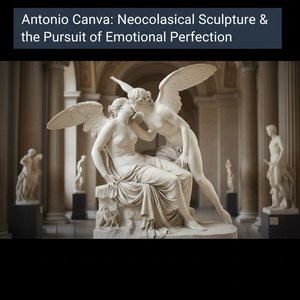
José Álvarez Cubero: A Life in Neoclassical Sculpture
Early Life and Education
Born: 23 April 1768, Priego de Córdoba, Spain.
José Álvarez Cubero began his artistic journey as the son of a stonemason, displaying an early aptitude for drawing and modeling.
He received formal training from the French sculptor Miguel Verdiguier in Cordova and later at the Academy of San Fernando in Madrid.
Career Development & Influences
Royal Patronage: In 1799, King Charles IV awarded Cubero a pension to study art in Paris and Rome – pivotal cities for Neoclassical sculpture.
Influences: While in these artistic hubs, he was profoundly influenced by the works of Antonio Canova, adopting and refining the principles of Neoclassicism.
His early work demonstrated a growing mastery of anatomical detail and classical forms.
Major Works & Artistic Style
“Ganymede” (1804): Executed in Paris, this sculpture brought Cubero immediate acclaim and established his reputation as a leading sculptor.
“Antilochus and Memnon” (1818): Commissioned by Ferdinand VII, this marble group is considered one of his most successful works and now resides in the Museum of Madrid.
Portrait Busts: He also created remarkable portrait busts of prominent figures like Ferdinand VII, Gioacchino Rossini, and the Duchess of Alba, noted for their vigor and fidelity.
“The Defence of Zaragoza” (1823): A significant work depicting a heroic scene from Spanish history.
Political Challenges & Later Life
Imprisonment: Cubero’s refusal to acknowledge Joseph Bonaparte as King of Spain led to his imprisonment in Rome, demonstrating his strong patriotic convictions.
Following his release, he briefly worked for Napoleon I decorating the Quirinal Palace.
Court Sculptor: In 1816, he was appointed court sculptor to Ferdinand VII, solidifying his position within Spanish artistic circles.
Upon returning to Madrid, Cubero dedicated himself to teaching at the Academy of San Fernando.
Legacy & Historical Significance
Mentorship: He mentored a new generation of Spanish sculptors, including Ponciano Ponzano, who became one of the most celebrated Neoclassical sculptors of his time.
Neoclassical Contribution: Cubero played a crucial role in establishing and promoting Neoclassical sculpture in Spain, bridging the gap between Italian and Spanish artistic traditions.
Death: José Álvarez Cubero died on 26 November 1827, in Madrid, leaving behind a legacy of refined craftsmanship and patriotic dedication.
Редакцией OriginalUniqueArt.com
Викторина
В каждом вопросе только один правильный ответ.
Вопрос 1:
José Álvarez Cubero is primarily known as a sculptor working in what style?
Вопрос 2:
Which of the following works significantly boosted José Álvarez Cubero's early recognition?
Вопрос 3:
Álvarez Cubero spent a significant portion of his career in which two cities?
Вопрос 4:
What event led to José Álvarez Cubero's imprisonment in Rome?
Вопрос 5:
Who was one of the notable pupils of José Álvarez Cubero at the Academy of San Fernando?
Journey through the shadows and light of Francisco Goya’s greatest works. From haunting Black Paintings to royal portraits, explore 25 iconic masterpieces and find museum-quality reproductions for your collection. Discover all masterpieces on OriginalUniqueArt.com.
Explore the life & art of Antonio Canova, the greatest Neoclassical sculptor. Discover his masterpieces, innovative techniques, and lasting influence on fine art collecting. Expert insights for discerning investors.
Which of the following works significantly boosted José Álvarez Cubero's early recognition?
Ganymede
Какие 3 картины José Álvarez Cubero занимают самые высокие позиции на ArtsDot.com?
Isabel de Braganza, Queen of Spain, The Defence of Zaragoza, Apollo
Кто такой José Álvarez Cubero?
José Álvarez Cubero: A Life in Neoclassical Sculpture
Early Life and Education
Born: 23 April 1768, Priego de Córdoba, Spain.
José Álvarez Cubero began his artistic journey as the son of a stonemason, displaying an early aptitude for drawing and modeling.
He received formal training from the French sculptor Miguel Verdiguier in Cordova and later at the Academy of San Fernando in Madrid.
Career Development & Influences
Royal Patronage: In 1799, King Charles IV awarded Cubero a pensio
В каком стиле работает José Álvarez Cubero?
neoclassicism
Who was one of the notable pupils of José Álvarez Cubero at the Academy of San Fernando?
Ponciano Ponzano
Распространяется ли еще действие авторского права на работы José Álvarez Cubero?
Нет, работы этого художника являются общественным достоянием.
Сколько картин José Álvarez Cubero представлено на ArtsDot.com?
4
В каком интерьере лучше всего будут смотреться работы José Álvarez Cubero?