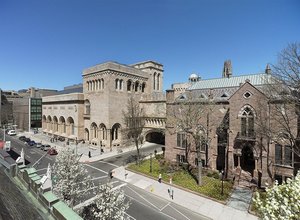
Портрет Джон Фергюсон Вейр

Картины Джон Фергюсон Вейр: 29 самых известных работ, взгляд галереи

Обновлено Ноябрь 2026 · рейтинг на основе нашего показателя популярности (количество поисковых запросов, посещений и заказов для каждой работы) · 31 работ Джон Фергюсон Вейр в нашем каталоге

Вкратце

По мнению экспертов галереи, самая известная картина Джон Фергюсон Вейр — это The Gun Foundry (1866). The Morning Paper (1868) и Forging the Shaft (1874) завершают трио, которое узнает каждый. Из 31 работ Джон Фергюсон Вейр в нашем каталоге ниже представлены 29 самых известных: каждая из них является оригиналом с указанием года создания, музея и уникальных особенностей.

1841 – 1926, Уэст-Пойнт Больше всего работ: Yale University Art Gallery

Топ-10 картин художника Джон Фергюсон Вейр в галерее

1
The Gun Foundry (1866) работы Джон Фергюсон Вейр

The Gun Foundry

1866 · Oil On Canvas

The Gun Foundry is an oil on canvas painting by the American artist John Ferguson Weir. Executed in 1866, the work depicts the interior of the West Point Iron and Cannon Foundry located in Cold Spring, New York. The scene captures a specific moment of industrial production during the mid-19th century, focusing on the casting of a Parrott gun. The composition centers on the movement of molten iron as workers…

2
The Morning Paper (1868) работы Джон Фергюсон Вейр

The Morning Paper

1868 · Oil On Canvas · Метрополитен-музей, Нью-Йорк

In the quietude of a dimly lit study, John Ferguson Weir’s 1868 masterpiece, “The Morning Paper,” invites the viewer into a sanctuary of profound stillness. This is not merely a portrait of an elderly gentleman lost in his morning reading; it is a masterful distillation of the American spirit during its formative years. As the eyes wander across the canvas, one feels the weight of a singular, private moment—a study…

3
Forging the Shaft (1874) работы Джон Фергюсон Вейр

Forging the Shaft

1874 · Oil On Canvas · Метрополитен-музей, Нью-Йорк

John Ferguson Weir's "Forging the Shaft," painted in 1874, isn’t merely a depiction of a blacksmith’s workshop; it’s a powerful testament to America’s burgeoning industrial age. Born at West Point Military Academy, Weir possessed a unique vantage point – his father was a long-standing professor there, and his family history intertwined with the nation's rapid transformation. This painting, created ten years after “The Gun Foundry,” reflects a shift from wartime…

4
An Artist's Studio (1864) работы Джон Фергюсон Вейр

An Artist's Studio

In 1864, John Ferguson Weir painted An Artist's Studio. The canvas captures a quiet, private moment within a workspace. It depicts the artist's father, Robert W. Weir, seated amidst the tools of his trade. This scene places the elder Weir within the familiar confines of his own studio.

5
Daniel Cady Eaton (1834-1895) (1892) работы Джон Фергюсон Вейр

Daniel Cady Eaton (1834-1895)

A man sits in the quiet gravity of 1892. Daniel Cady Eaton is rendered in oil, his form emerging from a dark, indistinct background that offers no distraction from his steady gaze. He is positioned slightly off-center, looking toward the left of the frame with an expression of quiet contemplation. The light falls from the upper left, carving the contours of his face and the texture of his mustache with…

6
Elihu Vedder (1902) работы Джон Фергюсон Вейр

Elihu Vedder

1902 · Oil On Canvas · Музей изящных искусств, Бостон

This oil on canvas portrait by John Ferguson Weir captures Elihu Vedder in a moment of quietude. Created about 1902, the work presents the subject as an older man, his presence defined by a thick, drooping mustache and hair of white. He is dressed in formal attire, including a dark jacket, a waistcoat, and a patterned tie, which anchors him within the studio setting.

7
The Rest (1900) работы Джон Фергюсон Вейр

The Rest

1900 · Oil On Canvas

A woman sits in a moment of stillness, her form anchored by the weight of a violin. She wears a dress of bright yellow, a sudden burst of light against a background of muted, dark green. The fabric of her gown is voluminous, its folds captured through thick, layered oil paint that suggests a heavy, tactile presence. Her expression is serious, a steady gaze that looks inward rather than at…

8
Christmas Eve (1865) работы Джон Фергюсон Вейр

Christmas Eve

1865 · Oil · Yale University Art Gallery, Нью-Хейвен

There is a profound stillness here, even amidst the swirling spirits. The work captures a sense of quiet enchantment, as if the viewer has stumbled upon a private, sacred moment in the dead of night. The organic curves of the vines and the rounded shape of the bell create a visual harmony that balances the verticality of the stone structure. Every brushstroke seems to contribute to a feeling of awe,…

9
His Favorite Model (1880) работы Джон Фергюсон Вейр

His Favorite Model

1880 · Oil On Canvas · Yale University Art Gallery, Хартфорд

In the quiet stillness of an art gallery, the gaze of John Ferguson Weir meets our own. His Favorite Model, an oil on canvas completed in 1880, presents a moment of profound stillness. Within this frame, the artist John Ferguson Weir turns his attention inward, offering us a self-portrait that feels less like a formal record and more like a private observation. He captures himself not merely as a man,…

Картины художника Джон Фергюсон Вейр, в рейтинге с 11 по 29

Знаменитые картины Джон Фергюсон Вейр по периодам творчества

Сюжеты, которые вдохновляли Джон Фергюсон Вейр

Четыре темы, которые чаще всего встречаются в этих оригиналах, каждая из которых представлена своим лучшим образцом.

Музеи, в которых хранятся оригиналы работ Джон Фергюсон Вейр

8 музеев, в которых находится большинство картин со страницы.

Музей Город Работы Джон Фергюсон Вейр Картины из этого списка
Yale University Art Gallery, Нью-ХейвенYale University Art Gallery Нью-Хейвен 5 Christmas Eve, Lake Como, Niagara Fall
Метрополитен-музей, Нью-ЙоркМетрополитен-музей Нью-Йорк 3 The Morning Paper, Forging the Shaft, The Alhambra, Granada, Spain
Yale University Art Gallery, ХартфордYale University Art Gallery Хартфорд 2 His Favorite Model, Lake Como
Смитсоновский американский художественный музей, Вашингтон, округ КолумбияСмитсоновский американский художественный музей Вашингтон, округ Колумбия 2 Kalorama Cottage, Roses
Лос-Анджелесский музей округа Лос-Анджелес, Лос-АнджелесЛос-Анджелесский музей округа Лос-Анджелес Лос-Анджелес 1 An Artist's Studio
Музеи изобразительных искусств Гарварда, КембриджМузеи изобразительных искусств Гарварда Кембридж 1 Daniel Cady Eaton (1834-1895)
Музей изящных искусств, БостонМузей изящных искусств Бостон 1 Elihu Vedder
New Britain Museum of American Art, Нью-БритейнNew Britain Museum of American Art Нью-Бритейн 1 Early Morning Light

Джон Фергюсон Вейр, одна знаковая картина в десятилетие

Произведения по десятилетиям

Выберите десятилетие, чтобы увидеть шедевр, определяющий его.

Картины Джон Фергюсон Вейр: ответы галереи

Какая картина Джон Фергюсон Вейр является самой известной из всех?Узнать ответ

The Gun Foundry (1866). Далее следуют The Morning Paper (1868) и Forging the Shaft (1874).

Сколько лет было Джон Фергюсон Вейр, когда была завершена работа The Gun Foundry?Узнать ответ

25 лет: The Gun Foundry датируется 1866 годом, а Джон Фергюсон Вейр родился в 1841.

Какие 10 лучших картин принадлежат Джон Фергюсон Вейр?Узнать ответ

The Gun Foundry, The Morning Paper, Forging the Shaft, An Artist's Studio, Daniel Cady Eaton (1834-1895), Elihu Vedder, The Rest, Christmas Eve, His Favorite Model и Kalorama Cottage. В рейтинге выше указаны год создания и музей для каждой работы.

Сколько работ создал(а) Джон Фергюсон Вейр?Узнать ответ

В нашем каталоге представлено 31 работ Джон Фергюсон Вейр, созданных в период с 1860 по 1906.

Где висят самые известные оригинальные работы Джон Фергюсон Вейр?Узнать ответ

В основном в Yale University Art Gallery (Нью-Хейвен), Метрополитен-музей (Нью-Йорк) и Yale University Art Gallery (Хартфорд). В таблице выше перечислены все музеи.

Когда Джон Фергюсон Вейр создал свои самые известные картины?Узнать ответ

В 1860s: 10 из 29 работ на этой странице были созданы в этот период, The Gun Foundry из них.

Какие из самых известных работ Джон Фергюсон Вейр являются наиболее ранними и наиболее поздними?Узнать ответ

На этой странице самая ранняя работа датирована Kalorama Cottage (1860), а самая поздняя — East Rock (1906).

К каким сюжетам Джон Фергюсон Вейр обращался чаще всего?Узнать ответ

Mountains (4), Man (3) и Machinery (2) в 29 работах на этой странице.

В какой технике чаще всего работал(а) Джон Фергюсон Вейр?Узнать ответ

Oil On Canvas, для 8 из 29 работ на этой странице.

Какие оригинальные работы Джон Фергюсон Вейр хранятся в Yale University Art Gallery?Узнать ответ

Christmas Eve, Lake Como и Niagara Fall: в коллекции Yale University Art Gallery, Нью-Хейвен находится 5 работ со страницы.

Джон Фергюсон Вейр: художник

John Ferguson Weir - A Legacy Forged in Fire and Light: The Life and Art of John Ferguson Weir

John Ferguson Weir, born August 28, 1841, at West Point, New York, was a figure deeply embedded within the artistic currents of 19th-century America. His life unfolded as a fascinating interplay between familial legacy, industrial innovation, and academic dedication—a constellation mirrored in the careers of his brother, J. Alden Weir, and father, Robert Walter Weir. As the son of Robert Walter Weir, a long-standing professor of drawing at West Point, young John inherited not only an artistic lineage but also a unique vantage point – one that allowed him to observe and interpret the dramatic transformations sweeping across the nation during the Civil War era. This formative experience profoundly shaped his artistic vision and fueled his unwavering commitment to capturing pivotal moments in American history through powerful visual narratives.

Early Artistic Foundations and Familial Influence

From an early age, Weir demonstrated a remarkable aptitude for both still life and landscape painting—skills honed under his father’s tutelage and nurtured by formal study at the National Academy of Design in New York City. This foundational training provided him with the technical prowess to embark on a career that would resonate across generations. Robert Walter Weir, himself a celebrated painter known for his monumental canvases depicting American history, instilled in John a deep appreciation for artistic excellence and a dedication to portraying the grandeur of the nation’s heritage. The influence of this paternal mentorship extended beyond mere instruction; it fostered within John a profound understanding of how art could serve as a conduit for conveying complex ideas and emotions—a principle that would guide his artistic endeavors throughout his life. Furthermore, J. Alden Weir's pioneering work in American Impressionism served as an inspirational model for John, demonstrating the transformative potential of capturing fleeting moments of beauty with vibrant color palettes and innovative compositional techniques.

Industrial Visions: The Gun Foundry and Beyond

Weir’s early artistic explorations centered around the burgeoning industrial revolution—a period marked by rapid technological advancements and profound societal shifts. Recognizing the significance of documenting these transformations, he secured a commission from Robert Leighton Stuart to depict *Hudson Highlands, West Point, Summer Afternoon*, capturing the serene beauty of the Hudson Valley landscape against the backdrop of military life at West Point. This ambitious undertaking solidified Weir’s position within New York City’s artistic circles and established him as one of the foremost painters of his time. However, it was his fascination with the West Point Iron and Cannon Factory—a crucial manufacturer of Union artillery during the Civil War – that truly defined this initial phase of his artistic journey. Driven by a desire to portray not only industrial processes but also the spirit of American ingenuity and resilience, Weir undertook monumental commissions like *The Gun Foundry* (1866) and *Forging the Shaft* (1868). These paintings—executed in colossal scale with masterful chiaroscuro effects—became emblems of the era’s transformative energy. The depiction of labor figures illuminated by the fiery glow of furnaces served as a poignant reminder of the sacrifices made in defense of national unity, cementing Weir's reputation as a pioneer in depicting industrial scenes with both artistic sensitivity and technical mastery. Tragically, *Forging the Shaft* was lost to fire in 1869—a devastating setback that Weir meticulously recreated between 1874 and 1877, reaffirming his unwavering commitment to these powerful visual narratives.

Yale’s Artistic Renaissance: Education and Collaboration

Following his successes with the foundry paintings, Weir embarked on a period of intellectual enrichment abroad in 1868—a formative experience that broadened his artistic horizons and honed his skills through exposure to European masters. Upon his return, he was appointed as the first director – later dean – of the School of Fine Arts at Yale University—a position he held for an astounding forty-four years, from 1869 to 1913. Recognizing the importance of fostering artistic excellence and nurturing the next generation of artists, Weir envisioned a curriculum that blended traditional academic rigor with contemporary European methodologies—a bold initiative that reflected his unwavering belief in the transformative power of art education. To realize this ambitious vision, he actively sought input from his brother, Julian Alden Weir—who was studying at the École des Beaux-Arts in Paris—demonstrating a spirit of collaboration and shared intellectual curiosity. This partnership underscored a fundamental conviction: that artistic progress demanded both foundational knowledge and innovative experimentation.

A Lasting Impression: Sculpture and Legacy

Weir’s artistic output extended beyond painting into sculpture, culminating in the monumental statue of Theodore Dwight Woolsey for Yale University—a testament to his versatility and enduring dedication to artistic pursuits. Throughout his long and distinguished career, Weir remained a steadfast advocate for art education and a passionate artist—leaving behind a legacy that transcends individual masterpieces to encompass the countless students he inspired during his tenure at Yale. His work serves as a compelling reminder of an era defined by rapid change, artistic innovation, and the enduring power of visual storytelling—a legacy destined to resonate through generations of artists and scholars alike. He died in Providence, Rhode Island, in 1926, leaving behind a profound contribution to American art history.