Портрет Jacob Grimmer

28 самых известных картин Jacob Grimmer: подборка галереи

Обновлено Ноябрь 2026 · рейтинг на основе нашего показателя популярности (количество поисковых запросов, посещений и заказов для каждой работы) · 29 работ Jacob Grimmer в нашем каталоге

Вкратце

Из всех оригинальных работ, оставленных Jacob Grimmer, самой известной является Landscape with Large Tree (1588) из коллекции Штедель-Музей, Франкфурт. Сразу за ними следуют The preparations for winter in a panoramic landscape (1546) и Allegory of Spring (1546). В нашем каталоге представлено 29 работ Jacob Grimmer; галерея сохранила 28 самых почитаемых в мире произведений, каждое из которых сопровождается датой создания, информацией о музее и своей историей.

1525 – 1590, Antwerp Больше всего работ: Музей изящных искусств Будапешта

10 лучших картин Jacob Grimmer: выбор галереи

1
Landscape with Large Tree (1588) работы Jacob Grimmer

Landscape with Large Tree

1588 · Oil On Panel · Штедель-Музей, Франкфурт

A massive, sprawling tree dominates the view, its heavy branches reaching out like ancient limbs against a vast, pale sky. This central figure anchors the entire scene, its textured bark and layered foliage commanding the eye. Below this giant, a dirt path winds through the landscape, guiding the gaze toward a quiet middle ground where life unfolds in miniature. Small figures move through the grass, some traveling on horseback while…

2
The preparations for winter in a panoramic landscape (1546) работы Jacob Grimmer

The preparations for winter in a panoramic landscape

1546 · Oil On Panel

A pale blue sky hangs over a valley, thin and wispy with clouds that offer no warmth. Below, the earth is a patchwork of ochre and muted green, a landscape caught in the quiet tension of a seasonal shift. The horizon sits high, pulling the eye across rolling hills toward a distant, hazy architecture. It is a view from above, a bird's-eye perspective that captures the rhythmic, heavy labor of…

3
Allegory of Spring (1546) работы Jacob Grimmer

Allegory of Spring

1546 · Oil

The composition unfolds within a circular frame, a format that draws the eye into a dense, layered landscape of the Antwerp countryside. In the foreground, elegantly dressed nobles engage in social interaction, their attire rendered in deep reds, golds, and blues that contrast against the earthy tones of the terrain. This immediate layer of human activity transitions into a middle ground of pastoral life, where livestock and peasants move through…

4
Hunting a wild boar (1590) работы Jacob Grimmer

Hunting a wild boar

1590 · Oil On Panel · Национальный музей в Варшаве, Варшава

A dark, textured tree trunk anchors the left side of the frame, its gnarled bark reaching upward like a heavy curtain. Through this wooden frame, the eye is pulled into a thicket of deep greens and ochres where the air feels heavy with the scent of damp earth. In the foreground, the stillness of the woods is broken by the sudden, frantic movement of a hunt. Figures on horseback and…

5
Winter landscape with travellers and people on a frozen river (1533) работы Jacob Grimmer

Winter landscape with travellers and people on a frozen river

1533 · Oil On Panel

The air feels heavy and cold, thick with the quiet stillness of a winter afternoon. A wide, panoramic view stretches out before us, pulling the eye from the deep, shadowed banks of a river toward a distant, hazy village that seems to dissolve into the pale horizon. Everything is draped in a layer of frost and snow; it clings to the rooftops of timber-framed houses and settles unevenly upon the…

6
Summer (1546) работы Jacob Grimmer

Summer

1546 · Oil On Panel

The landscape known as Summer unfolds before us, a detailed vision of rural life captured by the hand of Jacob Grimmer. This work emerges from the mid-sixteenth century, dating to about 1546. Within this scene, the rhythmic pulse of the harvest and the communal efforts of a working countryside take shape, inviting a close look at the seasonal cycles that define human existence.

7
Wood Landscape with Buildings (1546) работы Jacob Grimmer

Wood Landscape with Buildings

1546 · Oil On Panel · Rijksmuseum Twenthe, Энсхеде

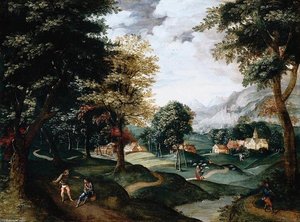
In "Wood Landscape with Buildings" by Jacob Grimmer, we find a serene and atmospheric scene from about 1546. The composition is structured with a deliberate sense of depth, utilizing large, dark trees on the left and right to frame a central view. This framing directs the eye through a tranquil rural setting, where architectural elements are nestled within dense woodland. Within this vista, one can observe rustic cottages and a…

9
Entrance to a village with peasants carousing (1550) работы Jacob Grimmer

Entrance to a village with peasants carousing

1550 · Oil

The composition opens with an expansive view of a village entrance, where the rhythm of rural life unfolds through a series of interconnected vignettes. In the foreground, figures move with a sense of unhurried purpose: a couple walks along a path, while others rest on the ground, and a man on horseback navigates the terrain. The eye is drawn toward the middle ground, where a large, open square becomes a…

10
The Tower of Babel (1550) работы Jacob Grimmer

The Tower of Babel

A massive, spiraling stone structure dominates the landscape, rising from a sprawling terrain toward a turbulent, overcast sky. This multi-tiered tower, rendered in earthy ochres, browns, and greys, creates a rhythmic, concentric movement that draws the eye upward. The composition utilizes a high-angle perspective to establish vast depth, stretching from the intricate, tiny silhouettes of figures in the foreground to a hazy, distant horizon. The scale of the architecture contrasts…

Подборка Jacob Grimmer продолжается, с 11 по 28

Знаменитые картины Jacob Grimmer по периодам творчества

Сюжеты, которые вдохновляли Jacob Grimmer

Четыре темы, которые чаще всего встречаются в этих оригиналах, каждая из которых представлена своим лучшим образцом.

Музеи, в которых хранятся оригиналы работ Jacob Grimmer

8 музеев, в которых находится большинство картин со страницы.

Музей Город Работы Jacob Grimmer Картины из этого списка
Музей изящных искусств Будапешта, БудапештМузей изящных искусств Будапешта Будапешт 4 The Summer, Winter, Autumn
Национальный музей в Варшаве, ВаршаваНациональный музей в Варшаве Варшава 3 Hunting a wild boar, Winter landscape with the flight into Egypt., Landscape with figures
Штедель-Музей, ФранкфуртШтедель-Музей Франкфурт 1 Landscape with Large Tree
Rijksmuseum Twenthe, ЭнсхедеRijksmuseum Twenthe Энсхеде 1 Wood Landscape with Buildings
Fogg Museum, КембриджFogg Museum Кембридж 1 Landscape with Cottages
Национальный музей изобразительных искусств Кубы, ГаванаНациональный музей изобразительных искусств Кубы Гавана 1 The Tower of Babel
Noordbrabants Museum, 'с-ХертогенбосNoordbrabants Museum 'с-Хертогенбос 1 Landscape of a garden + several people
Музей Карнавале, ПарижМузей Карнавале Париж 1 The Holy Innocents' Cemetery and Church

Jacob Grimmer по десятилетиям: оригиналы, определяющие каждую эпоху

Произведения по десятилетиям

Выберите десятилетие, чтобы увидеть шедевр, определяющий его.

Вопросы коллекционеров о картинах Jacob Grimmer

Какая работа Jacob Grimmer наиболее известна?Узнать ответ

Landscape with Large Tree (1588), Штедель-Музей, Франкфурт. Далее следуют The preparations for winter in a panoramic landscape (1546) и Allegory of Spring (1546).

Сколько лет было Jacob Grimmer, когда была создана работа Landscape with Large Tree?Узнать ответ

63 лет: Landscape with Large Tree датируется 1588 годом, а Jacob Grimmer родился в 1525.

Какие десять самых известных картин написал Jacob Grimmer?Узнать ответ

Landscape with Large Tree, The preparations for winter in a panoramic landscape, Allegory of Spring, Hunting a wild boar, Winter landscape with travellers and people on a frozen river, Summer, Wood Landscape with Buildings, Landscape with Cottages, Entrance to a village with peasants carousing и The Tower of Babel. В рейтинге выше указаны год создания и музей для каждой работы.

Сколько картин оставил(а) Jacob Grimmer?Узнать ответ

В нашем каталоге представлено 29 работ Jacob Grimmer, созданных в период с 1533 по 1590.

В каких музеях представлены шедевры Jacob Grimmer?Узнать ответ

В основном в Музей изящных искусств Будапешта (Будапешт), Национальный музей в Варшаве (Варшава) и Штедель-Музей (Франкфурт). В таблице выше перечислены все музеи.

В какие годы Jacob Grimmer написал свои самые известные работы?Узнать ответ

В 1540s: 4 из 28 работ на этой странице были созданы в этот период, The preparations for winter in a panoramic landscape из них.

Каковы первые и последние известные оригинальные работы Jacob Grimmer?Узнать ответ

На этой странице самая ранняя работа датирована Winter landscape with travellers and people on a frozen river (1533), а самая поздняя — Hunting a wild boar (1590).

Какие сюжеты Jacob Grimmer выбирал чаще всего?Узнать ответ

Trees (12), People (12) и Sky (11) в 28 работах на этой странице.

Какую технику чаще всего использовал(а) Jacob Grimmer?Узнать ответ

Oil On Panel, для 13 из 28 работ на этой странице.

Какие работы Jacob Grimmer представлены в Музей изящных искусств Будапешта?Узнать ответ

The Summer, Winter и Autumn: в коллекции Музей изящных искусств Будапешта, Будапешт находится 4 работ со страницы.

Jacob Grimmer: жизнь и творчество

The Architect of the Antwerp Countryside

Jacob Grimmer stands as a pivotal figure in the evolution of Flemish landscape painting during the Renaissance, marking a decisive shift away from grandiose panoramas towards a more contemplative and authentic portrayal of the Antwerp countryside. His artistic vision championed simplicity and meticulous observation, profoundly impacting subsequent generations of painters and securing his place amongst the most celebrated artists of his era. Born around 1525 in the vibrant merchant city of Antwerp, Grimmer was the son of Nicolaas Cops and Elisabeth Loureiro. While biographical details remain somewhat elusive, his professional trajectory is well-documented through his registration in the Antwerp Guild of Saint Luke.

The early years of Grimmer’s life were steeped in the rich artistic milieu of the Low Countries. Although art historians debate the exact nature of his training, accounts suggest he may have honed his skills under masters such as Matthys Cock and Christian van den Corpen. The only definitive documentary evidence from this period is his 1539 registration as a student under Gabriel Bouwens. This formative era provided him with the technical foundation necessary to move beyond the world landscape tradition—a style characterized by fantastical, much larger-than-life panoramas and whimsical rock formations—toward a more grounded, realistic aesthetic that celebrated the subtle beauty of the local terrain.

A Mastery of Season and Light

Grimmer’s artistic legacy is most profoundly felt in his ability to capture the rhythmic pulse of nature. He was a painter of labor, light, and the passing seasons, often creating works that reflected the changing cycles of the year. One of his most enduring contributions to the Flemish tradition was his exploration of the Four Seasons and the Twelve Months. In these series, Grimmer masterfully blended landscape with genre painting, portraying villagers engaged in the seasonal rhythms of rural life—from the arduous labor of the harvest to the communal joy of winter festivals.

His technique was characterized by an unwavering commitment to plein air principles, working directly from nature to achieve a level of atmospheric accuracy that was rare for his time. As a capable colorist, Grimmer possessed the ability to create harmonic landscapes through the use of realistic tones and effective atmospheric values. His compositions often featured low horizons and broad views that allowed the viewer to feel immersed in the weather and light of the Antwerp region. Whether depicting the skeletal beauty of a winter frost or the lush, golden warmth of autumn, his work breathed life into the landscape, making the environment itself a central protagonist.

Legacy and Historical Significance

The influence of Jacob Grimmer extends far beyond the borders of 16th-century Flanders. By moving away from the stylized, imaginary vistas of his predecessors, he paved the way for a more naturalistic approach to landscape art that would define much of the Dutch and Flemish Golden Age. His work echoes the spirit of Pieter Bruegel the Elder, yet Grimmer carved out a distinct identity through his focus on atmospheric depth and the quiet dignity of the rural landscape. His son, Abel Grimmer, would also go on to achieve distinction as a painter and architect, continuing the family's artistic lineage.

Today, Grimmer’s paintings serve as vital historical windows into the social and natural world of the Renaissance. His ability to find profound beauty in the mundane—a ruined wall in a forest, a peasant walking along a dusty road, or the simple movement of horse-drawn carts—reminds us of his role as a pioneer of authenticity. Through his meticulous observation and emotional resonance, Jacob Grimmer transformed the landscape from a mere backdrop into a soulful reflection of human existence and the eternal cycles of the earth.