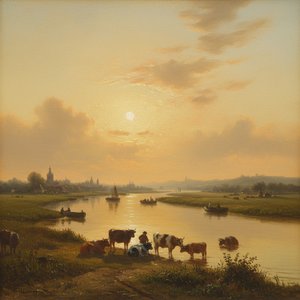
Hendrick Avercamp (1585 - 1634) – A Pioneer of Dutch Winter
Hendrick Avercamp, a name synonymous with the shimmering, frozen landscapes of the Dutch Golden Age, was born in Amsterdam on January 27, 1585. His life story is as intriguing as his art—a tale marked by both artistic innovation and personal circumstance. From an early age, it became apparent that Avercamp lived within a world experienced differently than most; he was mute, and likely deaf, earning him the affectionate yet defining moniker “de Stomme van Kampen” – the Mute of Kampen. This perceived limitation, however, did not stifle his artistic voice but perhaps sharpened his observational skills, allowing him to translate the nuances of the Dutch winter onto canvas with unparalleled clarity and charm. He initially studied in Amsterdam under Pieter Isaacsz, a portrait painter, and possibly also received guidance from David Vinckboons, whose influence can be seen in Avercamp’s early works. In 1608, he relocated to Kampen, where he would spend the majority of his life and establish himself as a unique and celebrated artist.
## Life – Silence Speaks Volumes
Avercamp’s existence was marked by profound physical challenges—he was mute and probably deaf—a circumstance that profoundly shaped his artistic vision. Born in Amsterdam during the Little Ice Age, a period characterized by unusually cold winters across Europe, Avercamp witnessed firsthand the dramatic climatic conditions that fueled his fascination with frozen landscapes. His father, Johannes Avercamp, was an apothecary, and his family moved to Kampen shortly after his birth, where he spent his entire life pursuing his artistic endeavors. Despite his inability to communicate verbally, Avercamp’s artistic talent shone brightly, earning him the enduring title “de Stomme van Kampen,” which translates to “the Mute of Kampen.” This moniker reflects not merely a physical disability but also a remarkable capacity for observation and an unwavering dedication to capturing the beauty of the natural world. He married Beatrix Peters in 1612, and together they had several children, including Barent Avercamp, who would become a fellow artist and continue his father’s stylistic legacy. Avercamp died peacefully in Kampen on May 15, 1634, leaving behind a legacy of breathtaking winter paintings that continue to inspire awe and admiration centuries later.
## Artistic Style – Mastering Aerial Perspective and Watercolor Technique
Avercamp stands apart from many of his contemporaries as one of the first dedicated landscape painters of the 17th-century Dutch school—a period traditionally dominated by portraiture, history painting, and still life. He distinguished himself by focusing exclusively on winter scenes—a subject rarely explored with such consistent dedication before him. Avercamp’s artistic brilliance lay in his ability to convey both the chilling grip of winter and the warmth of human companionship simultaneously. He achieved this remarkable feat through masterful use of aerial perspective—a technique that subtly shifts colors and details as they recede into the distance, creating a convincing illusion of depth and immersing viewers within the icy landscapes he depicted. Avercamp’s distinctive method involved applying watercolor washes over meticulously drawn pen and ink sketches, resulting in delicate and luminous effects that captured the ethereal quality of winter light. This technique—particularly evident in works like “Winter Landscape with Skaters”—became his signature style and cemented his place as a visionary artist.
## Influences – Bruegel’s Legacy and Flemish Tradition
Avercamp’s artistic development was undeniably influenced by the legacy of Pieter Bruegel the Elder, a Flemish master whose paintings explored similar themes of rural life and human behavior against dramatic landscapes. Avercamp absorbed Bruegel’s stylistic principles—particularly his penchant for depicting numerous figures engaged in everyday activities—incorporating them into his own compositions. This connection to Flemish art demonstrates Avercamp's awareness of artistic trends circulating throughout Europe during the early 17th century. Furthermore, Avercamp’s meticulous attention to detail and his unwavering commitment to realism mirrored the burgeoning movement towards naturalism within Dutch painting at the time, spearheaded by artists like Essaias van de Velde and Jan van Goyen. These influences combined to shape Avercamp's artistic vision—resulting in landscapes that are both aesthetically captivating and psychologically insightful.
## Notable Works – Capturing Winter Life on Canvas
Avercamp’s oeuvre comprises numerous paintings that exemplify his mastery of winter landscape painting, capturing the essence of Dutch life during the Little Ice Age with unparalleled precision and beauty. Among his most celebrated works are “Winter Landscape with Skaters,” which portrays a bustling scene of ice skating activity—a pastime deeply ingrained in Dutch culture—and “Street in Delfi,” offering a glimpse into urban life amidst the frozen winter months. Equally impressive is “Enjoying the Ice near a Town,” showcasing Avercamp’s ability to depict dynamic compositions filled with figures engaged in various activities, reflecting the social fabric of Kampen and beyond. His paintings are characterized by their vibrant colors, intricate details, and masterful use of aerial perspective—elements that contribute to their enduring appeal and solidify Avercamp's position as one of the foremost landscape artists of his era.
## Historical Significance – Defining a Dutch Aesthetic
Hendrick Avercamp’s contribution to Dutch art history is undeniable. He not only popularized winter landscapes as an independent genre but also established a distinctly Dutch aesthetic—one that prioritized realism, atmospheric effects, and the depiction of everyday life—setting a precedent for subsequent generations of artists. His work served as inspiration for painters like Johannes Vermeer and Rembrandt van Rijn, who embraced Avercamp’s innovative techniques and stylistic sensibilities. Avercamp's legacy extends beyond his artistic achievements; he embodies resilience and creativity in overcoming physical limitations—a testament to the transformative power of art and its ability to transcend boundaries of communication. His paintings continue to resonate with audiences today, offering a poignant glimpse into a bygone era—a world frozen in time yet brimming with human spirit and artistic brilliance.