Giuseppe Maria Crespi (1665–1747): A Bolognese Pioneer of Genre Painting
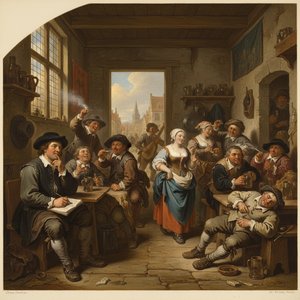
Giuseppe Maria Crespi, affectionately known as “Lo Spagnuolo” – the Spaniard – was a captivating anomaly within the Italian Baroque landscape. Born in Bologna in 1665, his nickname stemmed not from ancestry but from a penchant for the tightly fitted clothing fashionable in Spain at the time, a sartorial choice that hinted at the independent spirit simmering beneath the surface of this remarkable artist. Crespi’s journey began with a traditional apprenticeship, first under Angelo Michele Toni and then Domenico Maria Canuti, absorbing the foundational techniques of Bolognese painting. However, he resisted the pull of Rome when invited by Carlo Maratti, choosing instead to forge his own path, one that would ultimately redefine genre painting and offer a strikingly intimate glimpse into everyday life.
Early Life and Training
Crespi’s formative years were marked by meticulous study under established masters like Toni and Canuti. These instructors instilled in him the principles of Bolognese Baroque style—characterized by dramatic chiaroscuro, opulent ornamentation, and an emphasis on idealized forms—a foundation that would later inform his artistic vision. Yet, Crespi possessed a singular determination to transcend convention, recognizing the limitations of replicating established traditions. This rebellious impulse propelled him toward exploration beyond Bologna’s confines, fostering connections with influential artists across Italy.
Breaking With Tradition: A New Vision Emerges
Unlike many of his contemporaries who adhered rigidly to academic dogma, Crespi embarked on a daring experiment—a deliberate rejection of the prevailing stylistic trends. He sought inspiration from Rembrandt and Salvator Rosa, artists renowned for their psychological depth and masterful use of light and shadow. This embrace of realism represented a monumental shift within Bolognese art, signaling a move away from mythological narratives and towards depictions of human experience as it unfolded in daily life. Crespi’s style was characterized by a deliberate restraint in color and brushwork, employing a limited palette with judicious skill—though some critics noted a lack of robust physicality in his application. This subtlety, however, served to heighten the emotional impact of his scenes, drawing viewers into the quiet dramas of domestic existence.
The Seven Sacraments and Artistic Innovation
A pivotal achievement was *The Seven Sacraments*, a monumental series painted around 1712 for Cardinal Ottoboni—a commission that demanded an ambitious undertaking. Crespi confronted this challenge with unparalleled ingenuity, rejecting the conventional portrayal of biblical events in distant historical settings. Instead, he placed them within the context of his own time, featuring contemporary figures and locales. The result was a series that felt both deeply spiritual and profoundly human—a testament to Crespi’s ability to synthesize artistic innovation with religious contemplation. His masterful handling of light and shadow – a technique known as tenebrism – created dramatic contrasts that intensified emotional resonance and underscored the psychological complexity of his subjects.
Legacy and Influence
Giuseppe Maria Crespi died in Bologna in 1747, leaving behind a body of work that continues to captivate audiences today. He was recognized for his contribution to Italian art as a master observer of human nature—capable of capturing the subtle nuances of emotion and experience with remarkable sensitivity. His paintings are not merely historical artifacts; they are windows into the lives of ordinary people, offering a timeless glimpse into universal themes of love, loss, faith, and everyday existence. Crespi’s influence extended beyond Bologna; he mentored artists like Giovanni Battista Piazzetta and Pietro Longhi, who carried forward his commitment to realism and genre painting in Venice—establishing him as one of the foremost figures in Baroque art history. His legacy endures through reproductions found in museums such as Dresden's Gemäldegalerie Alte Meister and Florence’s Museo dell’Opera di Santa Croce.
- Notable Works: *The Seven Sacraments*, *St. Giovanni Nepomuceno Confessing to the Queen of Bohemia*
- Influences: Rembrandt, Salvator Rosa
- Style Characteristics: Genre Painting, Tenebrism, Psychological Depth
Further Resources: