Портрет Fyodor Bronnikov

Картины Fyodor Bronnikov: 39 самых известных работ, взгляд галереи

Обновлено Ноябрь 2026 · рейтинг на основе нашего показателя популярности (количество поисковых запросов, посещений и заказов для каждой работы) · 39 работ Fyodor Bronnikov в нашем каталоге

Вкратце

По мнению экспертов галереи, самая известная картина Fyodor Bronnikov — это Italian Tavern (1858). By the wayside shrine (1858) и The Sick Artist (1861) завершают трио, которое узнает каждый. Из 39 работ Fyodor Bronnikov в нашем каталоге ниже представлены 39 самых известных: каждая из них является оригиналом с указанием года создания, музея и уникальных особенностей.

1827 – 1902, Shadrinsk Romanticism Больше всего работ: Shadrinsk Museum of Local History

Топ-10 картин художника Fyodor Bronnikov в галерее

1
Italian Tavern (1858) работы Fyodor Bronnikov

Italian Tavern

1858 · Oil On Canvas

In this 1858 work, we find ourselves drawn into the warmth of an outdoor Italian tavern. The scene is populated by a group of men gathered around a dining table, their attention turned toward one another in the midst of quiet conversation. There is a palpable sense of ease in the way they sit, some seated with wine glasses before them, others standing nearby, caught in the natural rhythm of…

2
By the wayside shrine (1858) работы Fyodor Bronnikov

By the wayside shrine

A group of travelers pauses at a small roadside shrine, seeking a moment of rest or prayer amidst a rugged landscape. The scene is set in a Mediterranean or Southern European environment, where the warm, diffused light of late afternoon casts long, gentle shadows across the terrain. A horse-drawn carriage and several figures populate the composition, their presence grounding the spiritual moment in the reality of daily travel. The verticality…

3
The Sick Artist (1861) работы Fyodor Bronnikov

The Sick Artist

1861 · Oil On Canvas · Radishchev Art Museum, Saratov

A man sits slumped in a chair, his head resting heavily in his hand in a gesture of profound despondency. The interior is cluttered and dimly lit, a space defined by the weight of illness or grief. A woman stands behind him, her posture suggesting a quiet, supportive presence amidst the shadows. The room is filled with the artifacts of a lived life: a white classical bust, a suit of…

4
A Hymn to the Rising Sun (1869) работы Fyodor Bronnikov

A Hymn to the Rising Sun

1869 · Oil On Canvas

A group of ancient Greek men gathers upon a rugged, rocky outcrop overlooking a vast sea. At the center of the composition, an elevated figure gestures toward the horizon, commanding the attention of those around him. Several figures kneel in supplication, their postures conveying a sense of profound reverence. The scene is bathed in the soft, diffused light of dawn or dusk, casting a serene yet solemn atmosphere over the…

6
HYMN OF THE PYTHAGOREANS TO THE RISING SUN (1877) работы Fyodor Bronnikov

HYMN OF THE PYTHAGOREANS TO THE RISING SUN

1877 · Oil On Canvas

The first light of day breaks over a rugged, rocky coastline, casting a pale gold glow across the landscape. A group of figures, draped in long, flowing white garments, gathers upon the elevated terrain. They turn their faces toward the horizon, where the sun begins its ascent, marking a moment of profound spiritual exaltation. The air feels heavy with the weight of ritual, as the soft, luminous hues of pink…

7
The damned box. Place of execution in ancient Rome. The crucified slaves. the year 1878. (1878) работы Fyodor Bronnikov

The damned box. Place of execution in ancient Rome. The crucified slaves. the year 1878.

In this 1878 work, we find ourselves standing before a scene of profound tragedy set within the harsh landscape of ancient Rome. The composition draws the eye along a diagonal recession, pulling the viewer from the immediate, heavy grief of the foreground toward a distant, hazy horizon. A figure lies slumped upon the rocky earth, a silent witness to the exhaustion and suffering that permeates the air. Beyond this, several…

8
The Italian Girl (1889) работы Fyodor Bronnikov

The Italian Girl

In "The Italian Girl" by Fyodor Bronnikov, the composition focuses on a single female figure presented in a close-up bust view. The subject is positioned in a side profile, looking away from the viewer. This perspective emphasizes the contours of her face and the structure of her neck. The subject's head and shoulders are set against a neutral, textured background that appears mottled and light in color. Because the depth…

Картины художника Fyodor Bronnikov, в рейтинге с 11 по 39

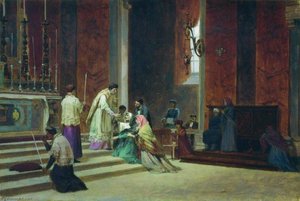
11Family (1856) работы Fyodor BronnikovFamily1856 · Shadrinsk Museum of Local History 12Horace Reading His Verses (1863) работы Fyodor BronnikovHorace Reading His Verses1863 · Одеський национальный художественный музей 13The Dying Gladiator (1856) работы Fyodor BronnikovThe Dying Gladiator1856 · Shadrinsk Museum of Local History 14Italian Girl (1869) работы Fyodor BronnikovItalian Girl1869 · Tyumen Regional Fine Arts Museum 15Martyr on the Arena (1869) работы Fyodor BronnikovMartyr on the Arena1869 · Shadrinsk Museum of Local History 16The Mass (1869) работы Fyodor BronnikovThe Mass1869 · Shadrinsk Museum of Local History 17The Masquerade (1870) работы Fyodor BronnikovThe Masquerade1870 · Shadrinsk Museum of Local History 18Judas (1874) работы Fyodor BronnikovJudas1874 · Shadrinsk Museum of Local History 19Italian Landscape with Fisherman Drying His Nets (1875) работы Fyodor BronnikovItalian Landscape with Fisherman Drying His Nets1875 · Shadrinsk Museum of Local History 20Head of Judas (study) (1874) работы Fyodor BronnikovHead of Judas (study)1874 · Shadrinsk Museum of Local History 21Greeting the Princess (1883) работы Fyodor BronnikovGreeting the Princess1883 · Shadrinsk Museum of Local History 22Lake Como (1897) работы Fyodor BronnikovLake Como1897 · Perm State Arts Gallery 23Reading the Death Sentence to Thrasea Paetus работы Fyodor BronnikovReading the Death Sentence to Thrasea PaetusRadishchev Art Museum 24Venetian Trial, 16th Century работы Fyodor BronnikovVenetian Trial, 16th CenturyRadishchev Art Museum 25Buildings работы Fyodor BronnikovBuildingsRadishchev Art Museum 26Dressing the Bride (1856) работы Fyodor BronnikovDressing the Bride1856 · Radishchev Art Museum 27Italian Peasant работы Fyodor BronnikovItalian Peasant 28Italian Courtyard работы Fyodor BronnikovItalian Courtyard 29Head of an Old Man (study) работы Fyodor BronnikovHead of an Old Man (study) 30Grooming Dogs in Naples работы Fyodor BronnikovGrooming Dogs in NaplesShadrinsk Museum of Local History 31During the Epidemic работы Fyodor BronnikovDuring the EpidemicShadrinsk Museum of Local History 32Interior работы Fyodor BronnikovInteriorShadrinsk Museum of Local History 33The Morning Toilet работы Fyodor BronnikovThe Morning ToiletDagestan Fine Arts Museum 34Italian Street Scene работы Fyodor BronnikovItalian Street SceneЕкатеринбургский музей изобразительных искусств 35Head of St.Peter (study) работы Fyodor BronnikovHead of St.Peter (study)Astrakhan State Picture Gallery 36Landscape with Ruins работы Fyodor BronnikovLandscape with RuinsBryansk Regional Art Museum 37Italian Girl with a Basket of Flowers работы Fyodor BronnikovItalian Girl with a Basket of FlowersRadishchev Art Museum 38Landscape with a Tree работы Fyodor BronnikovLandscape with a TreeRadishchev Art Museum 39Lady in White работы Fyodor BronnikovLady in WhiteBryansk Regional Art Museum

Сюжеты, которые вдохновляли Fyodor Bronnikov

Четыре темы, которые чаще всего встречаются в этих оригиналах, каждая из которых представлена своим лучшим образцом.

Музеи, в которых хранятся оригиналы работ Fyodor Bronnikov

8 музеев, в которых находится большинство картин со страницы.

Музей Город Работы Fyodor Bronnikov Картины из этого списка
Shadrinsk Museum of Local History, ShadrinskShadrinsk Museum of Local History Shadrinsk 12 Family, The Dying Gladiator, Martyr on the Arena
Radishchev Art Museum, SaratovRadishchev Art Museum Saratov 8 The Sick Artist, Portrait of Painter Konstantin Flavitsky, Reading the Death Sentence to Thrasea Paetus
Екатеринбургский музей изобразительных искусств, ЕкатеринбургЕкатеринбургский музей изобразительных искусств Екатеринбург 3 The Italian Girl, Street in Italy, Italian Street Scene
Государственная Третьяковская галерея, МоскваГосударственная Третьяковская галерея Москва 2 By the wayside shrine, The damned box. Place of execution in ancient Rome. The crucified slaves. the year 1878.
Bryansk Regional Art Museum, BryanskBryansk Regional Art Museum Bryansk 2 Landscape with Ruins, Lady in White
Одеський национальный художественный музей, ОдессаОдеський национальный художественный музей Одесса 1 Horace Reading His Verses
Tyumen Regional Fine Arts Museum, TyumenTyumen Regional Fine Arts Museum Tyumen 1 Italian Girl
Perm State Arts Gallery, PermPerm State Arts Gallery Perm 1 Lake Como

Fyodor Bronnikov, одна знаковая картина в десятилетие

Произведения по десятилетиям

Выберите десятилетие, чтобы увидеть шедевр, определяющий его.

Картины Fyodor Bronnikov: ответы галереи

Какая картина Fyodor Bronnikov является самой известной из всех?Узнать ответ

Italian Tavern (1858). Далее следуют By the wayside shrine (1858) и The Sick Artist (1861).

Сколько лет было Fyodor Bronnikov, когда была завершена работа Italian Tavern?Узнать ответ

31 лет: Italian Tavern датируется 1858 годом, а Fyodor Bronnikov родился в 1827.

Какие 10 лучших картин принадлежат Fyodor Bronnikov?Узнать ответ

Italian Tavern, By the wayside shrine, The Sick Artist, A Hymn to the Rising Sun, Portrait of Painter Konstantin Flavitsky, HYMN OF THE PYTHAGOREANS TO THE RISING SUN, The damned box. Place of execution in ancient Rome. The crucified slaves. the year 1878., The Italian Girl, Street in Italy и The Murder Scene. В рейтинге выше указаны год создания и музей для каждой работы.

Сколько работ создал(а) Fyodor Bronnikov?Узнать ответ

В нашем каталоге представлено 39 работ Fyodor Bronnikov, созданных в период с 1850 по 1897.

Где висят самые известные оригинальные работы Fyodor Bronnikov?Узнать ответ

В основном в Shadrinsk Museum of Local History (Shadrinsk), Radishchev Art Museum (Saratov) и Екатеринбургский музей изобразительных искусств (Екатеринбург). В таблице выше перечислены все музеи.

Когда Fyodor Bronnikov создал свои самые известные картины?Узнать ответ

В 1850s: 7 из 39 работ на этой странице были созданы в этот период, Italian Tavern из них.

Какие из самых известных работ Fyodor Bronnikov являются наиболее ранними и наиболее поздними?Узнать ответ

На этой странице самая ранняя работа датирована Street in Italy (1850), а самая поздняя — Lake Como (1897).

К каким сюжетам Fyodor Bronnikov обращался чаще всего?Узнать ответ

People (4), Landscape (3) и Chair (2) в 39 работах на этой странице.

В какой технике чаще всего работал(а) Fyodor Bronnikov?Узнать ответ

Oil On Canvas, для 7 из 39 работ на этой странице.

С каким направлением связан Fyodor Bronnikov?Узнать ответ

Romanticism, судя по оригиналам на этой странице.

Какие оригинальные работы Fyodor Bronnikov хранятся в Shadrinsk Museum of Local History?Узнать ответ

Family, The Dying Gladiator и Martyr on the Arena: в коллекции Shadrinsk Museum of Local History, Shadrinsk находится 12 работ со страницы.

Fyodor Bronnikov: художник

The Master of Intimate Realism: Fedor Bronnikov

Fedor Bronnikov remains a captivating figure in the annals of 19th-century Russian art, a painter whose brush possessed the rare ability to transform the quietude of everyday life into profound narrative experiences. While many of his contemporaries sought the grand scale of historical epics or the sweeping drama of landscapes, Bronnikov found his greatest strength in the subtle nuances of human interaction and the delicate textures of domesticity. His work serves as a window into a bygone era, capturing the elegance, tension, and serenity of Russian society with a meticulous eye for detail that borders on the poetic.

The essence of Bronnikov’s artistry lies in his mastery of the Realist style, blended seamlessly with the emotional depth of Romanticism. He did not merely document scenes; he imbued them with a palpable atmosphere. In masterpieces such as "Dressing the Bride," created in 1856, one can witness his extraordinary skill in orchestrating light and color to evoke a sense of warmth and intimacy. The painting, currently preserved at the Saratov State Art Museum, showcases his ability to render the soft folds of elegant fabrics and the gentle movements of figures within a room, drawing the viewer into a private, sacred moment of preparation and anticipation.

Narrative Depth and Emotional Resonance

Beyond the tranquil scenes of domestic life, Bronnikov was a painter capable of profound dramatic tension. He possessed a unique talent for exploring the darker or more chaotic aspects of the human condition through composition and light. His work "The Masquerade" stands as a striking testament to this capability, utilizing a complex and unsettling composition to depict the psychological weight of public humiliation. Here, the artist moves away from serenity toward a more visceral, Realist exploration of social dynamics, proving that his technical precision was always at the service of a deeper, often more turbulent, emotional truth.

This duality—the ability to pivot from the ethereal beauty of a portrait to the heavy drama of a historical or social scene—is what defines his artistic legacy. In works like "Lady in White," he leans into a more Romantic and evocative style, where the subject appears almost otherworldly, draped in a light that suggests a sense of eternal, serene beauty. Conversely, his more narrative-driven pieces, such as "Martyr on the Arena," demonstrate his command over historical storytelling, using rich details to transport the observer to a different time and place, evoking empathy through the sheer power of his visual storytelling.

Legacy and Artistic Significance

The significance of Fedor Bronnikov in the trajectory of Russian art is found in his dedication to the beauty of the mundane and the emotional weight of the specific. He helped refine a style that celebrated the richness of life's quietest moments, contributing to a movement that valued psychological truth as much as technical accuracy. His influence can be seen in the way subsequent generations of painters approached the concept of "genre painting," moving beyond simple illustration toward true fine art that captures the soul of a subject.

Today, his works continue to resonate with art lovers and historians alike, offering a sophisticated glimpse into the social fabric of 19th-century Russia. Through his careful use of oil on canvas, Bronnikov achieved a depth and richness that allows his paintings to breathe across the centuries. His ability to capture the ephemeral—a glance, a fold of silk, or the shifting light in a room—ensures that his contribution to the world of art remains as vibrant and enduring as the moments he so lovingly immortalized.