Портрет Ева Гессе

13 самых известных картин Ева Гессе: подборка галереи

Обновлено Ноябрь 2026 · рейтинг на основе нашего показателя популярности (количество поисковых запросов, посещений и заказов для каждой работы) · 13 работ Ева Гессе в нашем каталоге

Вкратце

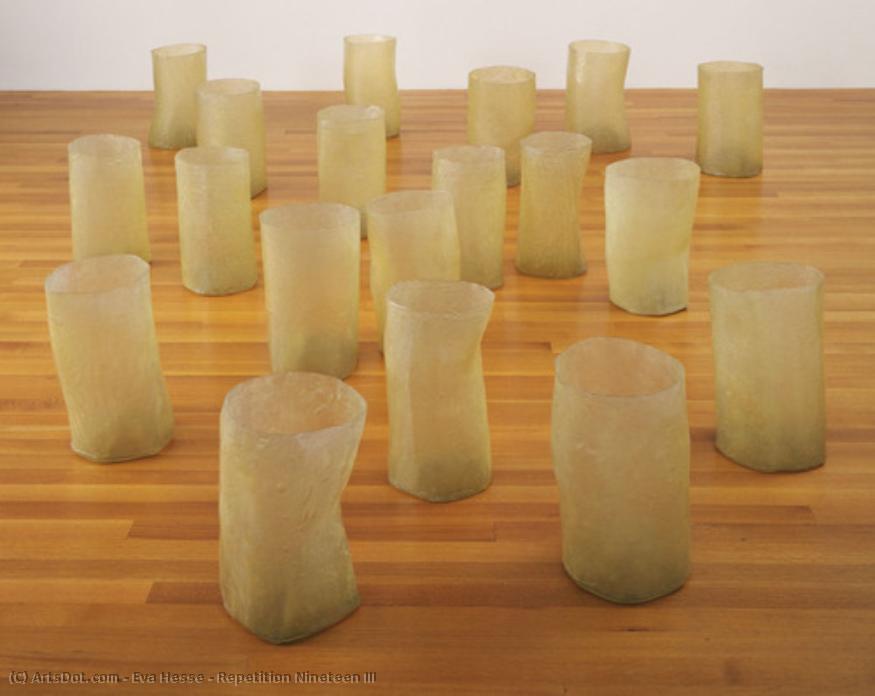
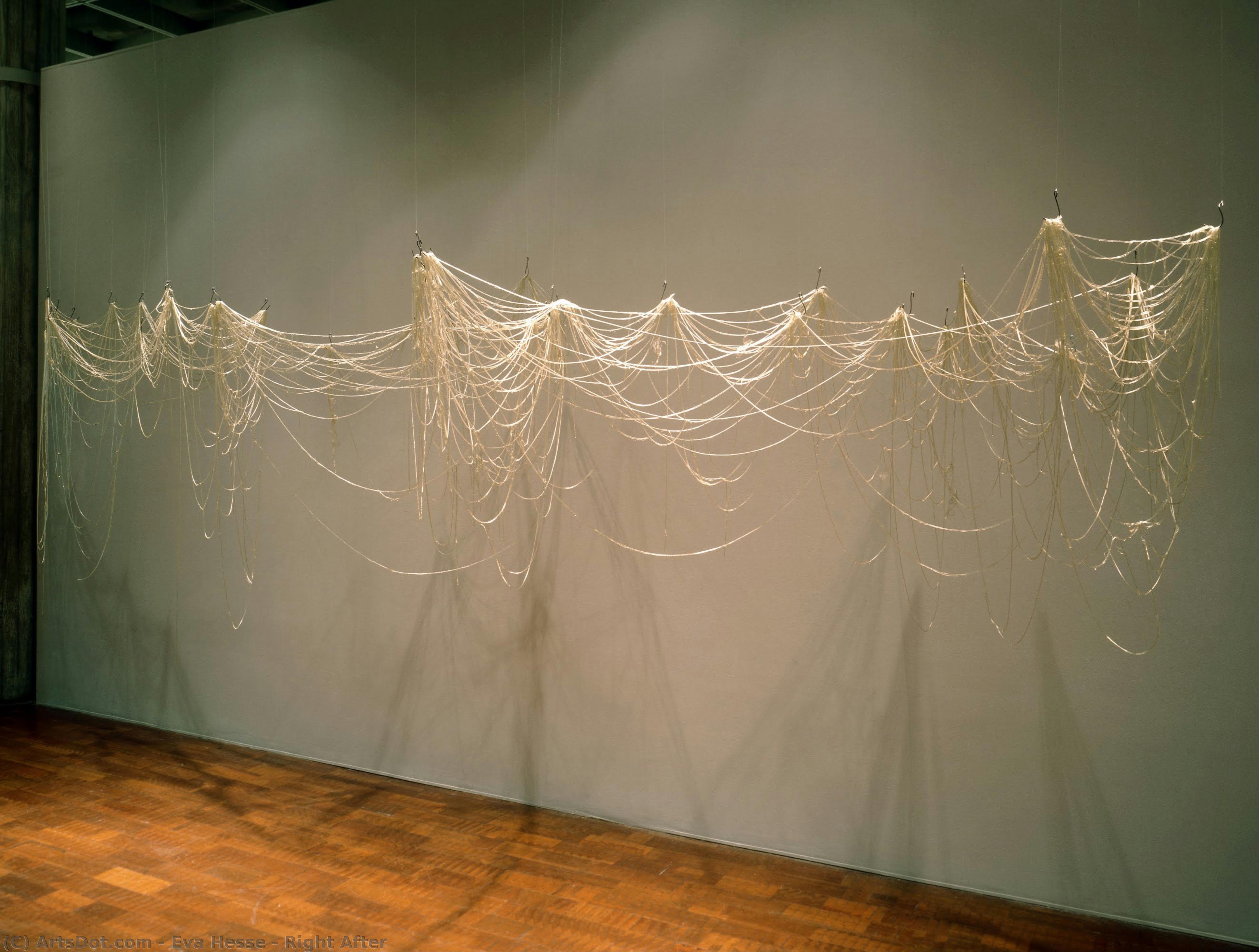
Из всех оригинальных работ, оставленных Ева Гессе, самой известной является Repetition Nineteen III (1968) из коллекции Музей современного искусства (MoMA), Нью-Йорк. Сразу за ними следуют Tomorrow's Apples (5 in White) (1965) и Right After (1969). В нашем каталоге представлено 13 работ Ева Гессе; галерея сохранила 13 самых почитаемых в мире произведений, каждое из которых сопровождается датой создания, информацией о музее и своей историей.

1936 – 1970, Гамбург Post-minimalism Больше всего работ: Тейт Модерн

10 лучших картин Ева Гессе: выбор галереи

1
Repetition Nineteen III (1968) работы Ева Гессе

Repetition Nineteen III

To stand before Repetition Nineteen III is to encounter not merely an arrangement of objects, but a meditation on persistence and the beautiful imperfection of being. Eva Hesse’s work from this period pulses with a quiet, almost visceral energy. The sculpture presents a constellation of roughly hewn, organic forms resting upon a grounding plane of warm wood. These pieces, cast in a muted, pale green material—perhaps resin or fiberglass—reject the…

2
Tomorrow's Apples (5 in White) (1965) работы Ева Гессе

Tomorrow's Apples (5 in White)

1965 · Sculpture · Тейт Модерн, Лондон

In the quiet, evocative realm of Eva Hesse, materiality speaks where words fail. Her 1965 masterpiece, Tomorrow's Apples (5 in White), stands as a profound testament to the beauty found in imperfection and the delicate balance between structure and decay. At first glance, the viewer is met with a minimalist landscape: five vibrant, rope-like forms—hues of blue, red, pink, yellow, and green—casually draped across a stark, textured white expanse. These…

5
Contingent (1968) работы Ева Гессе

Contingent

1968 · Mixed Media · Национальная галерея Австралии, Канберра

Eva Hesse’s 1968 work, “Contingent,” isn't merely a sculpture; it’s an embodied meditation on vulnerability and the precarious nature of existence. Born from the tumultuous backdrop of post-war Germany and Hesse’s deeply personal experiences – displacement, loss, and the lingering shadow of her mother’s suicide – the piece speaks to a profound sense of uncertainty and reliance. Hesse, a pivotal figure in the emergence of Post-Minimalism, deliberately eschewed the rigid…

7
Hang Up (1966) работы Ева Гессе

Hang Up

Eva Hesse’s “Hang Up,” created in 1966, isn't merely a sculpture; it’s an arresting meditation on the very nature of art and its relationship to space. Captured with remarkable clarity in this photograph, the work immediately commands attention with its stark simplicity – a rectangular frame, painted a subtly grayish-blue, suspended from a thick, black cord that descends dramatically to the floor. This seemingly austere composition belies a profound depth…

Подборка Ева Гессе продолжается, с 11 по 13

Знаменитые картины Ева Гессе по периодам творчества

Сюжеты, которые вдохновляли Ева Гессе

Четыре темы, которые чаще всего встречаются в этих оригиналах, каждая из которых представлена своим лучшим образцом.

Музеи, в которых хранятся оригиналы работ Ева Гессе

5 музеев, в которых находится большинство картин со страницы.

Музей Город Работы Ева Гессе Картины из этого списка
Тейт Модерн, ЛондонТейт Модерн Лондон 2 Tomorrow's Apples (5 in White), Untitled
Институт искусств Детройта, ДетройтИнститут искусств Детройта Детройт 2 Accession II, Accession II
Музей современного искусства (MoMA), Нью-ЙоркМузей современного искусства (MoMA) Нью-Йорк 1 Repetition Nineteen III
Национальная галерея Австралии, КанберраНациональная галерея Австралии Канберра 1 Contingent
Институт искусств Чикаго, ЧикагоИнститут искусств Чикаго Чикаго 1 Hang Up

Ева Гессе по годам: оригинальные работы, определяющие каждый период

Всего за одно десятилетие, с 1960 по 1969, этот период подарил миру все оригинальные работы Ева Гессе, представленные в этой подборке: перед вами — по годам.

Работы по годам

Выберите год, чтобы увидеть оригиналы.

Вопросы коллекционеров о картинах Ева Гессе

Какая работа Ева Гессе наиболее известна?Узнать ответ

Repetition Nineteen III (1968), Музей современного искусства (MoMA), Нью-Йорк. Далее следуют Tomorrow's Apples (5 in White) (1965) и Right After (1969).

Сколько лет было Ева Гессе, когда была создана работа Repetition Nineteen III?Узнать ответ

32 лет: Repetition Nineteen III датируется 1968 годом, а Ева Гессе родился в 1936.

Какие десять самых известных картин написал Ева Гессе?Узнать ответ

Repetition Nineteen III, Tomorrow's Apples (5 in White), Right After, No Title (Spectres series), Contingent, Untitled, Hang Up, Untitled, Expanded Expansion и Addendum. В рейтинге выше указаны год создания и музей для каждой работы.

Сколько картин оставил(а) Ева Гессе?Узнать ответ

В нашем каталоге представлено 13 работ Ева Гессе, созданных в период с 1960 по 1969.

В каких музеях представлены шедевры Ева Гессе?Узнать ответ

В основном в Тейт Модерн (Лондон), Институт искусств Детройта (Детройт) и Музей современного искусства (MoMA) (Нью-Йорк). В таблице выше перечислены все музеи.

В какие годы Ева Гессе написал свои самые известные работы?Узнать ответ

В 1965: 3 из 13 работ на этой странице были созданы в этот период, Tomorrow's Apples (5 in White) из них.

Каковы первые и последние известные оригинальные работы Ева Гессе?Узнать ответ

На этой странице самая ранняя работа датирована No Title (Spectres series) (1960), а самая поздняя — Right After (1969).

Какие сюжеты Ева Гессе выбирал чаще всего?Узнать ответ

Materiality (4), Fragility (4) и Organic forms (2) в 13 работах на этой странице.

Какую технику чаще всего использовал(а) Ева Гессе?Узнать ответ

Sculpture, для 2 из 13 работ на этой странице.

К какому художественному направлению относится Ева Гессе?Узнать ответ

Post-minimalism и Postminimalism, судя по оригиналам на этой странице.

Какие работы Ева Гессе представлены в Тейт Модерн?Узнать ответ

Tomorrow's Apples (5 in White) и Untitled: в коллекции Тейт Модерн, Лондон находится 2 работ со страницы.

Ева Гессе: жизнь и творчество

Eva Hesse - A Life Interrupted: The Poetic Vulnerability of Eva Hesse

Eva Hesse’s story is one of profound displacement and a relentless pursuit of artistic expression in the face of personal tragedy. Born in 1936 in Hamburg, Germany, her early life was irrevocably altered by the looming shadow of Nazism. Fleeing persecution, her family sought refuge in the United States in 1938, an act that would forever shape Hesse’s identity as a displaced person navigating two worlds. This sense of rootlessness, coupled with the emotional trauma of her parents' separation and her mother’s subsequent suicide when Hesse was just ten years old, became a subtle yet powerful undercurrent in her art—a haunting exploration of fragility, loss, and the ephemeral nature of existence. Her formal artistic training began at Pratt Institute in Brooklyn, followed by studies at Cooper Union and Yale University School of Art and Architecture, where she encountered the rigorous material explorations championed by Josef Albers. However, it was not within the confines of traditional painting that Hesse found her true voice; rather, she embarked on a path of radical experimentation with materials and form, ultimately becoming a pivotal figure in the development of Postminimalism and Eccentric Abstraction.

Early Life and Influences

Eva Hesse’s formative years were marked by significant upheaval. Her parents, Jewish immigrants from Poland, faced increasing antisemitic pressures during Hitler’s rise to power, prompting them to relocate their family to America in 1938—a decision that profoundly impacted Hesse's worldview. This experience instilled a deep awareness of vulnerability and displacement, themes that would permeate her artistic vision throughout her career. Hesse’s exposure to Surrealist art during her adolescence ignited her fascination with subconscious imagery and dreamlike landscapes, influencing her approach to composition and symbolism. Simultaneously, she absorbed the energy and dynamism of Abstract Expressionism, particularly the gestural brushstrokes of artists like Willem de Kooning and Jackson Pollock, recognizing their capacity to convey emotion and spontaneity. These influences combined to shape Hesse’s artistic sensibility—a blend of intellectual rigor and visceral feeling that distinguished her from many of her contemporaries.

Formal Artistic Training and Initial Exploration

Hesse pursued her formal artistic education diligently, enrolling at Pratt Institute in Brooklyn and subsequently attending Cooper Union and Yale University School of Art and Architecture. At Yale, she encountered the influential teachings of Josef Albers, whose exploration of color theory and perceptual illusion profoundly impacted Hesse’s understanding of visual art. Albers's emphasis on reductive abstraction—the simplification of forms to their essential elements—served as a catalyst for Hesse’s own experimentation with minimalist principles. However, Hesse quickly rejected the perceived limitations of pure geometric abstraction, yearning for a more expressive engagement with materiality—a desire that would propel her into uncharted territory. She sought inspiration from artists who challenged conventional artistic norms and embraced unconventional materials and techniques, including Hans Arp and Jean Dubuffet, whose biomorphic sculptures explored organic forms and textures.

A Sculptural Revolution: Embracing Materiality

Initially drawn to abstract painting, Hesse soon felt constrained by its traditional conventions. She recognized that painting alone couldn’t adequately convey the complexities of human experience—the anxieties, uncertainties, and emotional nuances that she wished to explore. This conviction led her to decisively turn towards sculpture, embarking on a transformative journey into the realm of three-dimensional art. Hesse deliberately rejected industrial production methods, favoring instead techniques that allowed for unpredictable results and celebrated imperfections. She experimented with diverse materials—latex rubber, fiberglass, resin, copper wire, felt, and even dirt—pushing their boundaries and revealing their inherent qualities. Her sculptures weren’t intended to represent recognizable objects or figures; rather, they aimed to evoke feelings of vulnerability, disorientation, and contemplation. Hesse's approach mirrored the spirit of Postminimalism—a movement that emerged in the mid-1960s as a reaction against the formalism of Minimalism and championed subjectivity and organic form.

Major Achievements and Legacy

Eva Hesse’s sculptural output produced several groundbreaking works that continue to resonate with artists and critics today. Pieces like Hang Up (1966), featuring suspended latex-covered circles, exemplify her masterful manipulation of material properties—the way latex stretched and warped under gravity—to create evocative visual forms. Her series of fiberglass boxes, including Contingent (1968) and Schema and Sequel (1967–68), explored the interplay between geometric precision and organic irregularity, reflecting Hesse’s fascination with both order and chaos. Notably, her installation Accession II (1968)—a monumental assemblage of translucent fiberglass boxes containing phallic forms—challenged societal norms surrounding sexuality and embodied Hesse's commitment to confronting difficult emotions with honesty and vulnerability. Hesse’s influence extended beyond sculpture; she championed feminist art practices by exploring themes of gender identity, bodily experience, and psychological introspection. Her courageous embrace of imperfection and her willingness to experiment with unconventional materials solidified her position as a pioneer in Postminimalism and Eccentric Abstraction—a legacy that continues to inspire artists striving for originality and emotional depth. Hesse’s untimely death from cancer in 1970 tragically curtailed her artistic career, but her work remains a testament to the transformative power of art and its ability to illuminate the human condition.