Портрет Edward Armitage

27 самых известных картин Edward Armitage, каждая из которых уникальна

Обновлено Ноябрь 2026 · рейтинг на основе нашего показателя популярности (количество поисковых запросов, посещений и заказов для каждой работы) · 29 работ Edward Armitage в нашем каталоге

Вкратце

The Festival of Esther (1865) — это самая популярная картина Edward Armitage; оригинал находится в Королевская академия искусств, Лондон. Затем взгляд переходит на The Woman Taken in Adultery (1860) и Saint Simon (1862). Из 29 работ Edward Armitage в нашем каталоге эти 27 являются самыми известными: каждая из них — уникальный оригинал с указанием года создания, музея и причины ее бессмертия.

1817 – 1896, London Academic art Больше всего работ: Auckland Art Gallery Toi o Tāmaki

Топ-10 картин Edward Armitage глазами галереи

1
The Festival of Esther (1865) работы Edward Armitage

The Festival of Esther

1865 · Oil On Canvas · Королевская академия искусств, Лондон

The scene unfolds within the grand, storied atmosphere of The Festival of Esther, a work that invites us into a moment of communal celebration. Painted by Edward Armitage, this oil on canvas captures a specific instance of gathering and shared joy. Some observers recognize this same scene through its alternative title, Esther's Banquet, a name that highlights the central importance of the feast being shared by the figures gathered around…

2
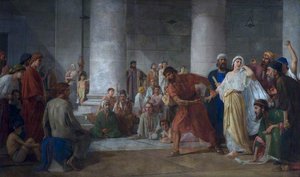
The Woman Taken in Adultery (1860) работы Edward Armitage

The Woman Taken in Adultery

1860 · Oil On Canvas

In "The Woman Taken in Adultery" by Edward Armitage, the viewer is immediately drawn into a complex and crowded arrangement of figures. The composition centers upon a woman who is surrounded by a dense group of people, creating a sense of immediate tension. At the heart of this confrontation, a man holds a scroll, presenting it as he faces her. This central interaction is framed by the weathered ruins of…

3
Saint Simon (1862) работы Edward Armitage

Saint Simon

1862 · Oil On Canvas

The profile of a man emerges from the shadows, his face turned toward an unseen light. He is Saint Simon, captured in a moment of quiet, heavy contemplation. His shoulder-length black hair falls in soft, dark waves, framing a countenance that carries the weight of profound thought. Clad in white, his garment catches the light, creating a stark contrast against the textured, abstract background that surrounds him. There is a…

Знаменитые картины Edward Armitage, с 11 по 27

Сюжеты, которые вдохновляли Edward Armitage

Четыре темы, которые чаще всего встречаются в этих оригиналах, каждая из которых представлена своим лучшим образцом.

Музеи, в которых хранятся оригиналы работ Edward Armitage

8 музеев, в которых находится большинство картин со страницы.

Музей Город Работы Edward Armitage Картины из этого списка
Auckland Art Gallery Toi o Tāmaki, ОклендAuckland Art Gallery Toi o Tāmaki Окленд 3 Dawn of the first Easter Sunday, Blind Beggar of Assisi, Sea urchins
Walker Art Gallery, ЛиверпульWalker Art Gallery Ливерпуль 2 Julian the Apostate Presiding at a Conference of Sectarians, Serf Emancipation
Hastings Library, HastingsHastings Library Hastings 2 A Dream of Fair Women (diptych, panel 2), A Dream of Fair Women (diptych, panel 1)
Laing Art Gallery, Ньюкасл-апон-ТайнLaing Art Gallery Ньюкасл-апон-Тайн 2 The Cities of the Plain, Souvenir of Scutari
Королевская коллекция, ЛондонКоролевская коллекция Лондон 2 The Pontoon on Virginia Water, 5 July 1853, The Battle of Meanee, 17 February 1843
Королевская академия искусств, ЛондонКоролевская академия искусств Лондон 1 The Festival of Esther
Королевское общество, ЛондонКоролевское общество Лондон 1 Deputation to Faraday
Guildhall Art Gallery, ЛондонGuildhall Art Gallery Лондон 1 Herod's Birthday Feast

Edward Armitage сквозь десятилетия: по одному уникальному оригиналу на каждое десятилетие

Произведения по десятилетиям

Выберите десятилетие, чтобы увидеть шедевр, определяющий его.

Картины Edward Armitage: вопросы к галерее

Какая работа Edward Armitage является самой известной?Узнать ответ

The Festival of Esther (1865), Королевская академия искусств, Лондон. Далее следуют The Woman Taken in Adultery (1860) и Saint Simon (1862).

В каком возрасте Edward Armitage создал(а) The Festival of Esther?Узнать ответ

48 лет: The Festival of Esther датируется 1865 годом, а Edward Armitage родился в 1817.

Какие десять картин Edward Armitage являются самыми известными?Узнать ответ

The Festival of Esther, The Woman Taken in Adultery, Saint Simon, Dawn of the first Easter Sunday, Deputation to Faraday, Julian the Apostate Presiding at a Conference of Sectarians, The Death of Marmion, The Death of Nelson, The Christian Martyr и Christ Calling the Apostles James and John. В рейтинге выше указаны год создания и музей для каждой работы.

Сколько известно работ Edward Armitage?Узнать ответ

В нашем каталоге представлено 29 работ Edward Armitage, созданных в период с 1842 по 1882.

Где можно увидеть подлинники, созданные Edward Armitage?Узнать ответ

В основном в Auckland Art Gallery Toi o Tāmaki (Окленд), Walker Art Gallery (Ливерпуль) и Hastings Library (Hastings). В таблице выше перечислены все музеи.

В какой период Edward Armitage создал свои самые известные картины?Узнать ответ

В 1860s: 10 из 27 работ на этой странице были созданы в этот период, The Festival of Esther из них.

Какая из знаменитых картин Edward Armitage была написана раньше, а какая — позже?Узнать ответ

На этой странице самая ранняя работа датирована The Death of Marmion (1842), а самая поздняя — Self Portrait (1882).

Какие сюжеты предпочитал Edward Armitage?Узнать ответ

Birth and death (3), Women (3) и Woman (2) в 27 работах на этой странице.

Какими материалами чаще всего пользовался Edward Armitage?Узнать ответ

Oil On Canvas, для 3 из 27 работ на этой странице.

К какому направлению относится творчество Edward Armitage?Узнать ответ

Academic art, судя по оригиналам на этой странице.

Какие оригинальные работы Edward Armitage можно увидеть в Auckland Art Gallery Toi o Tāmaki?Узнать ответ

Dawn of the first Easter Sunday, Blind Beggar of Assisi и Sea urchins: в коллекции Auckland Art Gallery Toi o Tāmaki, Окленд находится 3 работ со страницы.

Edward Armitage: портрет художника

Early Life and Family Roots

Edward Armitage, born in London on May 20th, 1817, emerged from a background steeped in the burgeoning industrial wealth of Yorkshire. Though his initial years were spent within the capital’s confines, his lineage was firmly anchored in the north of England, specifically to the Armitage family of Farnley Hall, just south of Leeds. His father, James Armitage, was a prominent ironmaster, one of seven sons descended from a line that had acquired Farnley Hall in 1799. This familial foundation—a blend of established land ownership and entrepreneurial spirit—would subtly shape the artist’s trajectory, providing both opportunity and a degree of independence.

The Armitage family's involvement extended beyond ironworks; his brother, Thomas Rhodes Armitage, notably founded the Royal National Institute of the Blind, demonstrating a commitment to social betterment. This sense of purpose, though not directly artistic, resonates within the often-grand and morally weighty themes that would come to define Edward’s work. He was connected through family to several notable figures including Robert Armitage (MP) and Robert Selby Armitage.

Artistic Formation in Paris

Recognizing his son's inclination towards art, James Armitage supported Edward’s pursuit of formal training, leading him to Paris in 1837. The École des Beaux-Arts became the crucible where young Armitage honed his skills under the tutelage of Paul Delaroche, a history painter at the zenith of his fame. Delaroche's influence proved profound; he instilled in Armitage a meticulous draughtsmanship, a dedication to historical accuracy, and a penchant for dramatic narrative—qualities that would become hallmarks of his style.

Armitage wasn’t merely a student but an active participant in Delaroche’s ambitious projects. He was selected as one of four assistants tasked with the monumental fresco *Hémicycle* within the Palais des Beaux-Arts, even reputedly serving as a model for the head of Masaccio—a testament to his developing physical presence and artistic aptitude. His early Parisian works, such as *Prometheus Bound* (1842), already hinted at the power he would later wield, earning praise for its skillful execution but also noted for an almost “brutally energetic” quality.

The Westminster Palace Competitions and Early Success

Returning to London in 1843, Armitage entered a period of intense competition with the ambitious project to decorate the new Palace of Westminster. Following the devastating fire of 1834, Queen Victoria’s consort, Prince Albert, spearheaded an initiative to adorn the rebuilt Houses of Parliament with frescoes depicting scenes from British history and literary masterpieces—Spenser, Shakespeare, and Milton being key sources of inspiration.

The ensuing cartoon competitions were fiercely contested. Armitage quickly distinguished himself, securing first prizes for *The Landing of Julius Caesar in Britain* (1843) and later for *The Spirit of Religion* (1845). While these designs weren’t ultimately realized as frescoes—a consequence of the technical challenges inherent in the London climate—they established his reputation and led to commissions for two significant works within the Poets' Gallery: *The Thames and its Tributaries* (from Pope) and *The Death of Marmion* (from Scott). These early successes, coupled with the Queen’s purchase of his large-scale oil painting *The Battle of Meeanee* (1847), cemented Armitage’s position within the Victorian art world.

A Career Defined by Historical Grandeur

Following a period of study in Rome, Armitage consistently exhibited at the Royal Academy from 1848 until 1893. His oeuvre became characterized by large-scale historical and biblical paintings—works that demanded both technical skill and an understanding of complex narratives. *Retribution* (1858), now housed in the Leeds Museum, stands as a particularly striking example; its allegorical depiction of the suppression of the Indian Mutiny, embodied in a colossal female figure grappling with a tiger, exemplifies his dramatic flair and moral seriousness.

His travels during the Crimean War informed paintings like *The Bottom of the Ravine at Inkerman* (1856) and *Souvenir of Scutari*, demonstrating an engagement with contemporary events. However, it was his ability to translate grand historical themes—such as *Samson* (1851) and *Hagar* (1852)—into visually compelling narratives that truly defined his artistic legacy.

Legacy and Historical Significance

Edward Armitage’s career unfolded within a Victorian art landscape increasingly fascinated by historical spectacle and moral allegory. While he consciously emulated the style of Paul Delaroche, his work also reflects a uniquely British sensibility—a blend of meticulous detail, dramatic composition, and a commitment to narrative clarity.

Though his frescoes proved vulnerable to the ravages of time, Armitage’s oil paintings continue to captivate viewers with their scale, ambition, and technical mastery. He represents a significant figure in Victorian art, bridging the gap between academic tradition and a growing interest in contemporary events. His dedication to “high purposes,” as one critic noted, irrespective of immediate reward, underscores his enduring appeal—a testament to an artist who sought not merely to depict history but to imbue it with meaning and moral weight.