1


Обновлено Ноябрь 2026 · рейтинг на основе нашего показателя популярности (количество поисковых запросов, посещений и заказов для каждой работы) · 29 работ David Octavius Hill в нашем каталоге
Вкратце
Из всех оригинальных работ, оставленных David Octavius Hill, самой известной является Unidentified minister (Sketch for the The Signing of the Deed of Demission, The Disruption of the Church of Scotland 1843) (1843) из коллекции Шотландская национальная портретная галерея, Эдинбург. Сразу за ними следуют Unidentified minister (Sketch for the The Signing of the Deed of Demission, The Disruption of the Church of Scotland 1843) (1843) и Viaduct over the River Almond, West Lothian (1841). В нашем каталоге представлено 29 работ David Octavius Hill; галерея сохранила 28 самых почитаемых в мире произведений, каждое из которых сопровождается датой создания, информацией о музее и своей историей.
 1. Unidentified minister (Sketch for the The Signing of the Deed of Demission, The Disruption of the Church of Scotland 1843) 1843
 2. Unidentified minister (Sketch for the The Signing of the Deed of Demission, The Disruption of the Church of Scotland 1843) 1843
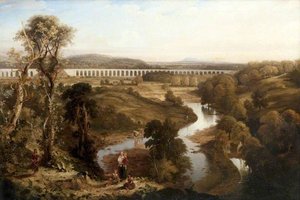 3. Viaduct over the River Almond, West Lothian 1841


 Portrait of a Minister – Sketch for 'The Signing of the Deed of Demission, The Disruption of the Church of Scotland 1843'1843 · Шотландская национальная портретная галерея
12
 An Evening Landscape1855
13
 A View in a Wood1855
14
 Clouds at Sunset1855
15
 Ballochmyle Viaduct over the River Ayr1851
16
 Reverend Thomas Chalmers (1780–1847), Preacher and Social Reformer, with his Grandson Thomas Chalmers Hanna (after a calotype by Robert Adamson and David Octavius Hill)1853 · Шотландская национальная портретная галерея
17
 Dumbarton from Kirktonhill1857
18
 Minister (unidentified)Шотландская национальная портретная галерея
19
 The Firth of ForthThe Hunterian Museum and Art Gallery
20
 Edinburgh Old and NewНациональная галерея Шотландии
21
 Thomas Hill1830
22
 View of Falkirk High Station1851 · Callendar House
23
 Kilmarnock Cross1840 · The Dick Institute
24
 An Old MillHospitalfield Arts
25
 In Memoriam The Calton
26
 Old Edinburgh, Showing the Castle from Greyfriars Churchyard
27
 Portrait of a MinisterШотландская национальная портретная галерея
28
 On the Quay at LeithНациональная галерея Шотландии
Четыре темы, которые чаще всего встречаются в этих оригиналах, каждая из которых представлена своим лучшим образцом.
8 музеев, в которых находится большинство картин со страницы.
| Музей | Город | Работы David Octavius Hill | Картины из этого списка |
|---|---|---|---|
 Шотландская национальная портретная галерея |
Эдинбург | 6 | Unidentified minister (Sketch for the The Signing of the Deed of Demission, The Disruption of the Church of Scotland 1843), Unidentified minister (Sketch for the The Signing of the Deed of Demission, The Disruption of the Church of Scotland 1843), Portrait of a Minister – Sketch for 'The Signing of the Deed of Demission, The Disruption of the Church of Scotland 1843' |
 Национальная галерея Шотландии |
Эдинбург | 2 | Edinburgh Old and New, On the Quay at Leith |
 The Stirling Smith Art Gallery - Museum |
Стерлинг | 1 | Sweetheart Abbey |
 Королевская коллекция |
Лондон | 1 | A View of Dunkeld |
 The Hunterian Museum and Art Gallery |
Глазго | 1 | The Firth of Forth |
 Callendar House |
Falkirk | 1 | View of Falkirk High Station |
 The Dick Institute |
Килмарнок | 1 | Kilmarnock Cross |
 Hospitalfield Arts |
Арброт | 1 | An Old Mill |
Выберите десятилетие, чтобы увидеть шедевр, определяющий его.

Unidentified minister (Sketch for the The Signing of the Deed of Demission, The Disruption of the Church of Scotland 1843) (1843), Шотландская национальная портретная галерея, Эдинбург. Далее следуют Unidentified minister (Sketch for the The Signing of the Deed of Demission, The Disruption of the Church of Scotland 1843) (1843) и Viaduct over the River Almond, West Lothian (1841).
41 лет: Unidentified minister (Sketch for the The Signing of the Deed of Demission, The Disruption of the Church of Scotland 1843) датируется 1843 годом, а David Octavius Hill родился в 1802.
Unidentified minister (Sketch for the The Signing of the Deed of Demission, The Disruption of the Church of Scotland 1843), Unidentified minister (Sketch for the The Signing of the Deed of Demission, The Disruption of the Church of Scotland 1843), Viaduct over the River Almond, West Lothian, A View of Leith, Perth from Boatland, Coasters Discharging in Perth Harbour, Sweetheart Abbey, Feu de joie, Taymouth Castle, Kirkoswald, Tam o' Shanter's Grave и A View of Dunkeld. В рейтинге выше указаны год создания и музей для каждой работы.
В нашем каталоге представлено 29 работ David Octavius Hill, созданных в период с 1826 по 1857.
В основном в Шотландская национальная портретная галерея (Эдинбург), Национальная галерея Шотландии (Эдинбург) и The Stirling Smith Art Gallery - Museum (Стерлинг). В таблице выше перечислены все музеи.
В 1850s: 7 из 28 работ на этой странице были созданы в этот период, An Evening Landscape из них.
На этой странице самая ранняя работа датирована Perth from Boatland (1826), а самая поздняя — Dumbarton from Kirktonhill (1857).
Romanticism, судя по оригиналам на этой странице.
Unidentified minister (Sketch for the The Signing of the Deed of Demission, The Disruption of the Church of Scotland 1843), Unidentified minister (Sketch for the The Signing of the Deed of Demission, The Disruption of the Church of Scotland 1843) и Portrait of a Minister – Sketch for 'The Signing of the Deed of Demission, The Disruption of the Church of Scotland 1843': в коллекции Шотландская национальная портретная галерея, Эдинбург находится 6 работ со страницы.
In the mid-nineteenth century, as the world stood on the precipice of a technological revolution, David Octavius Hill emerged not merely as a chronicler of reality, but as a poet of light. Born in 1802 in Perth, Scotland, Hill possessed an intellect shaped by the rigorous disciplines of mathematics and natural philosophy at Edinburgh University. This scientific foundation, paired with his early training in lithography and painting, allowed him to approach the nascent medium of photography with a rare duality: the precision of a scientist and the soul of an artist. While many saw the camera as a mere tool for mechanical reproduction, Hill envisioned it as a brush capable of capturing the profound psychological depths of the human condition.
His journey into the heart of photographic history was inextricably linked to his partnership with the engineer Robert Adamson. Together, they established the first photography studio in Scotland in 1843, creating a collaborative sanctuary where chemistry and art converged. Their work was defined by the use of the calotype process, a revolutionary method pioneered by William Henry Fox Talbot. Unlike the sharp, clinical clarity of the daguerreotype, the calotype offered a soft, textured grain that allowed for a more painterly expression. Through this medium, Hill and Adamson achieved a Rembrandtesque mastery of chiaroscuro, using dramatic shadows and luminous highlights to imbue their portraits with an almost spiritual weight.
The partnership of Hill and Adamson was brief but incandescent, lasting only from 1843 until Adamson's untimely death in 1847. Yet, in those few years, they produced a body of work that remains the cornerstone of Scottish photographic art. Their subjects ranged from the rugged, salt-laced faces of Newhaven fishermen to the dignified silhouettes of Edinburgh’s intellectual elite. Hill’s innate ability to put sitters at ease—a skill honed during his years as a prominent painter—allowed him to capture more than just a likeness; he captured an essence. In images such as those featuring Reverend Thomas Chalmers, one can sense the heavy atmosphere of Victorian morality and the quiet dignity of a life dedicated to social reform.
<Beyond the studio walls, Hill’s influence extended into the very fabric of the Scottish art scene. As an arts activist and painter, his contributions to the development of local institutions were as significant as his photographic prints. Even as he moved away from the camera following Adamson's death, the aesthetic principles he helped pioneer—the emphasis on tonal depth, texture, and emotional resonance—continued to ripple through the generations of photographers who followed. Today, the name David Octavius Hill stands as a testament to the moment when the mechanical eye first learned to see with the heart of an artist.