A Life Immersed in Color and Form
Nicholas Brice Marden Jr., known to the art world simply as Brice Marden, was a pivotal figure in
American painting whose career spanned over six decades. Born October 15, 1938, in Bronxville,
New York, and passing away August 9, 2023, in Tivoli,
New York, Marden’s artistic journey defied easy categorization, existing at the intersection of
minimalism,
abstract expressionism,
color field painting, and
lyrical abstraction. His life was as multifaceted as his art—a blend of rigorous formal exploration, deep engagement with historical precedents, and a restless curiosity that led him to diverse cultural landscapes. Growing up in Briarcliff Manor,
New York, Marden’s early exposure to the arts laid the foundation for his future pursuits. He initially attended Florida Southern College before earning his BFA from Boston University's School of Fine and Applied Arts in 1961. It was at Yale School of Art and Architecture, where he completed his MFA in 1963, that Marden truly began to forge his artistic path, studying under a constellation of influential figures including
Esteban Vicente,
Alex Katz, and
Jack Tworkov. His cohort included future luminaries like
Richard Serra,
Chuck Close, and
Vija Celmins, fostering an environment of intense creative exchange.
Early Explorations: Minimalism and the Monochrome
Marden’s early work emerged during a period when painting was undergoing profound reevaluation. He arrived in
New York City in 1963 and found himself captivated by
Jasper Johns' retrospective at the Jewish Museum, where he worked as a guard. This encounter sparked an interest in surface texture and subtle variations within limited palettes. His initial explorations led him to compressed
charcoal and
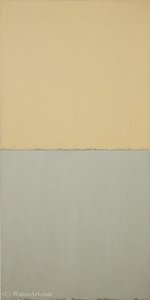
graphite grid-patterned drawings, followed by his signature monochrome panels—works that established him as a leading voice in minimalist painting during the late 1960s and early 1970s. These canvases, often executed in oil and beeswax, were not simply exercises in reduction but rather investigations into the inherent qualities of paint itself: its viscosity, texture, and capacity to evoke mood and atmosphere. Works like “The Dylan Painting” (1966), "1986" and “Lethykos (for Tonto)” (1976) exemplify this period—quietly powerful statements that challenged conventional notions of representation and embraced the expressive potential of pure form. Marden’s approach was deeply informed by a contemplative process, meticulously layering paint to create surfaces that seemed to breathe with an inner life. He wasn't aiming for emptiness but rather a profound sense of presence.
Expanding Horizons: From Hydra to Asia
A pivotal moment in Marden’s artistic development came with his first visit to the Greek island of Hydra in 1971, accompanied by his wife Helen Harrington. The light and landscape of Hydra profoundly impacted his work, inspiring a series of paintings that reflected the island's
serene beauty and ancient history. He began working on marble fragments, creating paintings directly onto the stone surface—a practice that further emphasized the materiality of his art. This period also saw Marden’s interest in architecture deepen, leading him to designs for
stained-glass windows for Basel Cathedral in 1977. In the early 1980s, a journey through Thailand, Sri Lanka, and India ignited a new phase in his artistic evolution. He became fascinated by Asian art, calligraphy, and philosophy, incorporating elements of these traditions into his work. The “Shell Drawings” (1985-87) and the acclaimed "Cold Mountain" series (1989-1991) are testaments to this influence—airy, calligraphic compositions that combined gestural lines with pale backgrounds, evoking a sense of meditative space.
A Legacy of Innovation
Throughout his career, Brice Marden consistently pushed the boundaries of
abstract painting, refusing to be confined by stylistic labels. He embraced experimentation, constantly reinventing his approach and exploring new materials and techniques. His work is characterized by a remarkable sensitivity to color, texture, and form—a subtle yet powerful language that speaks to the fundamental human experience. Marden’s influence on subsequent generations of artists is undeniable. He demonstrated that abstraction could be both intellectually rigorous and emotionally resonant, paving the way for a more nuanced understanding of contemporary painting. His works are held in major museum collections worldwide, including the Museum of
Modern Art, the
Solomon R. Guggenheim Museum, and the San Francisco Museum of
Modern Art, solidifying his place as one of the most important American artists of the 20th and 21st centuries.
He leaves behind a body of work that continues to inspire awe and contemplation.


 Институт искусств Чикаго