Портрет Benjamin Duterrau

Картины Benjamin Duterrau: 5 самых известных работ, взгляд галереи

Обновлено Ноябрь 2026 · рейтинг на основе нашего показателя популярности (количество поисковых запросов, посещений и заказов для каждой работы) · 6 работ Benjamin Duterrau в нашем каталоге

Вкратце

По мнению экспертов галереи, самой известной картиной Benjamin Duterrau является Woureddy, a wild native of Brune Island (1835), оригинал которой находится в National Portrait Gallery, Канберра. Truggernana, a native of southern part of V.D. Land (1835) и Mr Robinson's first interview with Timmy (1840) завершают трио, которое узнает каждый. Из 6 работ Benjamin Duterrau в нашем каталоге ниже представлены 5 самых известных: каждая из них является оригиналом с указанием года создания, музея и уникальных особенностей.

1768 – 1851, London Больше всего работ: National Portrait Gallery

Топ-10 картин художника Benjamin Duterrau в галерее

1
Woureddy, a wild native of Brune Island (1835) работы Benjamin Duterrau

Woureddy, a wild native of Brune Island

1835 · Etching · National Portrait Gallery, Канберра

The etching titled Woureddy, a wild native of Brune Island was created by Benjamin Duterrau in 1835. This portrait captures Woureddy, a Nuennone man from Bruny Island. He was a man of many voices, capable of speaking five different dialects. His hands were those of a skilled boat builder, accustomed to the grain of wood and the salt of the sea.

2
Truggernana, a native of southern part of V.D. Land (1835) работы Benjamin Duterrau

Truggernana, a native of southern part of V.D. Land

1835 · Ink On Paper · National Portrait Gallery, Канберра

The ink meets the paper with a quiet, deliberate precision, capturing a moment of profound stillness. A figure emerges from the pale expanse of the page, rendered in the meticulous lines of a pen and ink drawing. This is Truggernana, a woman of the Nuennone people, her presence felt through the delicate hatching and the careful weight of every stroke. She exists in a space that feels both intimate and…

3
Mr Robinson's first interview with Timmy (1840) работы Benjamin Duterrau

Mr Robinson's first interview with Timmy

1840 · Oil On Canvas · Национальная галерея Австралии, Канберра

The painting depicts a formal meeting between a European man and several Indigenous men under a heavy, overcast sky. In the foreground, the two primary figures are engaged in a handshake, a gesture that anchors the composition. The European man wears a dark, heavy coat over a shirt with white and blue stripes. His skin tone and the skin of the Indigenous men are rendered in deep browns and earthy…

4
Jack, a Tasmanian Aboriginal, holding a club (1841) работы Benjamin Duterrau

Jack, a Tasmanian Aboriginal, holding a club

1841 · Oil On Canvas · Art Gallery of South Australia, Аделаида

Jack, a Tasmanian Aboriginal, holding a club is a portrait by the English painter, etcher, and sculptor Benjamin Duterrau. Executed in 1841, the work captures a specific individual from the Tasmanian Indigenous population during a period of significant colonial transition. The subject of the painting is a man named Jack.

5
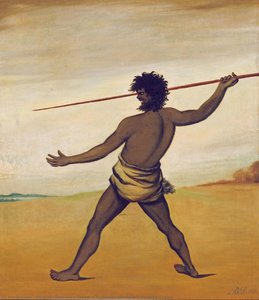
Timmy, a Tasmanian Aboriginal, throwing a spear (1838) работы Benjamin Duterrau

Timmy, a Tasmanian Aboriginal, throwing a spear

1838 · Oil On Canvas · Art Gallery of South Australia, Аделаида

In this 1838 oil painting, titled Timmy, a Tasmanian Aboriginal, throwing a spear, we encounter a singular moment of focused intensity. The artist, Benjamin Duterrau, captures a solitary Tasmanian Aboriginal man at the precise instant of action. There is a palpable sense of muscular tension in the figure, frozen in the middle of a throw. It is a quiet, heavy moment that speaks to the skill and survival required by…

Сюжеты, которые вдохновляли Benjamin Duterrau

Четыре темы, которые чаще всего встречаются в этих оригиналах, каждая из которых представлена своим лучшим образцом.

Музеи, в которых хранятся оригиналы работ Benjamin Duterrau

3 музеев, в которых находится большинство картин со страницы.

Музей Город Работы Benjamin Duterrau Картины из этого списка
National Portrait Gallery, КанберраNational Portrait Gallery Канберра 2 Woureddy, a wild native of Brune Island, Truggernana, a native of southern part of V.D. Land
Art Gallery of South Australia, АделаидаArt Gallery of South Australia Аделаида 2 Jack, a Tasmanian Aboriginal, holding a club, Timmy, a Tasmanian Aboriginal, throwing a spear
Национальная галерея Австралии, КанберраНациональная галерея Австралии Канберра 1 Mr Robinson's first interview with Timmy

Benjamin Duterrau, знаковые картины каждого года

7 лет, с 1835 по 1841, на этой странице представлена вся хронология творчества Benjamin Duterrau: краткий обзор самых известных оригинальных работ, представленных здесь по годам.

Работы по годам

Выберите год, чтобы увидеть оригиналы.

Картины Benjamin Duterrau: ответы галереи

Какая картина Benjamin Duterrau является самой известной из всех?Узнать ответ

Woureddy, a wild native of Brune Island (1835), National Portrait Gallery, Канберра. Далее следуют Truggernana, a native of southern part of V.D. Land (1835) и Mr Robinson's first interview with Timmy (1840).

Сколько лет было Benjamin Duterrau, когда была завершена работа Woureddy, a wild native of Brune Island?Узнать ответ

67 лет: Woureddy, a wild native of Brune Island датируется 1835 годом, а Benjamin Duterrau родился в 1768.

Сколько работ создал(а) Benjamin Duterrau?Узнать ответ

В нашем каталоге представлено 6 работ Benjamin Duterrau, созданных в период с 1835 по 1841.

Где висят самые известные оригинальные работы Benjamin Duterrau?Узнать ответ

В основном в National Portrait Gallery (Канберра), Art Gallery of South Australia (Аделаида) и Национальная галерея Австралии (Канберра). В таблице выше перечислены все музеи.

Когда Benjamin Duterrau создал свои самые известные картины?Узнать ответ

В 1835: 2 из 5 работ на этой странице были созданы в этот период, Woureddy, a wild native of Brune Island из них.

Какие из самых известных работ Benjamin Duterrau являются наиболее ранними и наиболее поздними?Узнать ответ

На этой странице самая ранняя работа датирована Woureddy, a wild native of Brune Island (1835), а самая поздняя — Jack, a Tasmanian Aboriginal, holding a club (1841).

К каким сюжетам Benjamin Duterrau обращался чаще всего?Узнать ответ

Man (3), Indigenous australia (2) и Cloudy sky (2) в 5 работах на этой странице.

В какой технике чаще всего работал(а) Benjamin Duterrau?Узнать ответ

Oil On Canvas, для 3 из 5 работ на этой странице.

Какие оригинальные работы Benjamin Duterrau хранятся в National Portrait Gallery?Узнать ответ

Woureddy, a wild native of Brune Island и Truggernana, a native of southern part of V.D. Land: в коллекции National Portrait Gallery, Канберра находится 2 работ со страницы.

Benjamin Duterrau: художник

A Life Between Two Hemispheres

Benjamin Duterrau arrived in Van Diemen's Land in August 1832, a man of sixty-five years who had already seen the bustling streets of London and the rigorous training of an English apprenticeship. Born in Soho to Anglo-French parents, his early life was shaped by the precision of an engraver’s craft and the artistic shadows of masters like Thomas Gainsborough and William Hogarth. He did not seek a quiet retirement in the colonies; instead, he brought with him a drive to lecture on the civilizing influence of art at the Hobart Mechanics' Hall only months after his arrival.

His transition from the established art circles of England to the rugged landscape of Tasmania was marked by a singular purpose. While many migrants sought fortune through trade, Duterrau sought to document a world in flux. He settled in Hobart, establishing a studio where he could apply the meticulous observation learned in London to the faces and environments of a new territory. His work as a painter, etcher, and sculptor allowed him to capture the nuances of a society undergoing profound colonial shifts.

The Documentation of a Vanishing People

Duterrau’s most significant contribution lies in his sensitive treatment of the Indigenous Tasmanian population. Working alongside figures such as George Augustus Robinson, he found himself positioned at the intersection of colonial expansion and the survival of Aboriginal culture. He did not merely paint subjects; he recorded individuals with a level of dignity that was rare for the 1830s. His etchings and portraits of Aboriginal men and women provided a visual record of people whose lives were being irrevocably altered by settlement.

His technical approach often relied on a realistic style, prioritizing ethnographic accuracy. In works such as his depiction of "Timmy, a Tasmanian Aboriginal, throwing a spear," he utilized layered brushstrokes to build physical presence and texture. He possessed a particular skill for capturing the tension of a moment, such as the muscular focus of a hunter or the quiet strength in a sitter's expression. These portraits remain vital historical documents for those studying the Nuennone and other tribes of the region.

Historical Weight and Artistic Legacy

The scale of Duterrau’s ambition is perhaps best seen in his larger-scale historical compositions. His painting "The Conciliation" (1840) depicts a formal meeting between European colonists and Aboriginal chiefs, utilizing light and color to convey the gravity of the encounter. This work was intended as a study for an even more expansive project titled "A National Picture," an epic canvas that remains lost to history. Despite the disappearance of his largest intended works, his presence in the Tasmanian colonial narrative is firmly established through his surviving sketches and etchings.

Duterrau’s life ended in Hobart in 1851, leaving behind a body of work that functions as both art and archive. His legacy is found in the collections of the Tasmanian Museum and Art Gallery, where his depictions of the landscape and its original inhabitants continue to provide insight into the nineteenth century. He remains a figure who used the tools of an engraver and painter to illuminate the human dimension of Australian colonization.