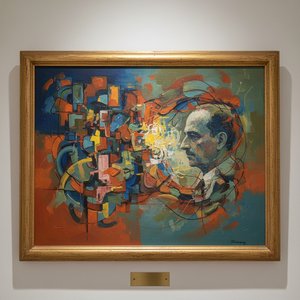
Architecting Perception: The Visual Voyages of Albert Merino Castillo
Born in the vibrant cultural landscape of Barcelona in 1979, Albert Merino Castillo has emerged as a profound architect of the moving image. His artistic journey is rooted in a rigorous academic foundation, having studied fine arts at both the University of Barcelona and the prestigious Kunsthochschule Berlin Weißensee. This dual exposure to Mediterranean sensibility and German conceptual rigor provided him with the critical tools necessary to navigate the complexities of contemporary video art. Rather than merely capturing reality, Merino approaches the screen as a canvas for reconstruction, utilizing digital collage and hybrid languages to bridge the gap between what is seen and what is felt.
The essence of Merino’s practice lies in his ability to manipulate the boundaries between simulation and truthfulness. He does not simply present a narrative; he constructs a spatial experience where the viewer is invited to inhabit a world of layered textures, geometric precision, and architectural depth. His work often explores the tension between the physical structures of our cities and the ephemeral nature of human thought. By employing graphic resources that blur the lines between reality and illusion, he challenges the spectator to question the stability of their own perceptions, turning the act of watching into an active process of discovery.
The Fluidity of Space and Symbolism
In his most celebrated works, such as "The Flight of the Hen/Installation view," Merino demonstrates a masterful command over the interplay of foreground and background. Through the use of immersive installations, he creates a sense of "liquid" reality—a term often used to describe his piercing yet poetic gaze. His subjects are diverse and deeply sociological, ranging from the isolation of the individual in modern society to the political weight of symbols and images. He frequently utilizes irony and absurdity as tools to dissect contemporary life, creating works that function as both fake documentaries and experimental poems.
The symbolism within his oeuvre often revolves around themes of:
- Architectural Deconstruction: Using geometric shapes to reshape urban landscapes and psychological spaces.
- The Utopia of the Virtual: Exploring how digital spaces allow for the realization of ideal, albeit fictional, social policies.
- Memory and Absence: Utilizing ghosts, shadows, and textures to evoke the hidden histories of remote or forgotten places.
- Social Solidarity: Narrating stories of collective action and the influence of media on public consciousness.
Global Recognition and Artistic Legacy
The reach of Albert Merino Castillo’s vision extends far beyond the borders of Spain and Germany. His work has been showcased in some of the world's most influential art institutions, including Palais de Tokyo in Paris, Les Abattoirs in Toulouse, and the Nam June Paik Art Center in Seoul. His presence in major international art fairs such as Art Basel Hong Kong and ARCO underscores his significance within the global contemporary art dialogue. By presenting his work in diverse settings—from the Los Angeles Art Fair to the Biennale of Wroclaw—he has successfully established a universal visual language that resonates across different cultural contexts.
As a pioneer of digital collage within video art, Merino’s historical significance lies in his refusal to accept the image as a static entity. He treats every frame as a site of intervention, where reality is constantly being edited, layered, and reimagined. His career serves as a testament to the power of moving images to act as a tool for social critique and emotional exploration, ensuring that his contribution to the evolution of digital media remains both profound and enduring.