Pop Art · 1955
Collection (Роберт Раушенберг, 1955)
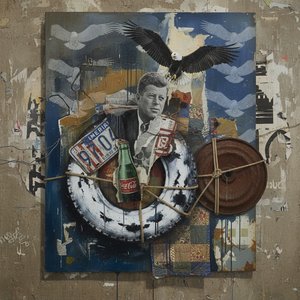
Роберт Раушенберг (1925–2008) создал(а) Collection. Создано в 1955. Относится к направлению Pop Art. Выполнено в технике Mixed Media. Хранится в Музей современного искусства Сан-Франциско в Сан-Франциско, Соединенные Штаты Америки. Размер: 203 × 243 cm
- 1955
- Mixed Media
- 203 × 243 cm
- Музей современного искусства Сан-Франциско

 Предпросмотр

 Картина маслом ручной работы
 Поделиться
 Поделиться
 Информационный лист


 Скачать
 Похожие предметы
 Рентгенография
 Слайд-шоу
 Вопросы и ответы

 Статистика просмотров
Collection вкратце
- Название
- Collection
- Автор
- Роберт Раушенберг (1925–2008)
- Дата рождения художника
- Порт-Артур, США
- Дата
- 1955
- Техника
- Mixed Media
- Размеры
- 203 × 243 cm
- Где посмотреть
- Музей современного искусства Сан-Франциско, Сан-Франциско, Соединенные Штаты Америки
- Движение
- Pop Art
- Период
- Modern
- Сюжет
- combine painting, collage, fabric, wood scraps, color field, everyday objects
Что изображено на Collection?
A Symphony of Chaos and Color: Rediscovering Rauschenberg’s “Collection”
In the mid-1950s, the art world was gripped by the intense, often brooding emotionalism of Abstract Expressionism. Yet, amidst this era of heavy shadows and singular gestures, Robert Rauschenberg emerged with a vision that refused to be contained by the edges of a traditional canvas. His 1955 masterpiece, “Collection,” serves as a breathtaking manifesto of this new era—a work that does not merely sit upon a wall but breathes with the vibrant, messy, and beautiful energy of life itself. To encounter this piece is to witness a pivotal moment in American art history, where the boundaries between the high art of the gallery and the raw textures of the street began to dissolve into something entirely new.
The visual impact of “Collection” is immediate and overwhelming. Spanning an impressive 203 x 243 cm, the work presents a kaleidoscopic tapestry that defies monochromatic simplicity. Instead of the somber tones favored by his contemporaries, Rauschenberg orchestrates a brilliant dialogue between deep reds, sunny yellows, calming blues, and fiery oranges. This is not a painting of static shapes, but a dynamic landscape of layered complexity. As your eyes wander across the surface, you encounter an asymmetrical dance of elements: fragments of weathered wood scraps juxtaposed against unexpected textures, and even the subtle, haunting presence of a mirror positioned off-center, which invites the viewer to physically enter the artwork’s space.
The Alchemy of the Combine: Technique and Texture
At the heart of this work lies Rauschenberg’s revolutionary “Combine” technique, a method that fundamentally redefined what a painting could be. He moved beyond the brush to embrace the world around him, seamlessly blending traditional painting with the tactile reality of collage. Through the use of silkscreen printing alongside meticulously applied fabric and found objects, he achieved a textural richness that is almost sculptural in nature. This hybrid approach allows light to play differently across the canvas, catching on raised surfaces and receding into deep, shadowed crevices.
For the discerning collector or interior designer, this piece offers an unparalleled depth of character. The way the artwork incorporates various shades—from verdant greens to stark whites—creates a sense of movement that changes depending on the lighting of a room. It is a work that demands attention, providing a sophisticated focal point that bridges the gap between modern abstraction and contemporary installation art. The inclusion of diverse shapes, including a delicate bird figure that drifts through the composition, adds a layer of narrative intrigue, making every viewing a new discovery.
A Legacy of Freedom and Artistic Rebellion
To understand “Collection” is to understand the spirit of rebellion that defined Rauschenberg’s career. Born in the oil fields of Texas, his life was one of transition and movement, a nomadic sensibility that allowed him to see beauty in the discarded and the everyday. By integrating found objects into his work, he sought to liberate painting from the rigid confines of form and content, mirroring the broader cultural shifts of a post-war America seeking new modes of expression. He rejected the perceived heaviness of the New York School in favor of a more democratic, inclusive aesthetic.
Ultimately, “Collection” is an invitation to embrace complexity. It symbolizes the beauty found in the collision of disparate parts—the way chaos can be orchestrated into harmony. For those seeking to bring a sense of historical significance and avant-garde energy into a curated space, a high-quality reproduction of this work offers more than just decoration; it offers a piece of the revolution. It is a profound statement of artistic freedom that continues to inspire awe, reminding us that art is not just something to be looked at, but something to be lived within.
В каком музее находится Collection?
Музей современного искусства Сан-Франциско
Сан-Франциско, Соединенные Штаты Америки
Истоки и история института Музей современного искусства Сан-Франциско был основан в 1935 году. В период своего становления под руководством директора Грейс Л. Макканн Морли учреждение функционировало как Сан-Францисский музей изобразительного искусства.


Изображения в высоком разрешении: Collection

Protected by copyright: these files are for personal reference, not a licence to republish.
Роберт Раушенберг, Collection (1955), Музей современного искусства Сан-Франциско.
Ответы на вопросы о Collection
Где можно увидеть оригинал «Collection», Роберт Раушенберг?
Картина «Collection», Роберт Раушенберг представлена в коллекции Музей современного искусства Сан-Франциско, Сан-Франциско, Соединенные Штаты Америки. В описании музея речь идет об оригинальном произведении, а не о репродукциях.
В каком году было создано произведение «Collection», Роберт Раушенберг?
«Collection» датируется 1955 годом. Эта дата позволяет определить место произведения в творчестве Роберт Раушенберг и в контексте его эпохи.
В какой технике выполнено произведение «Collection»?
Техника исполнения работы «Collection», Роберт Раушенберг — Mixed Media. Репродукции стремятся максимально точно передать особенности этой техники.
Каковы реальные размеры произведения «Collection», Роберт Раушенберг?
Размер оригинала произведения «Collection» составляет 203 x 243 cm. Оригинальные размеры могут служить полезным ориентиром при выборе размера репродукции.
Что изображено на картине «Collection»?
Темы, представленные в «Collection», Роберт Раушенберг, включают combine painting, collage, fabric, wood scraps, color field, everyday objects, abstract forms. Вместе они раскрывают основной сюжет произведения.
Является ли произведение «Collection» свободным от авторских прав?
Статус авторского права для «Collection», Роберт Раушенберг: произведение находится в находится под защитой авторского права. Это определяет, допускается ли свободное воспроизведение изображения.
Кто создал "Collection"?
Автор произведения «Collection» — Роберт Раушенберг. Работа внесена в каталог под именем Роберт Раушенберг.
К какому художественному направлению относится «Collection», Роберт Раушенберг?
Художественное направление, к которому относится «Collection», Роберт Раушенберг, — это Pop Art. Такая классификация позволяет соотнести данную работу с другими произведениями и мастерами того же периода.
К какому периоду творчества Роберт Раушенберг относится работа «Collection»?
«Collection» относится к Combine Era художника Роберт Раушенберг.
Об авторе, Роберт Раушенберг

1925–2008, США
Роберт Раушенберг
Жизнь, сотканная из перемен Роберт Раушенберг, урожденный Милтон Эрнест Раушенберг в 1925 году среди нефтеносных ландшафтов Порт-Артура, штат Техас, был художником, чье само существование казалось эхом динамичной энергии и преобразующего духа, который он привнес в мир искусства. Его детство не было определено одним местом; профессия его отца требовала кочевого образа жизни, путешествий по разнообразным местностям, которые тонко внушили ему восприимчивость к различным визуальным стимулам и готовность принять перемены. Этот ранний опыт сформировал чувствительность, настроенную на текстуры и ритмы американской жизни – подток, глубоко формирующий его художественные изыскания. Изначально увлеченный фармакологией в Техасском университете, Раушенберг быстро отклонился от этого пути, обратившись к искусству – сначала по необходимости во время службы в ВМС во время войны, затем с углубленным изучением в Институте искусств Канзас-Сити и, что особенно важно, в Блэк-Маунтин-Колледже в Северной Каролине.
Другие работы Роберт Раушенберг
 Недвижимость1963
 Signs1970
 Barge1963
 Odalisk1958
Эссе к произведению Collection
 Robert Rauschenberg: Bridging Painting & Life – A Comprehensive Exploration of Combines, Silkscreens, and the Erasure of BoundariesExplore the revolutionary art of Robert Rauschenberg – Combines, silkscreens & more. Discover his impact on Pop Art, investment potential &…
 Mastering Art Collecting: A Professional Guide to Acquiring Museum-Quality Famous ReproductionsMaster the art of collecting with our expert guide to museum-quality oil reproductions. Learn to distinguish hand-painted masterpieces from…
 Beyond the Subject: The Raw Power of Abstract Expressionism | A Definitive Guide for the Modern CollectorExplore the visceral power of Abstract Expressionism. From the New York School to action painting, discover how to collect high-impact, han…