Переключиться на печать
 Развернуть текст







































 Для произведений искусства или репродукций, размер которых превышает 105 см (приблизительно 41 дюйм) по любой из сторон, рама будет доставлена в разобранном виде (в виде комплекта). Этот метод обеспечивает безопасную доставку и предотвращает повреждения при транспортировке.


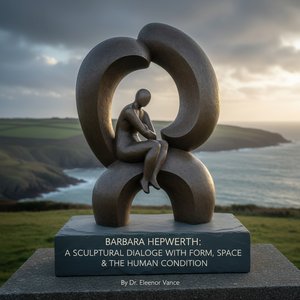
Fragment: A Meditation on Form and Absence
Dame Barbara Hepworth’s “Fragment,” created in 1971, stands as a testament to the enduring power of minimalist sculpture and its ability to convey profound emotional resonance. This unassuming piece—a simple sheet of paper bearing a carefully executed cutout design—appears deceptively straightforward at first glance. However, beneath its muted brown surface lies an intricate exploration of geometric abstraction and the evocative suggestion of sculptural form.
- Artist: Barbara Hepworth (1903 – 1975)
- Year Created: 1971
- Medium: Paper, Embossed Print
- Dimensions: Unknown
- Location: Tate Collection
Hepworth’s artistic journey began in Leeds School of Art and continued at the Royal College of Art, where she honed her skills in sculpture and embraced the burgeoning modernist movement. Influenced by Surrealism and abstraction-Création—a collaborative effort with fellow artists like Ben Nicholson—Hepworth consistently sought to distill visual experience into its purest essence.
"Fragment" exemplifies Hepworth’s signature style: a deliberate reduction of form, prioritizing surface texture and spatial relationships over representational detail. The embossed print technique adds another layer of complexity, creating subtle variations in tone that heighten the perception of depth and contour. It's remarkable how such a minimal intervention can evoke a powerful sense of contemplation.
Symbolism & Context: Hepworth’s work often engages with themes of geological time and primal forces—concepts reflected in her exploration of organic forms like stone and earth. “Fragment” speaks to the idea of incompleteness, hinting at something lost or hidden beneath the surface. The cutout design itself can be interpreted as representing a fractured element within a larger whole, prompting viewers to consider notions of balance and transformation.
Emotional Impact: Viewing "Fragment" invites introspection—a quiet engagement with its understated beauty and subtle textural qualities. Its simplicity encourages contemplation on the relationship between form and space, mirroring Hepworth’s broader artistic preoccupation with conveying emotion through abstract visual language. It's a piece that rewards repeated observation and offers a glimpse into the artist’s deeply considered vision of the world.
- Further Exploration: Visit Tate Britain (https://www.tate.org.uk/explore/artists/barbara-hepworth) to see more of Hepworth’s sculptures and drawings, including “Oval Form” and “Two Forms.”
- Related Artists: Explore the work of Ben Nicholson (Benjamin Nicholson), another key figure in British Modernism who collaborated closely with Hepworth.
Вопросы и ответы
Является ли произведение «Фрагмент» общественным достоянием?
Статус авторского права для «Фрагмент», Барбара Хэпворд: произведение находится в все еще защищено авторским правом. Это определяет, допускается ли свободное воспроизведение изображения.
В какой технике было выполнено произведение «Фрагмент» и когда оно было создано?
«Фрагмент» была создана в 1971 г., техника: Акрил на холсте.
Какова насыщенность и интенсивность цветов в работе «Фрагмент», Барбара Хэпворд?
В работе «Фрагмент», Барбара Хэпворд запечатлена Сбалансированная мягкость насыщенность и Сбалансированный интенсивность цвета.
 Примерить в интерьере
 Отправить
 Поделиться
 Подробнее
 Руководство

 Скачать
 Похожие объекты
 Рентгенография
 Слайд-шоу
 Q&A
Q&A Статистика