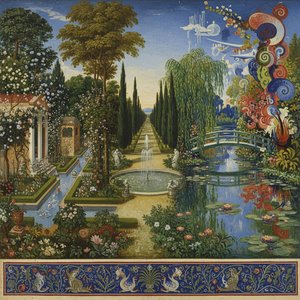

A Renaissance Masterpiece: Château de Villandry – Where Gardens Tell Stories
Nestled amidst the rolling hills of the Loire Valley, France, Château de Villandry isn’t merely a castle; it's an immersive experience, a living testament to the harmonious marriage of art, architecture, and nature. This magnificent estate invites visitors on a journey through centuries of vision, where meticulously crafted gardens whisper tales of noble lineage, strategic brilliance, and a profound appreciation for beauty. Originally conceived as a formidable medieval fortress, Villandry has undergone a breathtaking transformation, evolving into a lavish Renaissance residence—a place where every stone, every terrace, and every flowerbed contributes to an elaborate, symbolic narrative.
The story truly begins in the 16th century with Jean Le Breton, France’s Controller-General for War. Recognizing the strategic potential of the site, he commissioned a new château to be built around the existing 14th-century keep – a clever decision that preserved a tangible link to the past while embracing the burgeoning Renaissance ideals of symmetry and grandeur. However, it was Joachim Carvallo, a Spanish doctor and an ardent horticulturalist, who truly elevated Villandry to its iconic status. In 1906, he purchased the estate alongside his wife, Ann Coleman – a woman whose considerable wealth fueled an ambitious project: to transform the existing gardens into a series of interconnected “parterres,” each meticulously designed to embody a distinct philosophical or historical concept. These aren’t simply decorative flowerbeds; they are carefully orchestrated dialogues between art, nature, and human intellect—a testament to Carvallo's visionary genius.
The Gardens – A Symphony in Stone and Bloom
Villandry’s gardens are a breathtaking spectacle, divided into several distinct areas, each boasting its own unique character. The Water Garden, perhaps the most immediately arresting, is a star-shaped expanse of canals, fountains, and reflecting pools—a shimmering dance of water and light that mirrors the architectural forms above. Adjacent to it lies the Ornamental Garden, a riot of color and texture where meticulously arranged flowerbeds are presented in geometric designs – a bold expression of Renaissance principles of order and proportion. Yet, beyond these formal displays, lies a surprising element: the Vegetable Garden. This isn’t merely a utilitarian space; it's a captivating demonstration of medieval agricultural practices, featuring raised beds planted with herbs, vegetables, and flowers arranged according to traditions that valued both beauty and practicality.
Beyond these core areas, visitors can discover the Sun Garden (Jardin au Soleil), a more intimate sanctuary designed for quiet contemplation and relaxation. The “Parterre des Nobles” – or Grounds of the Nobility – is another highlight, showcasing intricate patterns representing coats of arms and heraldic symbols—a visual representation of lineage, social status, and familial pride. The entire garden complex unfolds across a series of terraces, creating a dramatic sense of depth and perspective that draws the eye upwards towards the château itself. The use of low box hedges – a defining characteristic of Villandry’s style – creates crisp lines and sharp angles, providing a striking contrast to the soft curves of the flowerbeds.
A Château Steeped in History
Château de Villandry is more than just a beautiful estate; it's a repository of French history. Originally constructed as a medieval fortress, it has witnessed pivotal events throughout the centuries. One particularly significant moment occurred in 1189 when King Philip II of France and Richard I of England met within its walls to discuss peace – an event commemorated with a plaque proudly displayed on the château’s façade. The property remained under the control of the Le Breton family for over two centuries before being acquired by the Marquis de Castellane in the 18th century. During the tumultuous period of the French Revolution, the château briefly served as a temporary residence for Napoleon Bonaparte's brother, Jérôme – adding another layer to its rich and complex past.
Today, the Carvallo family continues to cherish this remarkable estate, diligently preserving its legacy for future generations. Their dedication ensures that the beauty and artistry of Château de Villandry will continue to inspire and delight visitors from around the globe. The meticulous restoration work, combined with their unwavering commitment, guarantees that this extraordinary landmark remains a vibrant symbol of French heritage.
Notable Exhibitions & Ongoing Preservation
While the gardens themselves are undoubtedly the primary attraction, Château de Villandry regularly hosts temporary exhibitions that complement its permanent collection. These thoughtfully curated displays often feature works by contemporary artists who respond to the historical and horticultural themes inherent in the estate’s design. Furthermore, ongoing preservation efforts ensure that this remarkable estate remains a vibrant testament to French heritage for generations to come. The meticulous restoration work, combined with the dedication of the Carvallo family, guarantees that the beauty and artistry of Château de Villandry will continue to inspire and delight visitors from around the world.