Portretul lui Wolfgang Laib

Cele 7 cele mai faimoase picturi ale lui Wolfgang Laib, o selecție de galerie

Actualizat Noiembrie 2026 · clasat în funcție de scorul nostru de popularitate (căutări, vizite și comenzi pentru fiecare operă) · 7 lucrări ale lui Wolfgang Laib în catalogul nostru

Pe scurt

Dintre toate originalele lăsate de Wolfgang Laib, cea mai faimoasă este Milkstone (1987), din colecția MoMA - Museum of Modern Art, New York City. Imediat după acestea urmează Milk Stone (1978) și Untitled (1983). Catalogul nostru cuprinde 7 lucrări ale lui Wolfgang Laib; galeria a păstrat cele 7 pe care lumea le admiră cel mai mult, fiecare fiind prezentată împreună cu data, muzeul și povestea sa.

născut în 1950, Metzingen Minimalism Cele mai multe lucrări: MoMA - Museum of Modern Art

Cele mai importante 10 picturi ale lui Wolfgang Laib: selecția galeriei

1
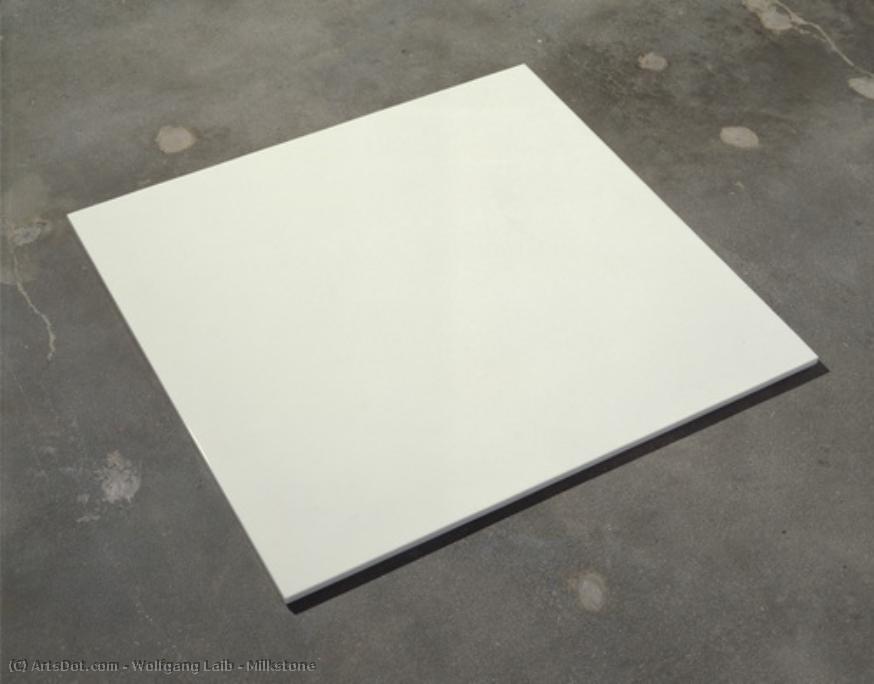
Milkstone (1987) de Wolfgang Laib

Milkstone

1987 · Photography · MoMA - Museum of Modern Art, New York City

In the quietude of a darkened gallery space, Wolfgang Laib’s Milkstone emerges not merely as an object, but as a profound encounter with the elemental. Created in 1987, this sculptural installation—captured here through a striking photographic lens—commands the viewer's attention through its stark, minimalist presence. At first glance, one is met with a monolithic rectangular prism of luminous white, a crystalline form that seems to glow against the deep, obsidian…

2
Milk Stone (1978) de Wolfgang Laib

Milk Stone

1978 · Photography · MoMA - Museum of Modern Art, New York City

To stand before Wolfgang Laib’s Milk Stone is not merely to observe an object; it is to enter a state of quiet contemplation. This piece, dating from 1978, strips away the superfluous until only the essential remains: a perfect square of luminous white resting upon the warm, grounding expanse of aged wood. The composition itself is deceptively simple, yet its power lies in the profound dialogue between its constituent parts.…

3
Untitled (1983) de Wolfgang Laib

Untitled

1983 · Ink On Paper · MoMA - Museum of Modern Art, New York City

To stand before this untitled work by Wolfgang Laib is to enter a space of profound stillness. It is not an image that shouts for attention; rather, it whispers secrets drawn from the quiet corners of nature and deep contemplation. The composition itself—a delicate interplay of reddish-orange markings against a vast expanse of white—immediately draws the eye into its minimalist embrace. One perceives not merely pigment on paper, but the…

Subiectele care i-au captivat privirea lui Wolfgang Laib

Cele patru teme care revin cel mai des în aceste opere originale, fiecare având cel mai sublim exemplu.

Muzeele care păstrează originalele lui Wolfgang Laib

Muzeul care deține cele mai multe dintre picturile prezentate pe această pagină.

Muzee Oraș Lucrări lui Wolfgang Laib Picturi din această listă
MoMA - Museum of Modern Art, New York CityMoMA - Museum of Modern Art New York City 6 Milkstone, Milk Stone, Untitled

Wolfgang Laib deceniu cu deceniu: originalul care definește fiecare

Lucrări pe deceniu

Alege o deceniu pentru a descoperi opera originală care îl definește.

Întrebări ale colecționarilor despre picturile lui Wolfgang Laib

Pentru ce operă este cel mai cunoscut Wolfgang Laib?Află răspunsul

Milkstone (1987), MoMA - Museum of Modern Art, New York City. Urmează Milk Stone (1978) și Untitled (1983).

Ce vârstă avea Wolfgang Laib când a fost creată Milkstone?Află răspunsul

37 ani: Milkstone datează din 1987, iar Wolfgang Laib s-a născut în 1950.

Câte picturi a lăsat Wolfgang Laib?Află răspunsul

Catalogul nostru cuprinde 7 lucrări ale lui Wolfgang Laib, datate între 1978 și 2008.

În ce muzee sunt expuse capodoperele lui Wolfgang Laib?Află răspunsul

În principal în MoMA - Museum of Modern Art (New York City). Tabelul cu muzee de mai sus le enumeră pe toate.

În ce ani a pictat Wolfgang Laib cele mai cunoscute opere?Află răspunsul

În 1980s: 2 dintre cele 7 lucrări de pe această pagină au fost realizate atunci, fiind Milkstone dintre acestea.

Care sunt prima și ultima pictură originală celebră a lui Wolfgang Laib?Află răspunsul

Pe această pagină, cea mai veche lucrare datează din Milk Stone (1978), iar cea mai recentă este din Rice House (2008).

Ce subiecte a ales cel mai des Wolfgang Laib?Află răspunsul

Geometry (3), Silence (3) și Geometric (3), din cele 7 lucrări de pe această pagină.

Ce tehnică a folosit cel mai des Wolfgang Laib?Află răspunsul

Photography, pentru 3 dintre cele 7 lucrări de pe această pagină.

Din ce mișcare artistică face parte Wolfgang Laib?Află răspunsul

Minimalism, judecând după originalele de pe această pagină.

Ce lucrări ale lui Wolfgang Laib sunt expuse la MoMA - Museum of Modern Art?Află răspunsul

Milkstone, Milk Stone și Untitled: MoMA - Museum of Modern Art, New York City deține 6 dintre lucrările de pe această pagină.

Wolfgang Laib: viață și operă

The Sculptor of Silence and Elemental Essence

Born in Metzingen, Germany, in 1950, Wolfgang Laib has cultivated an artistic practice that transcends the boundaries of traditional sculpture, moving instead into the realm of pure, meditative experience. His work does not merely occupy space; it breathes with the rhythms of the natural world. Operating from a tranquil village in southern Germany while maintaining studios in New York City and South India, Laib’s life is a testament to the pursuit of stillness. This unique geographical duality—the structured precision of Europe meeting the spiritual depth of India—informs an aesthetic that seeks to find the eternal within the ephemeral.

Laib’s artistic journey was profoundly shaped by his early immersion in the philosophies of Taoism and Zen Buddhism. These ancient traditions provided him with a lens through which to view the universe, emphasizing simplicity, the beauty of natural forms, and the profound power of emptiness. Rather than imposing a human will upon his materials, Laib seeks a state of harmony, where the artist acts as a facilitator for the inherent qualities of the earth itself. This spiritual foundation is evident in every meticulously placed grain of pollen and every drop of milk that graces his monumental works.

Materiality and the Poetry of Nature

The hallmark of Laib’s oeuvre is his radical use of elemental, organic materials that challenge the conventional permanence of sculpture. He is perhaps most celebrated for his milkstones—monumental blocks of white marble that serve as a canvas for a single, delicate drop of milk. In these pieces, the cold, enduring weight of the stone meets the fragile, life-giving essence of the liquid, creating an evocative juxtaposition of purity and vulnerability. This subtle interplay serves as a meditation on nourishment, renewal, and the delicate balance of existence.

Beyond the marble, Laib’s use of pollen has become one of the most iconic expressions of contemporary Land Art. By collecting vast quantities of pollen and arranging them into precise, geometric fields, he creates installations that feel both cosmic and deeply terrestrial. These golden, velvety surfaces possess a luminous quality that seems to vibrate with life. A defining moment in his career was the presentation of his colossal pollen installation at the Museum of Modern Art (MoMA) in 2013, an achievement that showcased his ability to transform a museum's white cube into a sacred, breathing landscape.

Legacy and Global Recognition

Laib’s contribution to the contemporary art canon is marked by his ability to bridge the gap between the physical and the metaphysical. His participation in the prestigious Documenta 7 (1982) and Documenta 8 (1987) established him as a pivotal figure within the German Land Art movement, proving that sculpture could be found not just in earthworks, but in the very substances of life itself. His work has been recognized on the highest international stages, including representing Germany at the Venice Biennale.

The historical significance of Wolfgang Laib lies in his refusal to participate in the noise of the modern era, choosing instead to champion a quiet, profound minimalism. For his immense contributions to the arts, he has been honored with the Praemium Imperiale, one of the highest honors in the art world. His legacy continues to inspire those who seek meaning in the subtle textures of the natural world, reminding us that true greatness often resides in the most delicate and silent of gestures.