Portretul lui William Aikman

Cele 65 cele mai faimoase picturi ale lui William Aikman, fiecare unică în felul ei

Actualizat Noiembrie 2026 · clasat în funcție de scorul nostru de popularitate (căutări, vizite și comenzi pentru fiecare operă) · 73 lucrări ale lui William Aikman în catalogul nostru

Pe scurt

John Campbell, Second Duke of Argyll and Duke of Greenwich (1680-1743) (1709) este pictura lui William Aikman care atrage cele mai multe priviri; originalul aparține Colecția Regală, Londra. După aceasta, privirea se îndreaptă către Anne Dalrymple, Lady Steuart, d. 1736 (1710) și James Gibbs (1682-1754) holding a Plan of St Mary le Strand, London (1713). Dintre cele 73 opere ale lui William Aikman din catalogul nostru, acestea 65 sunt cele mai celebre, fiecare fiind o piesă unică, prezentată împreună cu anul creării, muzeul deținător și motivul pentru care aceasta rămâne memorabilă.

1682 – 1731, Aberdeenshire Neoclassicism Cele mai multe lucrări: Galeria Națională a Scottei

Cele mai importante 10 picturi ale lui William Aikman, prin ochii galeriei

1
John Campbell, Second Duke of Argyll and Duke of Greenwich (1680-1743) (1709) de William Aikman

John Campbell, Second Duke of Argyll and Duke of Greenwich (1680-1743)

1709 · Oil On Canvas · Colecția Regală, Londra

The subject of this oil on canvas is John Campbell, Second Duke of Argyll and Duke of Greenwich. He is depicted in a vertical, three-quarter length pose, positioned slightly off-center against a background of heavy dark drapery and a distant, hazy landscape. The sitter wears a deep crimson coat accented by metallic silver and gold details, paired with a bright blue sash. His posture is upright, conveying a sense of…

2
Anne Dalrymple, Lady Steuart, d. 1736 (1710) de William Aikman

Anne Dalrymple, Lady Steuart, d. 1736

1710 · Oil On Canvas · Galeria Națională a Scottei, Edinburgh

This three-quarter length portrait presents Anne Dalrymple, Lady Steuart, d. 1736, captured by the hand of William Aikman. Painted about 1710, the work fixes the subject in a moment of quietude. She exists within a space of soft light and deep shadow, her presence defined by the stillness of her posture. The artist, William Aikman, focuses on the steady gaze of the sitter, anchoring the composition with her steady, pale…

3
James Gibbs (1682-1754) holding a Plan of St Mary le Strand, London (1713) de William Aikman

James Gibbs (1682-1754) holding a Plan of St Mary le Strand, London

1713 · Oil On Canvas · Wimpole Hall

The air in the studio feels heavy and still as the light catches the fine, white powder of a meticulously styled wig. We find ourselves in the presence of an older man, his gaze fixed forward with a quiet, steady intensity that suggests a mind preoccupied with geometry and stone. He sits in a three-quarter pose, his dark brown coat absorbing the shadows of the room, while a crisp white…

4
Archibald Campbell, Earl of Ilay, later 3rd Duke of Argyll (1682-1761) (1715) de William Aikman

Archibald Campbell, Earl of Ilay, later 3rd Duke of Argyll (1682-1761)

1715 · Oil On Canvas · Colecția Regală, Londra

Archibald Campbell, Earl of Ilay, later 3rd Duke of Argyll, occupies the space with a commanding stillness that demands immediate recognition. He stands in a vertical three-quarter length pose, his figure cutting a sharp silhouette against a dark, muted background of umber and black. A single light source from the upper left sweeps across the scene, catching the pale sheen of his wig and the luminous texture of his skin.…

5
Patie Birnie, the Fiddler of Kinghorn (1721) de William Aikman

Patie Birnie, the Fiddler of Kinghorn

1721 · Oil On Canvas · Galeria Națională a Scottei, Edinburgh

The air feels heavy with the scent of aged wood and wool as Patie Birnie, the Fiddler of Kinghorn, meets our gaze. He sits in a three-quarter pose, his body angled slightly away while his eyes lock onto ours with a warmth that suggests a shared joke or a song just about to begin. A gentle smile creases his weathered face, softening the deep lines carved by years of laughter…

6
Sir Thomas Saunders Sebright, 4th Bt (1692-1736) or Mr Crawley (1730) de William Aikman

Sir Thomas Saunders Sebright, 4th Bt (1692-1736) or Mr Crawley

1730 · Oil On Canvas · Blickling Hall

A single figure occupies the center of this vertical landscape, a man caught in a moment of poised stillness. He wears a grey frock coat, its surface punctuated by the hard glint of silver buttons. Beneath the coat, a blue tunic reveals a pattern of brown damask braid, a subtle detail against the pale skin of his neck. A white cravat is knotted precisely, leading the eye upward to a…

7
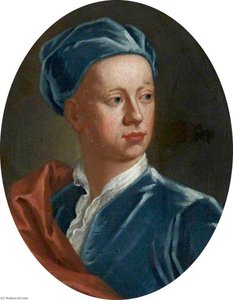
An Unfinished Study of the Head of James Thomson (1725) de William Aikman

An Unfinished Study of the Head of James Thomson

1725 · Oil · Yale Center for British Art, New Haven

In this unfinished oil study, the young man James Thomson emerges from a haze of muted tones. William Aikman captures a fleeting moment of quietude, freezing the subject in a three-quarter view as he gazes toward the right. The portrait feels immediate, as if the artist has just stepped back to observe the play of light across a face that is still being brought into being. It is a glimpse…

8
Henry Kelsall (1692–1762) (1729) de William Aikman

Henry Kelsall (1692–1762)

1729 · Oil On Canvas · National Trust, Norwich

In this 1729 portrait, we encounter Henry Kelsall, a man whose presence commands the space he occupies. He is depicted in a full-length pose, standing with a quiet authority that suggests a life of significant social standing. The composition is traditional, placing him centrally against a backdrop that hints at a stately interior. A heavy red curtain drapes to one side, providing a deep, saturated contrast to the cool tones…

9
Sir Robert Walpole (1676–1745), 1st Earl of Orford, KG (1730) de William Aikman

Sir Robert Walpole (1676–1745), 1st Earl of Orford, KG

1730 · Oil On Canvas · National Trust, Norwich

This oil on canvas portrait, dating to 1730, depicts Sir Robert Walpole, 1st Earl of Orford, KG. The subject is presented in a three-quarter pose, facing slightly to the left, and occupies most of the frame. He is dressed in elaborate robes that signify wealth, power, and rank. The composition is centered, with the figure set against a dark and indistinct background that serves to highlight the subject. The lighting…

10
Dorothy Boyle (1699–1758), Countess of Burlington (1728) de William Aikman

Dorothy Boyle (1699–1758), Countess of Burlington

1728 · Oil On Canvas

In this 1728 oil on canvas, we encounter Dorothy Boyle, Countess of Burlington, presented in a formal, waist-up portrait. She gazes toward the viewer with a composure that suggests a life lived within the highest circles of British nobility. The composition is intimate, utilizing an oval frame to focus our attention entirely upon her figure against a muted, neutral brown background. There is a quietude in her expression, a seriousness…

Păiți celebrele picturi ale lui William Aikman, de la numărul 11 la 65

11Caroline of Brandenburg Ansbach (1683–1737), and Her Son Prince William Augustus (1721–1765), Duke of Cumberland (1730) de William AikmanCaroline of Brandenburg Ansbach (1683–1737), and Her Son Prince William Augustus (1721–1765), Duke of Cumberland1730 · National Trust 12James Hadow de William AikmanJames HadowUniversity of St Andrews 13George Alexander (1704) de William AikmanGeorge Alexander1704 14Robert Geddes, FRCSEd (1709) (1709) de William AikmanRobert Geddes, FRCSEd (1709)1709 · The Royal College of Surgeons of Edinburgh 15John Lauder (c.1680–1737), FRCSEd (1709) (1700) de William AikmanJohn Lauder (c.1680–1737), FRCSEd (1709)1700 · The Royal College of Surgeons of Edinburgh 16Robert Clerk (1664–1720), FRCSEd (1689) (1700) de William AikmanRobert Clerk (1664–1720), FRCSEd (1689)1700 · The Royal College of Surgeons of Edinburgh 17John Gay, Poet and Dramatist (1720) de William AikmanJohn Gay, Poet and Dramatist1720 18James Thomson, Poet (1720) de William AikmanJames Thomson, Poet1720 19John Campbell, 2nd Duke of Argyll and Greenwich, Soldier and Statesman (1720) de William AikmanJohn Campbell, 2nd Duke of Argyll and Greenwich, Soldier and Statesman1720 20James Thomson (1700–1748), Poet (1720) de William AikmanJames Thomson (1700–1748), Poet1720 · Galeria Națională a Scottei 21Allan Ramsay (1684–1758), Poet (1722) de William AikmanAllan Ramsay (1684–1758), Poet1722 · Galeria Națională a Scottei 22John Gay (1685–1732), Poet and Dramatist (1720) de William AikmanJohn Gay (1685–1732), Poet and Dramatist1720 · Galeria Națională a Scottei 23John McGill (d.1735), FRCSEd (1710) (1711) de William AikmanJohn McGill (d.1735), FRCSEd (1710)1711 · The Royal College of Surgeons of Edinburgh 24Sir Patrick Hume (1641–1724), 1st Earl of Marchmont, Statesman (1720) de William AikmanSir Patrick Hume (1641–1724), 1st Earl of Marchmont, Statesman1720 · Muzeul Național din Varșovia 25William Aikman (1682–1731), Artist, Self Portrait (1711) de William AikmanWilliam Aikman (1682–1731), Artist, Self Portrait1711 · Galeria Națională a Scottei 26John Campbell (1680–1743), 2nd Duke of Argyll and Greenwich, Soldier and Statesman (1720) de William AikmanJohn Campbell (1680–1743), 2nd Duke of Argyll and Greenwich, Soldier and Statesman1720 · Galeria Națională a Scottei 27John Monro (1670–1740), FRCSEd (1703) (1715) de William AikmanJohn Monro (1670–1740), FRCSEd (1703)1715 · The Royal College of Surgeons of Edinburgh 28Lieutenant Colonel Alexander Campbell of Finab (1715) de William AikmanLieutenant Colonel Alexander Campbell of Finab1715 · The Black Watch Castle - Museum 29Field Marshal Sir Robert Rich (1685–1768), 4th Bt (1729) de William AikmanField Marshal Sir Robert Rich (1685–1768), 4th Bt1729 · National Trust 30Francis Pringle, Professor of Greek at St Andrews (1723) de William AikmanFrancis Pringle, Professor of Greek at St Andrews1723 · University of St Andrews 31Sir Thomas Saunders Sebright (1692–1736), 4th Bt (or 'Mr Crawley') (1730) de William AikmanSir Thomas Saunders Sebright (1692–1736), 4th Bt (or 'Mr Crawley')1730 · National Trust 32Colonel Harbord Harbord (1675 –1742) (Harbord Cropley) (1732) de William AikmanColonel Harbord Harbord (1675 –1742) (Harbord Cropley)1732 · National Trust 33Sir John Cope (1690–1760) (1730) de William AikmanSir John Cope (1690–1760)1730 · National Trust 34Edmund Prideaux (1693–1745) (detail) (1730) de William AikmanEdmund Prideaux (1693–1745) (detail)1730 · National Trust 35Sir William Harbord (1696 –1770), MP, KB (1729) de William AikmanSir William Harbord (1696 –1770), MP, KB1729 · National Trust 36Thomas Coke (1697–1759), 1st Earl of Leicester (1731) de William AikmanThomas Coke (1697–1759), 1st Earl of Leicester1731 · National Trust 37Sir William Leman (d.1741), 2nd Bt of Northaw, Hertfordshire (1729) de William AikmanSir William Leman (d.1741), 2nd Bt of Northaw, Hertfordshire1729 · National Trust 38William Kent (1725) de William AikmanWilliam Kent1725 · National Portrait Gallery 39Sir Charles Blois (1657–1738), 1st Bt, MP for Ipswich and Dunwich (1725) de William AikmanSir Charles Blois (1657–1738), 1st Bt, MP for Ipswich and Dunwich1725 40John Hay, 4th Marquess of Tweeddale, Lord Justice General for Scotland (1728) de William AikmanJohn Hay, 4th Marquess of Tweeddale, Lord Justice General for Scotland1728 41Sir Gilbert Elliot (1693–1766), 1st Lord Minto (1726) de William AikmanSir Gilbert Elliot (1693–1766), 1st Lord Minto1726 · Galeria Națională a Scottei 42Sir Henry Harpur (1708–1748), 5th Bt (1728) de William AikmanSir Henry Harpur (1708–1748), 5th Bt1728 · National Trust 43Mary Savile (1700–1751), Countess of Thanet (1728) de William AikmanMary Savile (1700–1751), Countess of Thanet1728 44John St John (1702–1748), 2nd Viscount St John (1742) de William AikmanJohn St John (1702–1748), 2nd Viscount St John1742 · Lydiard House 45Adam Cockburn, Lord Ormiston, 1656 - 1735. Lord Justice-Clerk de William AikmanAdam Cockburn, Lord Ormiston, 1656 - 1735. Lord Justice-ClerkGaleria Națională a Scottei 46Sir James Steuart, 1st Baronet, of Goodtrees and Coltness, 1681 - 1727 de William AikmanSir James Steuart, 1st Baronet, of Goodtrees and Coltness, 1681 - 1727Galeria Națională a Scottei 47John Dalrymple (1673–1747), 2nd Earl of Stair or John Campbell (1680–1743), Duke of Argyll and Greenwich de William AikmanJohn Dalrymple (1673–1747), 2nd Earl of Stair or John Campbell (1680–1743), Duke of Argyll and Greenwich 48Lady Anne Maxwell de William AikmanLady Anne Maxwell 49John Erskine, 14th of Dun, Son of Lord Dun, Aged 10 de William AikmanJohn Erskine, 14th of Dun, Son of Lord Dun, Aged 10 50Landscape with a River de William AikmanLandscape with a River 51Katherine Erskine, Daughter of Sir Charles Erskine of Alva, Wife of Patrick Campbell of Monzie de William AikmanKatherine Erskine, Daughter of Sir Charles Erskine of Alva, Wife of Patrick Campbell of Monzie 52Elizabeth Graham of Airth de William AikmanElizabeth Graham of AirthThe National Trust For Scotland 53John Erskine (1712–1787), 14th of Dun, Son of Lord Dun, Aged 10 de William AikmanJohn Erskine (1712–1787), 14th of Dun, Son of Lord Dun, Aged 10National Trust for Scotland 54Self Portrait de William AikmanSelf PortraitScottish National Gallery 55Elizabeth Ogilvy, Countess of Lauderdale de William AikmanElizabeth Ogilvy, Countess of Lauderdale 56John Lumsden of Blanearn de William AikmanJohn Lumsden of BlanearnThe National Trust For Scotland 57Charles Maitland (1688–1744), 6th Earl of Lauderdale de William AikmanCharles Maitland (1688–1744), 6th Earl of Lauderdale 58Rachel Graham, Wife of John Lumsden of Blanearn de William AikmanRachel Graham, Wife of John Lumsden of BlanearnThe National Trust For Scotland 59David Erskine (1672–1758), 13th of Dun, in the Robes of the Court of Session de William AikmanDavid Erskine (1672–1758), 13th of Dun, in the Robes of the Court of SessionNational Trust for Scotland 60Anne Erskine (1709–1735), Daughter of Lord Dun and Wife Successively of James, 9th Earl of Airlie and Sir Alexander Macdonald de William AikmanAnne Erskine (1709–1735), Daughter of Lord Dun and Wife Successively of James, 9th Earl of Airlie and Sir Alexander MacdonaldNational Trust for Scotland 61George Watson (1654–1723) de William AikmanGeorge Watson (1654–1723)The Merchant's Hall 62Walter Scott, 'Beardie' (1679–1729), Great Grandfather of Sir Walter Scott de William AikmanWalter Scott, 'Beardie' (1679–1729), Great Grandfather of Sir Walter ScottAbbotsford House 63Susanna Kennedy (1689–1780), Countess of Eglinton, Third Wife of the 9th Earl of Eglinton, Patroness of Letters de William AikmanSusanna Kennedy (1689–1780), Countess of Eglinton, Third Wife of the 9th Earl of Eglinton, Patroness of LettersGaleria Națională a Scottei 64Sir James Campbell of Lawers and Rowallan (1667–1745), Soldier de William AikmanSir James Campbell of Lawers and Rowallan (1667–1745), SoldierGaleria Națională a Scottei 65John Campbell, 2nd Duke of Argyll and Duke of Greenwich (1725) de William AikmanJohn Campbell, 2nd Duke of Argyll and Duke of Greenwich1725 · National Portrait Gallery

Piesele celebre ale lui William Aikman, perioadă cu perioadă

Subiectele care i-au captivat privirea lui William Aikman

Cele patru teme care revin cel mai des în aceste opere originale, fiecare având cel mai sublim exemplu.

Muzeele care păstrează originalele lui William Aikman

Cele 8 muzee care dețin cele mai multe dintre picturile de pe această pagină.

Muzee Oraș Lucrări lui William Aikman Picturi din această listă
Galeria Națională a Scottei, EdinburghGaleria Națională a Scottei Edinburgh 12 Anne Dalrymple, Lady Steuart, d. 1736, Patie Birnie, the Fiddler of Kinghorn, James Thomson (1700–1748), Poet
National Trust, NorwichNational Trust Norwich 10 Henry Kelsall (1692–1762), Sir Robert Walpole (1676–1745), 1st Earl of Orford, KG, Field Marshal Sir Robert Rich (1685–1768), 4th Bt
The Royal College of Surgeons of Edinburgh, EdinburghThe Royal College of Surgeons of Edinburgh Edinburgh 5 Robert Geddes, FRCSEd (1709), John Lauder (c.1680–1737), FRCSEd (1709), Robert Clerk (1664–1720), FRCSEd (1689)
The National Trust For Scotland, EdinburghThe National Trust For Scotland Edinburgh 3 Elizabeth Graham of Airth, John Lumsden of Blanearn, Rachel Graham, Wife of John Lumsden of Blanearn
National Trust for Scotland, MontroseNational Trust for Scotland Montrose 3 John Erskine (1712–1787), 14th of Dun, Son of Lord Dun, Aged 10, David Erskine (1672–1758), 13th of Dun, in the Robes of the Court of Session, Anne Erskine (1709–1735), Daughter of Lord Dun and Wife Successively of James, 9th Earl of Airlie and Sir Alexander Macdonald
Colecția Regală, LondraColecția Regală Londra 2 John Campbell, Second Duke of Argyll and Duke of Greenwich (1680-1743), Archibald Campbell, Earl of Ilay, later 3rd Duke of Argyll (1682-1761)
University of St Andrews, St AndrewsUniversity of St Andrews St Andrews 2 James Hadow, Francis Pringle, Professor of Greek at St Andrews
National Portrait Gallery, LondraNational Portrait Gallery Londra 2 William Kent, John Campbell, 2nd Duke of Argyll and Duke of Greenwich

William Aikman de-a lungul deceniilor: o piesă unică pentru fiecare

Lucrări pe deceniu

Alege o deceniu pentru a descoperi opera originală care îl definește.

Picturile lui William Aikman: întrebări pentru galerie

Care este cea mai celebră operă a lui William Aikman?Află răspunsul

John Campbell, Second Duke of Argyll and Duke of Greenwich (1680-1743) (1709), Colecția Regală, Londra. Urmează Anne Dalrymple, Lady Steuart, d. 1736 (1710) și James Gibbs (1682-1754) holding a Plan of St Mary le Strand, London (1713).

La ce vârstă a creat William Aikman John Campbell, Second Duke of Argyll and Duke of Greenwich (1680-1743)?Află răspunsul

27 ani: John Campbell, Second Duke of Argyll and Duke of Greenwich (1680-1743) datează din 1709, iar William Aikman s-a născut în 1682.

Care sunt cele mai celebre zece picturi ale lui William Aikman?Află răspunsul

John Campbell, Second Duke of Argyll and Duke of Greenwich (1680-1743), Anne Dalrymple, Lady Steuart, d. 1736, James Gibbs (1682-1754) holding a Plan of St Mary le Strand, London, Archibald Campbell, Earl of Ilay, later 3rd Duke of Argyll (1682-1761), Patie Birnie, the Fiddler of Kinghorn, Sir Thomas Saunders Sebright, 4th Bt (1692-1736) or Mr Crawley, An Unfinished Study of the Head of James Thomson, Henry Kelsall (1692–1762), Sir Robert Walpole (1676–1745), 1st Earl of Orford, KG și Dorothy Boyle (1699–1758), Countess of Burlington. Clasamentul de mai sus indică anul și muzeul pentru fiecare piesă.

Câte lucrări ale lui William Aikman sunt cunoscute?Află răspunsul

Catalogul nostru cuprinde 73 lucrări ale lui William Aikman, datate între 1700 și 1731.

Unde pot fi vizualizate originalele celor mai faimoși William Aikman?Află răspunsul

În principal în Galeria Națională a Scottei (Edinburgh), National Trust (Norwich) și The Royal College of Surgeons of Edinburgh (Edinburgh). Tabelul cu muzee de mai sus le enumeră pe toate.

În ce perioadă a creat William Aikman cele mai cunoscute picturi?Află răspunsul

În 1720s: 23 dintre cele 65 lucrări de pe această pagină au fost realizate atunci, fiind Patie Birnie, the Fiddler of Kinghorn dintre acestea.

Care este cea mai veche și care este cea mai recentă pictură a lui William Aikman?Află răspunsul

Pe această pagină, cea mai veche lucrare datează din John Lauder (c.1680–1737), FRCSEd (1709) (1700), iar cea mai recentă este din Thomas Coke (1697–1759), 1st Earl of Leicester (1731).

Ce teme prefera William Aikman?Află răspunsul

Man (46), Portrait (17) și Wig (12), din cele 65 lucrări de pe această pagină.

Cu ce materiale a pictat cel mai des William Aikman?Află răspunsul

Oil On Canvas, pentru 44 dintre cele 65 lucrări de pe această pagină.

Din ce curent artistic face parte opera lui William Aikman?Află răspunsul

Neoclassicism, judecând după originalele de pe această pagină.

Ce originale de William Aikman pot vedea la Galeria Națională a Scottei?Află răspunsul

Anne Dalrymple, Lady Steuart, d. 1736, Patie Birnie, the Fiddler of Kinghorn și James Thomson (1700–1748), Poet: Galeria Națională a Scottei, Edinburgh deține 12 dintre lucrările de pe această pagină.

William Aikman: un portret al artistului

Sufletul Iluminismului Scoțian: Viața și Arta lui William Aikman

În peisajul intelectual vibrant al Scoției secolului al XVIII-lea, puține figuri au întruchipat unirea armonioasă dintre măiestria vizuală și profunzimea literară cu atâta grație precum William Aikman. Născut în 1682 într-o familie care îi vizionase un viitor în rândul riguroaselor săli ale jurisprudenței, Aikman a ales în cele din urmă o cale mult mai evocatoare și eterică. În loc să urmărească complexitățile seci ale legii, s-a lăsat cuceritor de pensulă, devenind un portrețist al cărui opus ar fi capturat însăși esența Iluminismului scoțian. Viața sa nu a fost doar o căutare a măiestriei tehnice, ci o implicare profundă în idealurile umaniste care începeau să reformeze conștiința europeană.

Fundamentul identității artistice a lui Aikman a fost pus în anii săi de formare la Universitatea din Edinburgh. Aici a forjat o legătură durabilă și transformatoare cu Allan Ramsay, celebrul poet al tradiției Doriment. Această prietenie a fost mult mai mult decât o conexiune socială; a fost o călătorie intelectuală împărtășită. Prin intermediul lui Ramsay, Aikman s-a imersat profund într-un ethos poetic caracterizat prin sinceritate, rezonanță emoțională și o apreciere delicată pentru natură. Această sensibilitate literară s-ar fi manifestat ulterior în picturile sale, oferind subiectelor sale o anumită profunzime psihologică și o demnitate liniștită, care transcendea simpla înregistrare a trăsăturilor fizice.

O Călătorie Prin Măreția Clasică

Pentru a-și rafina talentul emergent, Aikman a căutat instruirea riguroasă disponibilă în Londra, unde a întâlnit influențele înfloritoare ale neoclasicismului italian. Totuși, adevărata sa metamorfoză artistică a avut loc în timpul călătoriilor sale extinse prin Italia. Imersat în cradle Renașterii, Aikman a studiat meticulos maeștrii, găsind inspirație profundă în compozițiile echilibrate și formele idealizate ale lui Rafael și Michelangelo. Această perioadă de pelerinaj i-a permis să absoarbă principiile antichității, integrând un sentiment de permanență structurală și grație clasică în portretura sa.

La întoarcerea sa în Scoția, stilul lui Aikman a apărut ca o fuziune sofisticată între sensibilitatea nordică și măreția sudică. Opera sa era caracterizată de o eleganță sobră, evitând fluturarea excesiv dramatică a Barocului în favoarea unei prezentări mai compozate și contemplative. El poseda o capacitate remarcabilă de a reda texturile — lucianța subtilă a mătăsii, greutatea catifelei și finețea pielii — cu o precizie care părea atât viecită, cât și elevată de un ideal artistic. Portretele sale nu erau simple reflexii în oglindă, ci erau îmbibate de un simț al caracterului și al prezenței intelectuale.

Patronaj, Moștenire și Importanță Istorică

Dincolo de realizările sale tehnice individuale, Aikman a jucat un rol crucial în ecosistemul cultural al erei sale. El a fost o punte esențială între lumile artei frumoase și ale literaturii, acționând ca un susținător timpuriu pentru figuri precum James Thomson. Profitând de conexiunile sale sociale pentru a asigura patronajul unor figuri influente precum Robert Walpole, Aikman a ajutat la cultivarea unui mediu în care intelectualii scoțieni puteau prospera pe o scenă europeană mai largă. Capacitatea sa de a naviga prin coridoarele puterii, menținându-și în același timp integritatea artistică, l-a transformat într-o figură centrală în renașterea culturală emergentă a orașului Edinburgh.

Moștenirea lui William Aikman rezidă în forța tăcută a portretelor sale, care continuă să servească drept ferestre către spiritul unei epoci definite de rațiune și rafinament. Contribuțiile sale pot fi rezumate prin câteva piloni cheie ai carierei sale:

  • Sinteza Artelor: El a îmbinat cu succes limbajul vizual al neoclassicismului italian cu sinceritatea emoțională a poeziei scoțiene.
  • Custodia Culturală: Prin patronajul și conexiunile sale, a ajutat la elevarea statutului intelectualilor scoțieni în cadrul Insulelor Britanice.
  • <Măiestria Tehnică: Dedicarea sa de a studia Marii Stăpâni i-a permis să introducă un nivel desofisticare clasică în portretura scoțiană, ceva ce nu fusese văzut anterior.
  • <Influență Durabilă: Opera sa rămâne un punct de referință vital pentru înțelegerea curentelor estetice și intelectuale ale Iluminismului din secolul al XVIII-lea.

Deși viața sa a fost relativ scurtă, încheindu-se în 1731, impactul lui William Aikman rămâne gravat în istoria artei britanice. El stă ca un testament al puterii de a-ți urma adevărata vocație, dovedind că atunci când pensula este ghidată de intelect și de inimă, ea poate captura nu doar o față, ci însăși sufletul unei epoci.